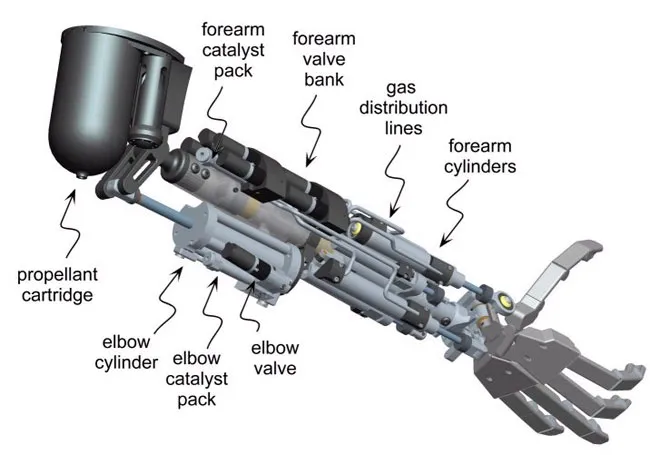
Rockets can help power robotic arms, which could help lead to "better, stronger, faster" bionic limbs, research now reveals.
A new prototype rocket-powered mechanical arm can lift about 20 to 25 pounds—three to four times more than current commercial prosthetic arms—and can do so three to four times faster.
"Our design does not have superhuman strength or capability, but it is closer in terms of function and power to a human arm than any previous prosthetic device that is self-powered and weighs about the same as a natural arm," said researcher Michael Goldfarb, a roboticist at Vanderbilt University in Nashville.
Latest Videos From
"It has about 10 times as much power as other [robotic] arms," Goldfarb said.
The rocket-powered arm also has greater dexterity and freedom of movement than any other prosthetic to date. Conventional prosthetic arms have only two joints, at the elbow and the "claw." This prototype functions more naturally than previous models, with a wrist that can twist and bend, and fingers that open and close independently.
Rockets replace batteries
Conventional bionic arms are driven by batteries and electric motors.
"Battery power has been adequate for the current generation of prosthetic arms because their functionality is so limited that people don't use them much," Goldfarb said. "The more functional the prosthesis, the more the person will use it and the more energy it will consume."
The weight of the batteries needed to power a bionic arm for a reasonable amount of time is a problem. This led Goldfarb and his colleagues to look for alternatives—in this case, rockets.
The radical design is similar to rocket systems that help the space shuttle and satellites maneuver in orbit. It employs a miniature rocket about the size of a pencil. It burns pressurized liquid hydrogen peroxide using iridium-coated alumina granules as catalysts, generating pure steam that forces pistons up and down, generating motion.
You might expect such a setup to be noisy.
"It's much quieter than I would have ever thought," Goldfarb told LiveScience. "You can be in a room where people are talking at very low levels and never hear it. You have to be very quiet to hear this thing operate."
Steam gets vented out through a porous skin-like cover, where it evaporates like normal sweat. "The amount of water involved is about the same as a person would normally sweat from their arm on a warm day," Goldfarb said.
Complex setup
A key concern was protecting the arm's owner and those in close proximity from heat the arm generated—the steam can get up to 450 degrees Fahrenheit (232 degrees Celsius). The hottest parts are covered with special insulating plastic, making them safe to touch. A small sealed canister of hydrogen peroxide that fits easily in the upper arm can provide enough energy to power the device for 18 hours of normal activity.
The researchers got their latest prototype working properly at the end of June. Future research can make the 4-pound arm even lighter and more robust.
So far the work has been funded by the Defense Advanced Research Projects Agency (DARPA), which aims to develop better prosthetic limbs. Improvements in body armor and battlefield medicine have reduced the number of casualties from conflicts, but the side effect is a significantly increasing number of amputees, as has become evident among veterans of the ongoing war with Iraq.
DARPA's goal is to have an advanced, commercially available prosthetic arm in two years. Unfortunately, Goldfarb is concerned DARPA funding might dry up for his team's research because of the arm's novel power source, which will probably take a long time to get regulatory approval due to safety issues.
Still, if DARPA support is withdrawn, Goldfarb is confident his team can still get alternative funding for their arm. "We have made so much progress and gotten such positive feedback from the research community that I'm certain we'll be able to keep going," he said.
Goldfarb also has a parallel project on an artificial leg of similar design, funded by the National Institutes of Health. When asked why he is so interested in designing artificial limbs, Goldfarb said, "I think that it has something to do with the fact that building an artificial limb is like trying to imitate the ultimate machine."

 Live Science Plus