













Scientists Create 12-Headed Jellyfish

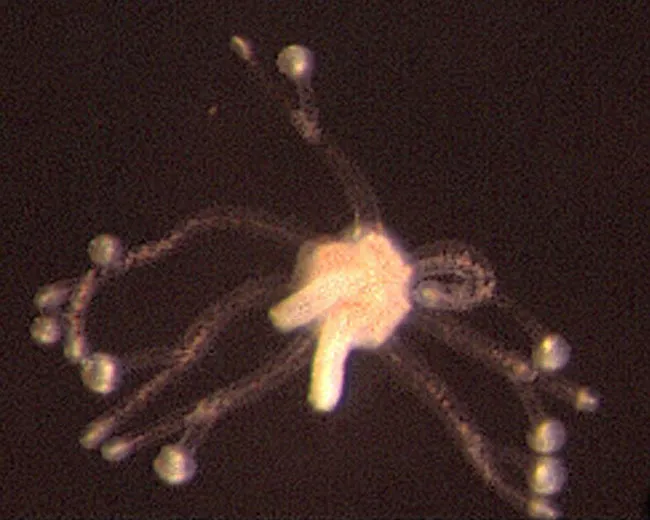
Jellyfish with up to a dozen heads have been created in the laboratory by carefully monkeying with a few genes.
The genetic experiments could shed light on how natural colonies of other multi-headed organisms first originated, including some that build coral reefs.
Researchers targeted so-called Cnox genes, which help control how the bodies of jellyfish are laid out as their embryos develop. These genes are closely related to Hox genes, which play a similar role in humans.
How they did it
They experimented on the European hydromedusa (Eleutheria dichotoma), collected from the south of France. (In Greek mythology, the Hydra was a monster with innumerable heads, while Medusa had writhing snakes for hair.)
The researchers designed RNA molecules that specifically only "silenced" Cnox genes in these saltwater critters. Normally, the saltiness of these animals would prevent the molecules from entering their cells, but the scientists diluted seawater with freshwater enough "where the jellyfish still survived and the RNA got in," said evolutionary biologist and invertebrate zoologist Bernd Schierwater at the Hanover University of Veterinary Medicine in Germany.
By inhibiting one Cnox gene called Cnox-3, two heads often formed, where both were completely functional—regarding food intake, for instance. By deactivating another, Cnox-2, more than two heads usually sprouted—"up to a dozen," Schierwater told LiveScience.
Get the world’s most fascinating discoveries delivered straight to your inbox.
He and colleague Wolfgang Jakob, also at Hanover, detailed their findings in the Aug. 1 issue of the online journal PLoS ONE. Twelve heads better than one?
Animals with many heads are rare in nature, suggesting that two or more heads usually aren't better than one—having more than one head results in costs with no immediate matching benefits.
However, Schierwater noted that corals, which are animals, often form colonies by adding heads to a common stalk, each of which connect to a common gut, just as with the modified jellyfish that the researchers created.
Jellyfish are related to the creatures that build coral reefs—they are both carnivores belonging to a group called cnidarians, which means "stinging nettles," because of their stingers. Schierwater conjectured the solitary ancestors of corals and other colonial organisms might have adapted genes related to multiple heads long ago "in such a way that animal colonies were able to emerge."
Indeed, these findings suggest the suppression of just a few genes could have led to incredible diversity in body plans "from the very beginning," Schierwater said, shedding light on "the evolution and development of animal life in general."
- Freaks of Nature: Vote for the Freakiest
- Image Gallery: Small Sea Monsters
- The Surprising Reality of Mythical Creatures
