













Nostradamus: Predictions of Things Past

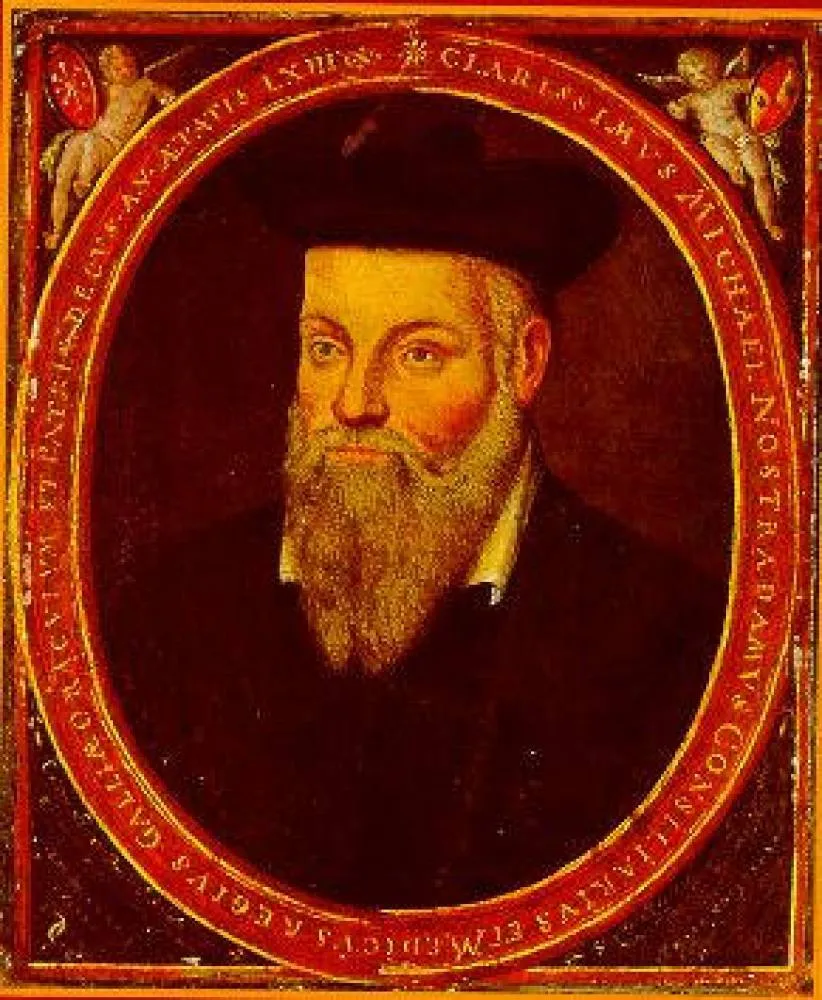
The writer Michel de Nostredame, better known as Nostradamus, is widely known as a French physician, astrologer and prophet. Nostradamus remains famous over four hundred years after his death mostly for a 1555 book he wrote titled "Centuries," a collection of one thousand quatrains (four-line rhyming verses) which are said to foretell the future.
Depending on which source you consult, Nostradamus has been credited with accurately predicting the bombing of Hiroshima, Japan, in 1945; the Space Shuttle Challenger accident in 1986; the French Revolution in 1789; the Apollo moon landing in 1969; the death of Princess Diana in 1997; both World Wars, and so on. In fact you'd be hard pressed to name some significant global event that Nostradamus was not said, by someone, to have foreseen.
Nostradamus and 9/11
Perhaps the most famous assertion made in the past 20 years was that Nostradamus predicted the September 11, 2011, terrorist attacks. It's a story that circulated widely in late 2001, and is still widely believed. One verse in particular went viral on the Internet:
"Two steel birds will fall from the sky on the Metropolis, The sky will burn at forty-five degrees latitude Fire approaches the great new city Immediately a huge, scattered flame leaps up Within months, rivers will flow with blood The undead will roam the earth for little time."
Could "steel birds" be interpreted as airplanes? Could New York City be the "Metropolis" that lies at about 40 degrees north latitude? Many people thought so; however it was later revealed that this piece is a hybrid of real Nostradamus verse and fiction. Not only is it not in quatrain form, but the phrase "two steel birds" is particularly revealing, as steel suitable for airplanes wasn't invented until 1854 — nearly 200 years after Nostradamus died.

Another quatrain read:
"In the city of God there will be a great thunder Two brothers torn apart by Chaos while the fortress endures The great leader will succumb The third big war will begin when the big city is burning — Nostradamus 1654"
Get the world’s most fascinating discoveries delivered straight to your inbox.
Given the fact that Nostradamus died in 1566, eighty-eight years before the quatrain was supposedly written, it would be a remarkable piece indeed. This was actually published on a Canadian website as part of an essay on how easily important-sounding prophecy can be created using vague imagery. It is ironic that what began as an essentially skeptical, anti-prophecy piece circulated as the real thing. [Countdown: Oops! 11 Failed Doomsday Predictions]
Say what?
In 2007, John Hogue, author of several books about Nostradamus prophecies, stated that the following year a global famine would kill millions of people: "the era of global famine foreseen by Nostradamus will begin in 2008," he wrote. The prediction of a global famine obviously (and thankfully) was one of many that didn't come true, but the faulty prophecy highlights another aspect of the Nostradamus industry: there's little or no general agreement about what exactly he meant.
Nostradamus wrote in Middle French, using vague words, metaphors, and obscure, dated references. There are dozens of different translations of his "Centuries" book, with many variations on different words and phrases. This wide variety of interpretations helps the prophecies come "true," since if one translation doesn't really support the historical evidence, another can often be found that fits better.
Often even Nostradamus scholars can't agree on what he was trying to say. Several of the prophecies have been the result of simple ignorance of the language, history, or both. For example one famous line widely interpreted as referring to Adolf Hitler mentions "The major battle shall be close by the Hister / He shall cause the great one to be dragged in an iron cage, while the Germans shall be looking at the infant Rhine."
It mentions Germany, and a war, and Hister (which kind of sounds like Hitler to modern ears): amazing prophetic powers? No; in fact "Hister" (which can also be translated as "Ister" or "Iter") is not the name of Adolf Hitler or anyone else; it is another name for the lower Danube River, a word that Nostradamus also used in his 1554 "Almanac."

In his book "The Complete Prophecies of Nostradamus," Henry S. Roberts offers the following translation of Century VIII (2):
"Condon and Aux, and about Mirande I see a fire from heaven that surrounds them. Sol, Mars, in conjunction with the lion, and then Marmande. Lightning, great war, wall falls into the Garonne."
What in the world does this mean? Sol and Mars may refer to the Sun and Mars (or not). Condon and the other proper nouns are place names (probably). And a fire from the heaven could be anything from a comet to an exploding sun. What do you think Roberts made of it?
If you guessed alien contact, you're right; according to Roberts's learned interpretation "Fire from heaven suggests extraterrestrial spacecraft landing amid a great war on Earth." Since no date is given it may yet happen of course — or maybe it was referring to Halley's Comet, which is seen about every 75 years and certainly has appeared in times of strife — or any number of other things. [Countdown: Tales of 10 Historical Predictions]
Though widely regarded as a prophet, many who have studied Nostradamus's works find that most of the amazing prophecies attributed to him are merely the result of poor linguistic and historical scholarship. In his book "Nostradamus, Bibliomancer: The Man, the Myth, the Truth," Peter Lemesurier, a former Cambridge linguist and author of nearly a dozen books on the French seer, concludes that Nostradamus was neither a doctor nor an astrologer, nor even (by his own admission) a prophet. He merely believed that history repeats itself, and thus projected known past events into the future.
Lemesurier laments that "Most of those who make such [predictions] — including the English-speaking authors of many popular books on the subject — know next to nothing either about Nostradamus, the texts, or even the sixteenth-century French in which they are written. Few of them have ever seen an original text, or even know sufficient French.... As a result [such predictions] are the result of not reading what the texts actually say, but of shamelessly twisting half-understood words retrospectively to fit the proposed event, or in some cases even twisting the event itself to fit the words."
Nostradamus couched his quatrains in such vague terms that people read whatever they want into them. Nostradamus did not in fact make predictions (statements that are read and known about before they happen); instead he made post-dictions (statements that appear to come true only after the events already happened). If Nostradamus had truly predicted the September 11 attacks, World War II, or the Challenger shuttle accident, for example, the world should have known about them decades (indeed centuries) before they occurred. Predictions that only make sense after the event they foretell are no predictions at all.
Accurate or not, for a man who hasn't written anything in well over 400 years, Nostradamus's works and biographies show no signs of slowing down.
