













Mozart's Skull Possibly Found
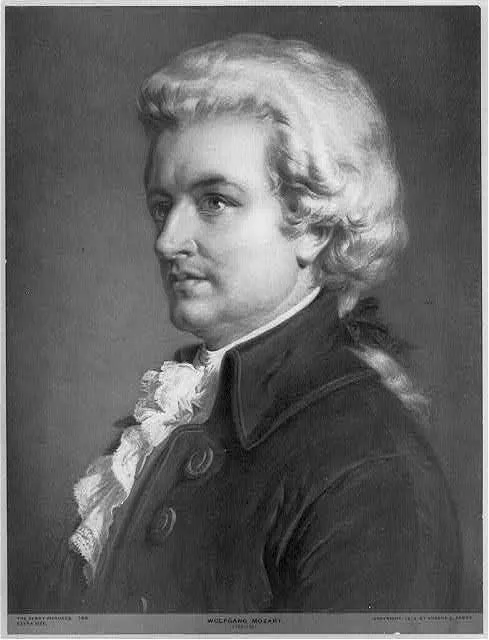
This musical prodigy was composing by age five and wrote his first symphony by age 10. As an adult, his music was extraordinarily complex, drawing influence from many different styles, and considered radical at the time. He composed more than 600 pieces—including concertos, operas, and symphonies—in his short life and is considered the most significant European classical composer.
VIENNA, Austria (AP) —Have scientists found Mozart's skull? Researchers said Tuesday they'll reveal the results of DNA tests in a documentary film airing this weekend on Austrian television as part of a year of celebratory events marking the composer's 250th birthday.
The tests were conducted last year by experts at the Institute for Forensic Medicine in the alpine city of Innsbruck, and the long-awaited results will be publicized in "Mozart: The Search for Evidence,'' to be screened Sunday by state broadcaster ORF.
Past tests were inconclusive, but this time, "we succeeded in getting a clear result,'' lead researcher Dr. Walther Parson, a renowned forensic pathologist, told ORF. He said the results were "100 percent verified'' by a U.S. Army laboratory, but refused to elaborate.
The skull in question is one that for more than a century has been in the possession of the International Mozarteum Foundation in Salzburg, the elegant Austrian city where Wolfgang Amadeus Mozart was born on Jan. 27, 1756.
Parson said genetic material from scrapings from the skull was analyzed and compared to DNA samples gathered in 2004 from the thigh bones of Mozart's maternal grandmother and a niece. The bones were recovered when a Mozart family grave was opened in 2004 at Salzburg's Sebastian Cemetery.
Mozart died in 1791 and was buried in a pauper's grave at Vienna's St. Mark's Cemetery. The location of the grave was initially unknown, but its likely location was determined in 1855.
The grave on that spot is adorned by a column and a sad-looking angel.
Get the world’s most fascinating discoveries delivered straight to your inbox.
Legend has it that a gravedigger who knew which body was Mozart's at some point sneaked the skull out of the grave. Through different channels, the skull —which is missing its lower jaw —came to the Mozarteum in Salzburg in 1902, according to Dr. Stephan Pauly, the foundation's director.
The foundation, a private nonprofit organization that works to preserve Mozart's legacy, was founded in 1880 by Salzburg residents and made the skull available for the DNA tests.
The skull long has fascinated experts: In 1991, a French scholar who examined it made the startling —though unconfirmed —conclusion that Mozart may have died of complications of a head injury rather than rheumatic fever as most historians believe.
Anthropologist Pierre-Francois Puech of the University of Provence based his belief on a fracture he found on the skull's left temple. Mozart, he theorized, may have sustained it in a fall, and that would help explain the severe headaches the composer was said to have suffered more than a year before his death.
Austria has designated 2006 a Mozart jubilee year, with dozens of events in Salzburg, Vienna and elsewhere to commemorate his 250 birthday.
- The Greatest Modern Mind: You Decide
- Beethoven's Bones?