













Ancient Peppers Reveal Early Taste for Heat
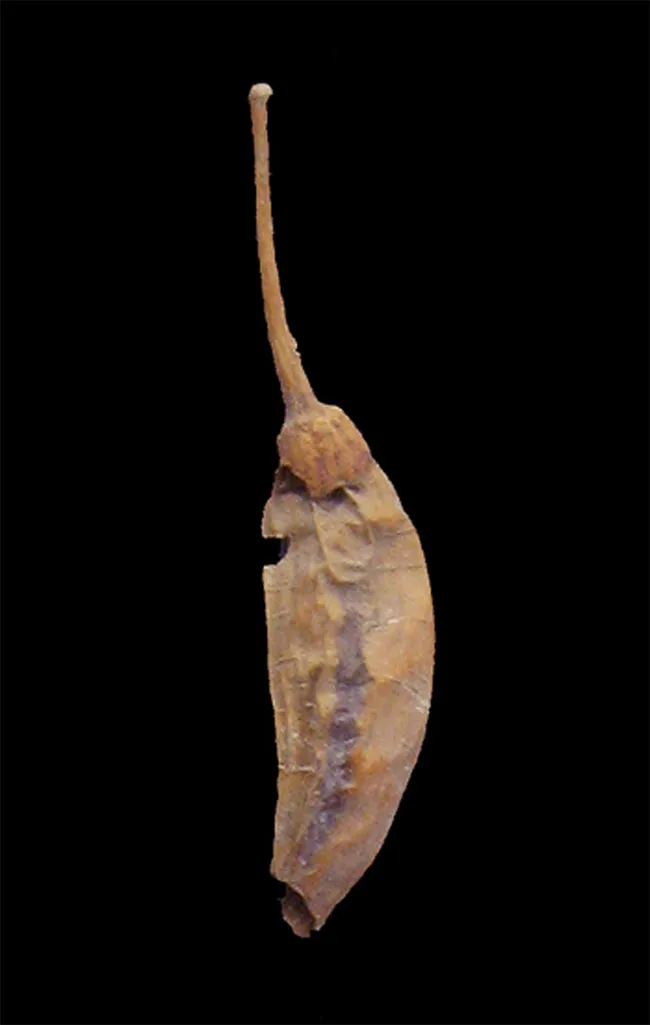
Shriveled peppers preserved for 1,500 years in two caves in southern Mexico are giving scientists a real taste of pre-Columbian agriculture and the spicy fare it yielded.
The desiccated chilies belong to Capsicum annum, which includes modern-day jalapenos and ancho peppers, and Capsicum frutescens, whose most famous member is the Tabasco pepper. Two of the peppers look similar to today’s Tabasco and cayenne varieties.
The plant remains, described today online in the journal Proceedings of the National Academy of Sciences, were discovered in Guila Naquiz and Silvia’s Cave, two dry rock shelters in the Valley of Oaxaca in southern Mexico. They were so well-preserved that researchers were able to distinguish seven cultivated types from Guila Naquitz and three from Silvia’s Cave.
“This shows there was very complex agriculture and really interesting food, because you don’t grow seven different kinds of peppers if you’re not making some really interesting food,” said lead author Linda Perry of the Smithsonian’s National Museum of Natural History in Washington, D.C.
Complex cuisines
Perry and archaeologist Kent Flannery of the University of Michigan analyzed the remains to find not only a variety of pepper types but also clues suggesting the people used both fresh and dried peppers to whip up an array of spicy foods.
Experiments with modern peppers yielded this insight: Perry, an archaeobotanist, discovered that if the peppers had been fresh back in the day, they would have a clean line where the pepper was cut from its stem. Dried peppers would end up with a “messy” tear when being prepared for a cuisine.
Get the world’s most fascinating discoveries delivered straight to your inbox.
“They would have used fresh peppers in salsas or in immediate preparation,” Perry said, “and they would have used the dried peppers to toss into stews or to grind up into sauces like moles.”
Chili cultivation
The aridity of the caves is what kept the spicy foods from decay. From around 500 to 1,500 A.D., the scientists suggest, the caves served as temporary camps and food-storage areas for the farmers from the nearby ancient city of Mitla.
The diverse locations of the remains indicate the Zapotec-speaking people planted crops in several areas, including river bottoms, piedmonts and mountains.
“It shows a very intimate knowledge of the landscape, because they were using all sorts of different areas for cultivating, up and down hillsides,” Perry told LiveScience, “probably to mitigate risk if you lose your crops in one area there’s something in another that’s going to be OK.”
- Why do Chili Peppers Taste Hot?
- Ancient Crumbs Reveal History of Chili Peppers
- Top 10 Good Foods Gone Bad
Jeanna Bryner is managing editor of Scientific American. Previously she was editor in chief of Live Science and, prior to that, an editor at Scholastic's Science World magazine. Bryner has an English degree from Salisbury University, a master's degree in biogeochemistry and environmental sciences from the University of Maryland and a graduate science journalism degree from New York University. She has worked as a biologist in Florida, where she monitored wetlands and did field surveys for endangered species, including the gorgeous Florida Scrub Jay. She also received an ocean sciences journalism fellowship from the Woods Hole Oceanographic Institution. She is a firm believer that science is for everyone and that just about everything can be viewed through the lens of science.