













CSI Technology Unlocks Secrets of Ancient Fabric
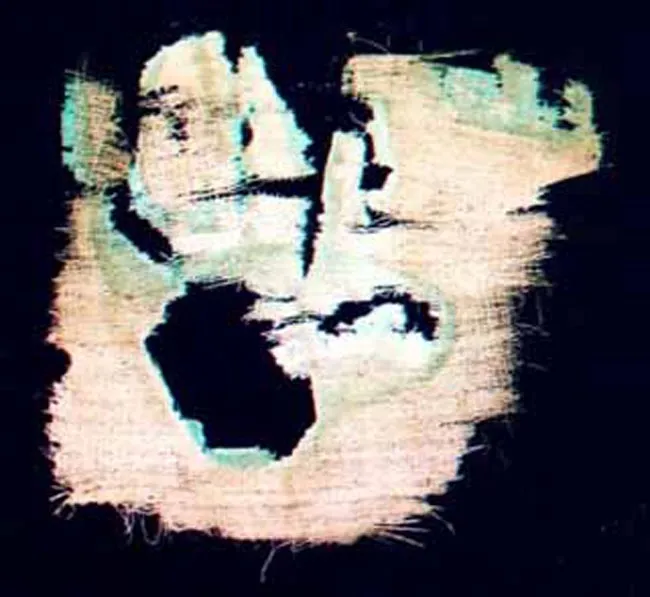
Fabric swatches dug up from archaeological sites often look like dull brown rags, but archaeologists are putting crime lab techniques to work to uncover the colors, patterns and other revealing features of antiquated textiles.
The patterns, in particular, have helped researchers identify the dyes, paints, skills and trade routes of the Hopewell, a broad network of Native American groups who lived in the eastern part of North America about 2,000 years ago. The Hopewell in Ohio made enclosures out of earthen walls called mounds, and traded materials with people as far away as Wyoming.
Color patterns are usually invisible to the naked eye under standard lighting conditions but behave differently in the infrared (IR) and ultraviolet (UV) spectra than in visible light. So Ohio State University archaeologists employed IR and UV technology normally used to detect fingerprints to look for patterns on fabric specimens found in Ohio's Seip burial grounds. The fabrics excavated from the burial grounds are thought to be part of a canopy that was arched over the deceased 1,600 years ago.
"The camera sees what we cannot see with our eyes alone," said Christel Baldia, lead author of a report on the technique and findings published in the April issue of the Journal of Archaeological Science.
- Visible light image shows the textile in normal conditions.
- Infrared image exposes darker patterns in contrast with lighter decorations.
- Ultraviolet image reveals other aspects of the same swatch.
- Ultraviolet fluorescence highlights lighter patterns near the center of the textile.
The intricacies of the fabric colors and patterns hint at the technology and knowledge shared among the prehistoric people.
Baldia and her colleague Kathryn Jakes saw colorants in the fabrics not typical of naturally colored fibers, showing that the prehistoric people understood the chemistry needed to apply substances to dye fabric.
"Just to be able to determine whether fabric is colored by a dye or pigment is a giant step for us," Baldia told LiveScience.
Get the world’s most fascinating discoveries delivered straight to your inbox.
Some of the materials found in Ohio were made with yarn spun so finely that the fabric is shear. The fabric maker therefore must have had a significant knowledge of textile technology to make such fine yarns, the researchers said.
The motifs seen on the studied fabrics look like the patterns seen on other artifacts, such as pottery, recovered from Hopewell sites throughout Illinois, Indiana, Ohio and Kentucky. It's known that these people had an extensive trade network, exchanging both goods and ideas, Jakes said. The patterns on the fabrics have been largely ignored because they are not obvious to the naked eye, although archaeologists at one site in the 1930s reported finding fabric bearing a design in color.
"Exposure to the air, handling and degradation in the burial may have caused the colors to become less visible," Jakes told LiveScience, "though the research shows that evidence of the colorants is still present in the materials."