This ScienceLives article was provided to LiveScience in partnership with the National Science Foundation.
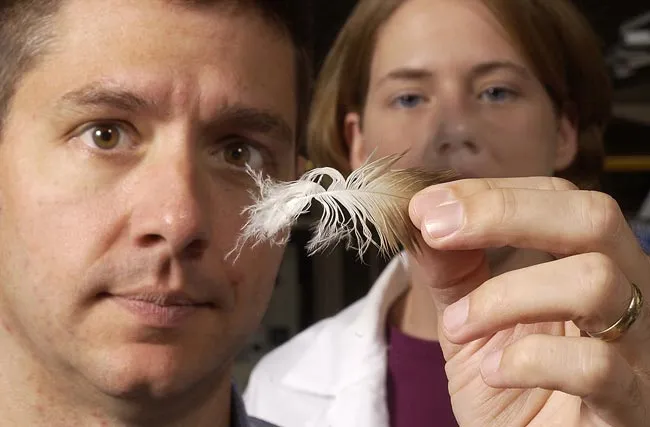
Andrew DeWoody, a Purdue University professor of genetics, leads a research group that is using molecular markers to study otherwise cryptic aspects of biology. For example, he has found an alternative to the daunting task of catching eagles to study the majestic birds. DeWoody collects their feathers and uses the small amount of DNA in them to create a tag that corresponds to a particular bird. Those tags can be used to determine population size, parentage, roosting patterns and sex ratios. In other research, his group is interested in how natural and sexual selection act in concert to maintain variation of a large collection of genes called the "major histocompatibility complex" (MHC) in wild populations of animals. Immunologists have long known that MHC genes play key roles in the immune response, but more recently behavioral ecologists have learned that the genes also influence how animals choose their mates. His findings have shown that female tiger salamanders select a mate based on a complex process that takes many factors, such as body size, into account. For more on the research, see the Purdue press releases hyper linked above. For more on DeWoody, read his responses to the ScienceLives 10 Questions below.
Name: Andrew DeWoody Age: 40 Institution: Purdue University Field of Study: Molecular ecology
Latest Videos From
What inspired you to choose this field of study? An undergraduate genetics course (taught by Dr. John Gold at Texas A&M) and a postgraduate field trip to the tropics of Mexico (with Drs. Dixon and Honeycutt).
What is the best piece of advice you ever received? "Don't tell people how to do things, tell them what to do and let them surprise you with their results." This quote is generally attributed to General George Patton with reference to the machinations of war, but I find it is quite applicable to running a lab!
What was your first scientific experiment as a child? Building an electromagnet with a battery, a wire, and an iron bar.
What is your favorite thing about being a researcher? For the most part, you get to do whatever you want while surrounded by bright, enthusiastic young people. I remember Ray Jackson, an old-school plant cytogeneticist at Texas Tech, telling me this when I was an aspiring graduate student. He was exactly right!
What is the most important characteristic a researcher must demonstrate in order to be an effective researcher? An intelligent work ethic.
What are the societal benefits of your research? In a world with wars, pathogen outbreaks, etc., my research provides a window into the complex and often secretive lives of animals. Think of "Wild Kingdom" with a lab component.
I think the societal benefits to my research are marginal in their own right, but serve to highlight the diversity of life and to help keep us in tune with nature. Even if people can't get out and see eagles themselves, they enjoy reading about them and learning about their biology.
Who has had the most influence on your thinking as a researcher? Wow, that's tough. But I'd have to say Robert Baker (my Ph.D. advisor at Texas Tech), John Avise (postdoc advisor at University of Georgia), and Peter Waser (my colleague here at Purdue). All three are terrific scientists and I honestly can't believe any of them continue to associate with me!
What about your field or being a researcher do you think would surprise people the most? I spend much of my time trying to find money to DO the research. Of course, most researchers know this already, but I suspect the general public has no idea how much time professors spend on fundraising. With NSF success rates at 10 percent or so, it is difficult to sustain a productive research program.
If you could only rescue one thing from your burning office or lab, what would it be? Family photos, perhaps a file of correspondence that includes Christmas cards, etc., from mentors and colleagues. Also, if there is time, a badger skull I collected in central Asia!
What music do you play most often in your lab or car? I'm pretty eclectic and listen to everything from Marty Robbins to The Dark Side of the Moon to contemporary pop. However, I confess to being a news junky and most often listen to NPR to and from work. I don't listen to music in my office or the lab, as I am easily distracted.
Editor's Note: This research was supported by the National Science Foundation (NSF), the federal agency charged with funding basic research and education across all fields of science and engineering. Any opinions, findings, and conclusions or recommendations expressed in this material are those of the author and do not necessarily reflect the views of the National Science Foundation. See the ScienceLives archive.

 Live Science Plus