















Secret of the Sea Horse: How Creature Got its Curve

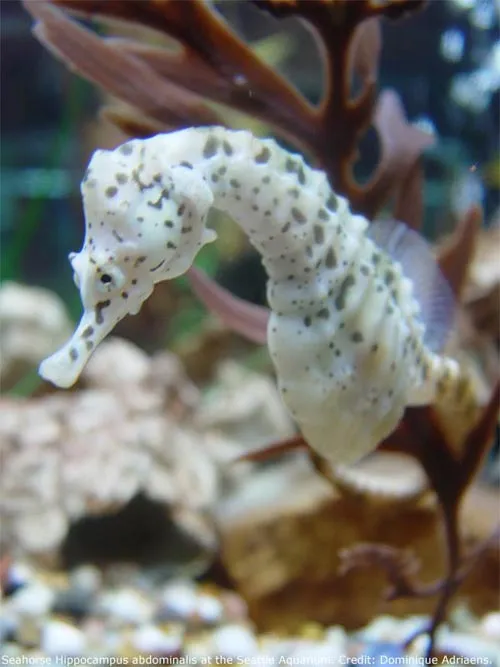
The wavy shape of sea horses might have evolved to help them capture prey, researchers now suggest.
Sea horses are unique among fishes for having heads and necks that resemble those of horses. Although they have long snouts like their close relatives the pipefish, their bent necks and curved trunks make them far different from their straight-bodied family.
To understand how the seahorse's peculiar head, neck and trunk might have evolved, scientists analyzed how effective the animals were at capturing food when compared with pipefish. If a horselike shape provided the ancestors of sea horses an edge when it came to finding a meal, that could help explain why it developed, the investigators reasoned.
Computer simulations revealed the shape and posture of sea horses helped them pivot forward to capture prey. High-speed video footage of both sea horses and pipefish corroborated these findings, revealing that sea horses can strike farther than pipefish.
The curved bodies of sea horses would therefore enlarge the area they could probe for prey. This is especially useful for sit-and-wait predators such as sea horses, which often hide amid coral or sea grass, holding themselves in place with their prehensile, or grasping, tails.
Interestingly, pygmy pipehorses have a prehensile tail like sea horses but lack the curved posture of their cousins. This suggests the development of a sit-and-wait lifestyle might have preceded the evolution of the bent head in sea horses.
"Once this shift in foraging behavior is made, natural selection will favor animals that can increase the strike distance, which according to our study puts a selective pressure to increase the angle between head and trunk and to become what we now know as sea horses," researcher Sam Van Wassenbergh, a biomechanicist at the University of Antwerp in Belgium, told LiveScience.
Get the world’s most fascinating discoveries delivered straight to your inbox.
The scientists detailed their findings online Jan. 25 in the journal Nature Communications.
