













Dinosaur Wore Primitive Down Coat
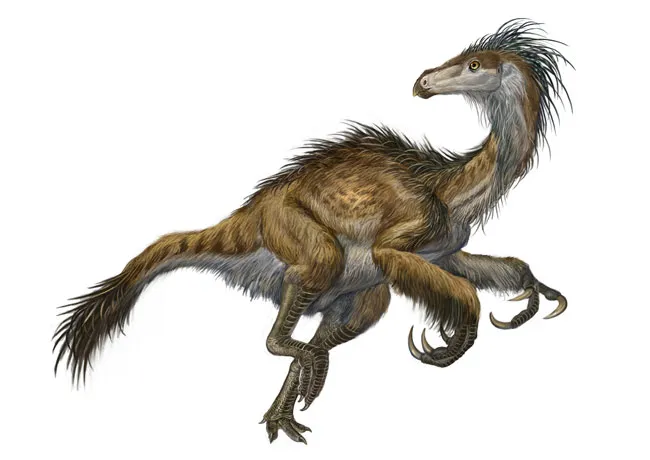
The evolution of the flashy down coat has been traced back to 125 million-year-old dinosaur fossils.
The feathers were worn by Beipiaosaurus, which is a therizinosaur, small-headed theropods with long necks and giant claws.
Most of the dinosaurs' bodies were covered with short and slender feathers that, based on the fossil evidence, appeared similar to those found in specimens of other non-avian theropods. These feathers had a central shaft with veins branching out from either side, paleontologists said. Other feathers on the head, neck and trunk were long and broad, with no branching.
They were not for flight, but might have kept the dinosaurs warm and looking good, said Xing Xu of the Institute of Vertebrate Paleontology and Paleoanthropology at the Chinese Academy of Sciences in Beijing.
"Both are definitely not for flight," Xu told LiveScience. "Inferring the function of some structures of extinct animals would be very difficult, and in this case, we are not quite sure whether these feathers are for display or some other functions."
He speculated that the short, branched feathers were probably used as insulation, while the more primitive feathers likely served as a visual display to woo mates or as a visual cue in other social interactions.
Paleontologists think birds derived from maniraptors (a group of theropods) some 150 million years ago during the Jurassic Period. And so the finding sheds light on the evolution of birds and bird-like features.
Get the world’s most fascinating discoveries delivered straight to your inbox.
The newly analyzed fossilized feathers came from two specimens unearthed years ago in China's Liaoning Province. The findings are detailed this week in the journal Proceedings of the National Academy of Sciences.
- Avian Ancestors: Dinosaurs That Learned to Fly
- Dinosaur News, Information and Images
- Images: Dinosaur Fossils
Jeanna Bryner is managing editor of Scientific American. Previously she was editor in chief of Live Science and, prior to that, an editor at Scholastic's Science World magazine. Bryner has an English degree from Salisbury University, a master's degree in biogeochemistry and environmental sciences from the University of Maryland and a graduate science journalism degree from New York University. She has worked as a biologist in Florida, where she monitored wetlands and did field surveys for endangered species, including the gorgeous Florida Scrub Jay. She also received an ocean sciences journalism fellowship from the Woods Hole Oceanographic Institution. She is a firm believer that science is for everyone and that just about everything can be viewed through the lens of science.