















Meat vs. Potatoes: What Our Ancestors Liked
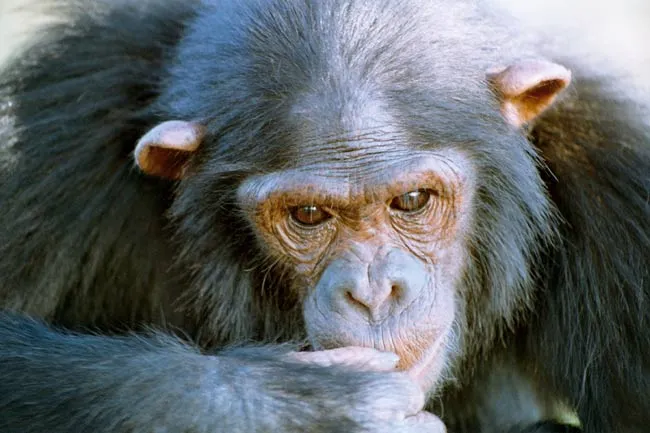
Chimpanzees prefer to dig for tubers and roots even when aboveground snacks are plentiful, a finding that bears on questions about humans' preferences for meat versus potatoes.
Eleven chimp digging sites and associated tools discovered in the Ugalla savanna woodland of western Tanzania in Africa provide the first tangible evidence that our closest living relatives use sticks and bark to dig up underground foods.
The finding, detailed in the Nov. 12 issue of the journal for the Proceedings of the National Academy of Sciences, could help resolve evolutionary diet questions as well as debates about what role plant-gathering abilities played in the success of early hominids. Did the ability to spear and consume meat (hunting) or the skills needed to uncover carbohydrate- rich, and sometimes protein-laden, roots, bulbs and tubers (gathering) give the earliest human ancestors the tools to thrive?
"Some researchers have suggested that what made us human was actually the tubers," said Adriana Hernandez-Aguilar, who collected the field data for her doctoral research at the University of Southern California.
The new finding suggests chimpanzees, and indirectly the earliest hominids, took advantage of tuber gathering. (Chimps are the best model for the earliest hominids, which eventually evolved into modern humans.)
Hidden treats
The evidence includes multiple holes in the ground, some directly beneath chimpanzee nests, knuckle prints, feces and chewed-up, spit-out wads of excavated tubers. The researchers also discovered seven tools at three of the sites. The sticks and bark showed worn edges and sediment patterns that imply they were used for digging.
Get the world’s most fascinating discoveries delivered straight to your inbox.
The researchers found the chimps feasted on the hidden resources during the rainy season, even though aboveground treats were readily available. Anthropologists had thought the roots and tubers only served as fallback foods for chimps during the dry seasons when sustenance was scarce.
The rainy-season finding "suggests it wasn't a matter of being pushed into something that you had no choice. It's a matter of opening up an opportunity," said Hernandez-Aguilar's colleague James Moore, a biological anthropologist at the University of California, San Diego.
Tooth anomaly
Root and tuber chow could help to explain dental changes found in the fossil record for the earliest human ancestors. Fossil evidence dating from 3 million to 4 million years ago has revealed changes in the teeth and jaws of the first hominids that indicate some fundamental change in diet that would require hardy chewing—more than is required by eating meat.
"We know that our earliest ancestors changed their diet in some fundamental way, because the teeth got bigger, especially the molar teeth, the jaws got stronger, the enamel got thicker," Moore said. He added the dental change "seems to be associated with moving into savanna-like habitats."
"For a variety of reasons, the meat-eating scenario hasn't been a very good explanation for why teeth got bigger," Moore told LiveScience. "People have tried to shoe-horn it in there. But of course, you don't need really thick enamel or very large molars to eat meat."
- Video: Jane Goodall's Wild Chimpanzees
- Amazing Animal Abilities
- Top 10 Missing Links
Jeanna Bryner is managing editor of Scientific American. Previously she was editor in chief of Live Science and, prior to that, an editor at Scholastic's Science World magazine. Bryner has an English degree from Salisbury University, a master's degree in biogeochemistry and environmental sciences from the University of Maryland and a graduate science journalism degree from New York University. She has worked as a biologist in Florida, where she monitored wetlands and did field surveys for endangered species, including the gorgeous Florida Scrub Jay. She also received an ocean sciences journalism fellowship from the Woods Hole Oceanographic Institution. She is a firm believer that science is for everyone and that just about everything can be viewed through the lens of science.