When it comes to finding the source of a scent, nothing beats a bloodhound. Now a new study proves that humans can also find the origin of odors.
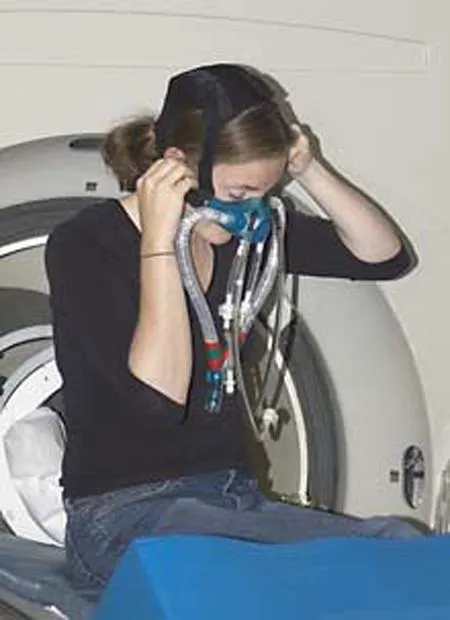
Researchers piped scents into each nostril of volunteers and tested whether the subjects could reliably tell which nostril the scent was coming from. The researchers also looked at the subjects' brain activity--using functional magnetic resonance images (fMRI)--to figure out how the brain sorted this out.
What they found was that smelling works a lot like hearing--at least when trying to pinpoint the source. The brain is set up to locate smells by interpreting scent intensity and time of arrival from each nostril, much like how it localizes sounds by contrasting input from each ear.
Latest Videos From
"It has been very controversial whether humans can do egocentric localization, that is, keep their head motionless and say where the spatial source of an odor is," said study coauthor Noam Sobel of UC Berkeley. "It seems that we have this ability and that, with practice, you could become really good at it."
Previous studies investigating the method for scent location were flawed because the scents tested stimulated the trigeminal nerve as well as the olfactory nerve. The trigeminal nerve is mainly responsible for motor movements and touch sensation in the face, but can sometimes be stimulated by strong odors.
The olfactory nerve, however, is responsible solely for smelling. To figure out how smell localization works, Sobel and his colleagues chose scents--essence of rose and cloves--that only stimulated the olfactory nerve. They also used two scents--vinegar-smelling propionic acid and banana-smelling amyl acetate--to test the trigeminal nerve.
They pumped scents into the noses of 16 subjects using a specially designed mask that provided separate air flow to each nostril. They also tested five volunteers with no olfactory nerves, a condition called anosmia.
Each of the normal subjects could tell which nostril was doing the smelling, but the anosmic volunteers had no idea. Sobel said this result shows that humans use their olfactory nerve to locate smells.
Each patient lay still in the fMRI machine--which shows what parts of the brain are active--while doing the smell test. Data from the fMRI supported the volunteers' claims - smells from each nostril activated separate areas of the brain's smell center, the primary olfactory cortex.
"Together, these results are the first description of the mammalian brain mechanisms for extracting spatial information from smell," Sobel said.
For future experiments, Sobel and his colleagues plan to train subjects to track odors in the field and determine humans' odor localization limits.
This research is detailed in the Aug. 18 issue of the journal Neuron.

 Live Science Plus