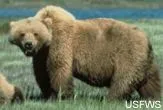
A grizzly bear treading higher into the Arctic than ever before has scientists wondering whether a changing landscape might lead to interbreeding with polar bears and other ecological effects.
Paw prints of a grizzly were found last year on Melville Island, about 620 miles (1,000 kilometers) north of the Arctic Circle. DNA evidence obtained from the beast's hair confirms it was a grizzly, scientists said Tuesday.
"The grizzly bear apparently is expanding its range into the northern reaches of the higher Arctic," said Jonathan Doupé of the Natural Sciences and Engineering Research Council in Canada.
Grizzlies have been bred with polar bears successfully in captivity. It's not clear whether they would do so in the wild.
"It's within the realm of genetics that you could have hybrid bears," Doupé told LiveScience in a telephone interview. "It's not necessarily within the realm of bear behavior."
He said the intermingling could have other ecological repercussions. Bears have different prey, for example, preferring musk ox to seals, for example. And both bear species are known to eat cubs.
Sign up for the Live Science daily newsletter now
Get the world’s most fascinating discoveries delivered straight to your inbox.
"Higher number of grizzlies cold interfere with polar bear reproduction," Doupé speculated.
Earlier this year scientists warned that global warming might wipe out polar bears in coming years.
Doupé and his colleagues are geologists. They said wildlife biologists would need to look into the situation to better understand possible impacts.
The Melville Island grizzly was first spotted by helicopter in 2003. Last summer, the creature frequented a cabin used by researchers.
The bear is called a barren-ground grizzly, Ursus arctos. Over the past 15 years or so, other grizzly sightings suggest a gradual expansion northward. Grizzlies have been spotted on Arctic sea ice, from the Beaufort Sea to Hudson Bay. Recently they've spent winters on Victoria Island, just south of Melville.
Polar bears range well south of the adventurous grizzlies.
The northward-migrating grizzlies are visible examples of climate changes occurring in the Arctic, according to the team of geologists, which includes John England of the University of Alberta.
Tale of the Tape
Polar bears (above) are descended from grizzlies (below). They have smaller heads and longer necks adapted for swimming.
Robert is an independent health and science journalist and writer based in Phoenix, Arizona. He is a former editor-in-chief of Live Science with over 20 years of experience as a reporter and editor. He has worked on websites such as Space.com and Tom's Guide, and is a contributor on Medium, covering how we age and how to optimize the mind and body through time. He has a journalism degree from Humboldt State University in California.