Patients with complete locked-in syndrome experience paralysis of nearly all voluntary muscles in the body. They cannot move, speak, make facial expressions or even move their eyes to communicate. For years, doctors and researchers believed that these people were unhappy with their quality of life and did not have the goal-directed thinking necessary to communicate.
Now, a groundbreaking study conducted by researchers at the Wyss Center for Bio and Neuroengineering in Geneva, Switzerland, has overturned those two common misconceptions. Patients with complete locked-in syndrome do obtain the goal-oriented thinking necessary to express their thoughts to others, and they say they're "happy," despite their condition.
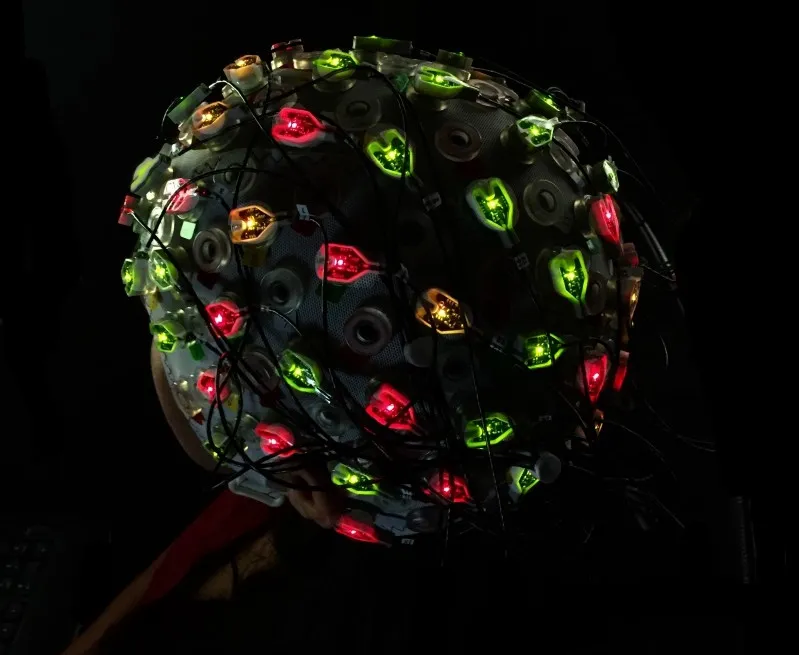
In the study, published in "PLOS Biology," four individuals with complete locked-in syndrome due to amyotrophic lateral sclerosis, or ALS, were each fitted with a non-invasive brain-computer interface. The interface is a cap packed with sensors and some intertwined wires.
Latest Videos From
It uses near-infrared spectroscopy (NIRS) and electroencephalography (EEG) to measure blood oxygenation and electrical activity in the brain, as these are distinctly different when the patient thinks "yes" or "no." After calibration, the patients were able to respond questions with a "yes" or "no" using their thoughts.
One 23-year-old female, pictured above, was asked if her mother's name was Margit. The interface detected the patient's correct answer of "yes."
Another patient was asked, at his family's request, if he would agree for his daughter to marry her boyfriend Mario. He answered "no" nine times out of ten.
RELATED: Hack Your Brain to Improve Your Health
The question, "Are you happy?" was answered with a resounding "yes" by all four patients, repeated over weeks of questioning.
"The striking results overturn my own theory that people with complete locked-in syndrome are not capable of communication," professor Niels Birbaumer, a neuroscientist at the Wyss Center for Bio and Neuroengineering, told Seeker. "We found that all four people we tested were able to answer the personal questions we asked them, using their thoughts alone."
In addition, Birbaumer told Seeker that one of the study's most surprising findings was that "the patients reported being happy." He said he and his team believe this may be because "quality of life depends on social care by the family and positive social attention from caretakers and friends."
The study included only patients living with their families in a positive family and caretaker environment. Birbaumer is confident that this technology, if someday widely available, could have a major impact on the day-to-day life of people with complete locked-in syndrome.
Along with his theory about a positive home environment, Birbaumer said there's also the possibility that the muscular paralysis indicative of the syndrome may create "a relaxed mental state to the brain" that could reduce wishful thinking and intention.
In the future, Birbaumer and his team plan to build a brain-computer interface that will allow patients with complete locked-in syndrome to select letters and words with their brains. They will start with non-invasive experimentation, but anticipate that it may involve implantation. They hope that they can apply their findings from ALS patients with complete locked-in syndrome to those with chronic stroke.
These findings also suggest that evolution built the brain as a movement organization, Birbaumer explained. "Structure and thinking and feeling is a consequence and not a cause of specific behavioral acts," he said.
Original article on Seeker.