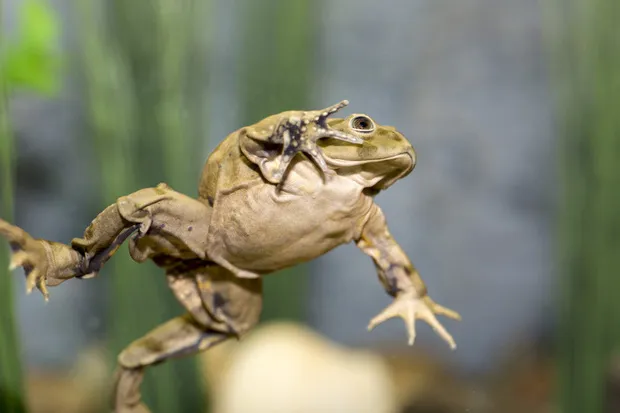
More than 10,000 endangered frogs and other water-dwelling animals living near a lake in South America were found mysteriously dead this month, according to reports from Peru’s wildlife and forestry service Serfor, leaving many people to wonder what could have caused this bizarre die-off.
The Titicaca water frog (Telmatobius culeus), also known as the "scrotum frog" for its loose skin, is one of the most critically endangered frogs in the world. The large, entirely aquatic frog adapted to the high altitudes of Lake Titicaca, which flows along the border between Bolivia and Peru, by taking in oxygen through its skin folds. This evolutionary adaptation also makes the frog highly sensitive to changes in its habitat, such as environmental contamination, according to Tom Weaver, curator of reptiles and fish at the Denver Zoo.
Researchers are currently investigating the latest massive die-off, which they think may have been caused by some sort of contamination. In 2014, an algae bloom that removed oxygen from the water, killed a number of frogs and fish, Weaver said. [5 Mysterious Animal Die-Offs]
Latest Videos From
"We're collecting more samples to find out what's causing this, because it could potentially be a disease outbreak or a contamination outbreak," Weaver told Live Science. "When you have an estimated 10,000 frogs die off, then it's usually a contamination of some sort."
The Denver Zoo has been involved in an effort to save the Titicaca water frog for nearly a decade. Researchers at the zoo have previously worked with authorities in South America when such large die-offs occur, and are again collaborating in research on the current die-off.
Weaver said the Denver Zoo team doesn't hear about every incident but that these die-offs are occurring more often, which suggests that the lake and surrounding rivers are perhaps being impacted by infrastructure development and contamination in the area.
"This is not something that happened just yesterday," Weaver said of the die-off at Lake Titicaca. "It's been going on for a while and is probably still going on right now. Everything else is dying in the lake — the fish — and it's affecting the whole chain — the whole ecosystem." [Photos: America's Only Lake Titicaca Frogs]
The rainy season has begun in the area, and Weaver said this may have triggered the movement of contaminants, such as human sewage and heavy metal pollution, toward the lake. He noted that locals say more amphibian and fish deaths occur during the rainy season.
In a blog post, Roberto Elias, Peru field program manager for the Denver Zoo, wrote about the infrastructure and waste that has contaminated the water and may have led to the frogs' deaths. Many of the deaths were noted along the Coata River, a tributary of Lake Titicaca. This river serves as a water source for several villages in the region, but it is also used as "landfill" by local people, according to Elias.
"In the past, there have been complaints due to high pollution" including solid waste seen along the river, Elias wrote in the post. "This can be harmful to human and animal health, and is seen to a greater degree in species more susceptible such as fish and amphibians."
For the Titicaca water frog, these incidents are incredibly harmful because the amphibian is considered "critically endangered" according to the International Union for Conservation of Nature (IUCN) Red List of Threatened Species, which assesses species' conservation status. Over 15 years, more than 80 percent of the Titicaca water frog population has disappeared due to overexploitation, habitat degradation and invasive species, the IUCN said.
"It's devastating; the species is already struggling to begin with, and this is a bigger hit to it," Weaver said. "Whether or not the populations come back in these areas is yet to be seen."
Original article on Live Science.