Early humans crossed a threshold around 75,000 years ago, when they started painting symbols, carving patterns and making jewelry. A new study found they also began to use fire to make tools around that time.
Until now, this complex, multi-step process for tool making was only known to occur as recently as 25,000 years ago in Europe. But the new findings show this breakthrough occurred much earlier, and in Africa, not Europe.
By heating up stones in a fire before chipping away at them to make blades, early humans could make tools sharper and produce them more efficiently.
Latest Videos From
Scientists think this advancement represents a link between the earlier use of fire for cooking and warmth, and the later production of ceramics and metals.
"Around 800,000 years ago we see some of the first evidence for hominid controlled use of fire," said study leader Kyle Brown, a graduate student in archaeology at the University of Cape Town in South Africa and at Arizona State University. "And then at about 10,000 years ago we see evidence for production of ceramics. And at about 5,000 years ago we see metal working."
"The heat treatment of tools is sort of a bridging technology," he said.
The development of this skill may represent a level of complex cognition that was just beginning in humans at this time.
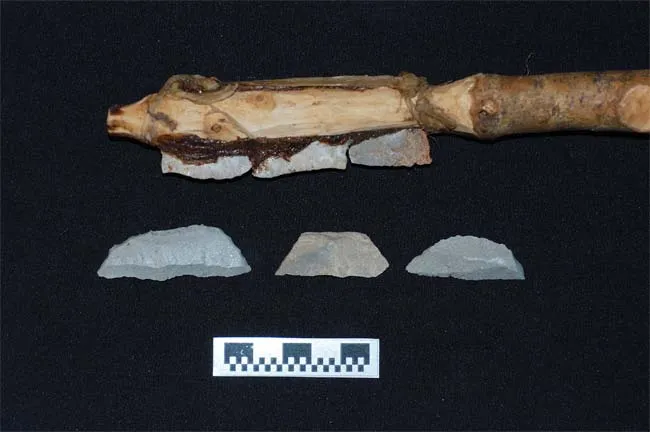
Brown and colleagues discovered the remains of tools that had been made using fire at archaeological sites in South Africa. The tools were made out of a stone called silcrete. Some of the earliest examples could date back to 164,000 years ago, and the researchers found that by 72,000 years ago this technique was seemingly common for silcrete tools.
The heat-treated tools look almost like stone razor blades, and are small enough that they could have been set into a handle.
"It’s a big debate to figure out what people were doing with these things," Brown told LiveScience. "Some people argue that they are the first arrowheads. Other people argue that they were set in a handle and used as knives."
To make the tools, early humans would have had to bury the stone beneath a fire, then slowly heat it up, keep it at a high temperature for hours, and then let it cool. The process was complicated and could take one to two days of continuous heating.
The heat transforms the stone so that it's harder and more brittle, which allows it to be more easily chipped away into a sharper edge. It also gives the stone a special sheen, which helped the archaeologists identify the tools as resulting from fire treatment.
"The most noticeable thing about heat-treated stone is that it has a luster or a gloss to it that’s fairly distinctive," Brown said. "A stone that's heated will only show that gloss if it's been flaked after it's heated."
The researchers then confirmed that the tools had been warmed in a fire with a technique called archaeomagnetics, which measures the realignment of iron particles in stone that results from heating. Another chemical process called thermoluminescence provided further proof that the stones had been heated.
Brown and colleagues report their results in the Aug. 14 issue of the journal Science.

 Live Science Plus