













Scientist: Human Origin Impossible to Pinpoint
All modern humans originated in sub-Saharan Africa, according to a new study touted by its funders as the “final blow” against an opposing viewpoint. Not so fast, says one anthropologist who finds flaws in the evidence.
Debate over the origins of modern humans has simmered among anthropologists for years, with one theory asserting that Homo sapiens migrated across the world from a single point in Africa. The other theory states that multiple populations of Homo sapiens independently evolved from Homo erectus in regions beyond Africa.
The new study, published in the July 19 issue of the journal Nature, delivers what the researchers say could be the final verdict in support of the single point "Out of Africa" theory.
“We have combined our genetic data with new measurements of a large sample of skulls to show definitively that modern humans originated from a single area in sub-Saharan Africa,” said lead researcher Andrea Manica of the University of Cambridge.
Out of Africa
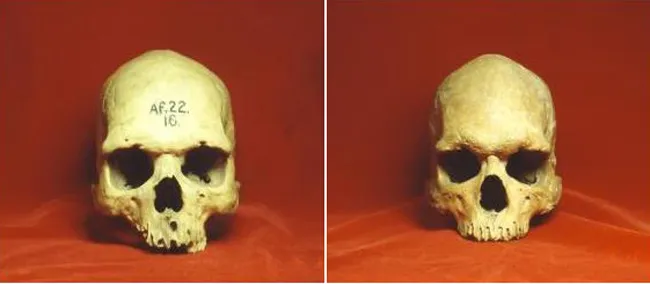
Manica and colleagues took multiple measurements of more than 4,500 male fossil skulls from 105 populations around the globe. They combined the results with data from studies of global genetic variations in humans, finding that both genetic and skull variability decreased with distance from Africa. So populations in southeastern Africa held the highest variability compared with populations in other countries.
“Humans seem to have poured out of Africa, spread out across the world, but at a really quite uniform rate such that you get this lovely gradual loss of diversity,” said study team member William Amos of the University of Cambridge.
Get the world’s most fascinating discoveries delivered straight to your inbox.
The results held even when the scientists accounted for climate, since climate conditions can lead to changes in skull features. “In very cold climates you tend to generate a slightly thicker brow ridge. Whether or not that’s to keep horrible blizzards out of your eyes, I don’t know,” Amos said.
Past studies based on skull morphology have been weak and have supported both of the human-origin views.
This study “adds a strong line of evidence to the Out of Africa [hypothesis] using such morphology,” said paleontologist Will Harcourt-Smith of the American Museum of Natural History in New York. Harcourt-Smith was not involved in the current research.
Dissenting voice
However, John Hawks of the University of Wisconsin-Madison says the paper is “mistaken.” A major flaw is that the current research is largely based on skull variability.
“You can’t find the origin of people by measuring the variability of their skulls,” Hawks told LiveScience.
Differences in skull features are related to genetics, and genetic variation depends on how much mixing occurs with other populations. “The main problem with the paper is that it takes some assumptions from genetics papers of 10 to 15 years ago that we now know are wrong,” Hawks said.
Other scenarios, besides the single-origin theory, could account for the link between distance and skull variability. “Africa is ecologically diverse, and cranial variation is a function of environments,” he said. In environments supporting hardy foods such as roots, people would need bigger jaw muscles, and thus larger areas for muscle attachments.
Also, correcting for climate is not a good idea, according to Hawks. “The most important feature that is related to climate is skull size. So by correcting for climate, they are subtracting a major component of variability," he said.
Impossible to solve?
In his own research, Hawks is finding that natural selection has led to changes in thousands of genes during only the past few thousand years.
“I’m really thinking just the opposite of this paper,” Hawks said. “There are differences in the skull between populations, including their variability, but it is mostly due to very recent effects and not the origin of modern humans.”
At the end of the day, a resolution to the "Out of Africa" debate may be impossible, he said. Most of the evidence can be interpreted as supporting both human-origins theories. “It’s really hard to find observations that distinguish the two,” Hawks said.
“The multiregional idea is identical to the recent African origin idea, except for its prediction that Europeans and Asians were part of the single population of origin and didn’t become extinct.”
Finding an answer still intrigues paleontologists. “To know the manner in which our direct ancestors evolved from earlier hominins, as well as which species died out and which didn't,” Harcourt-Smith said, “provides us with an insight into the actual process of human evolution.”
The recent study was funded by the Biotechnology and Biological Sciences Research Council (BBSRC).
- Top 10 Missing Links
- Video: Similarities Between Humans and other Primates
- Top 10 Useless Limbs (and Other Vestigial Organs)
Jeanna Bryner is managing editor of Scientific American. Previously she was editor in chief of Live Science and, prior to that, an editor at Scholastic's Science World magazine. Bryner has an English degree from Salisbury University, a master's degree in biogeochemistry and environmental sciences from the University of Maryland and a graduate science journalism degree from New York University. She has worked as a biologist in Florida, where she monitored wetlands and did field surveys for endangered species, including the gorgeous Florida Scrub Jay. She also received an ocean sciences journalism fellowship from the Woods Hole Oceanographic Institution. She is a firm believer that science is for everyone and that just about everything can be viewed through the lens of science.