













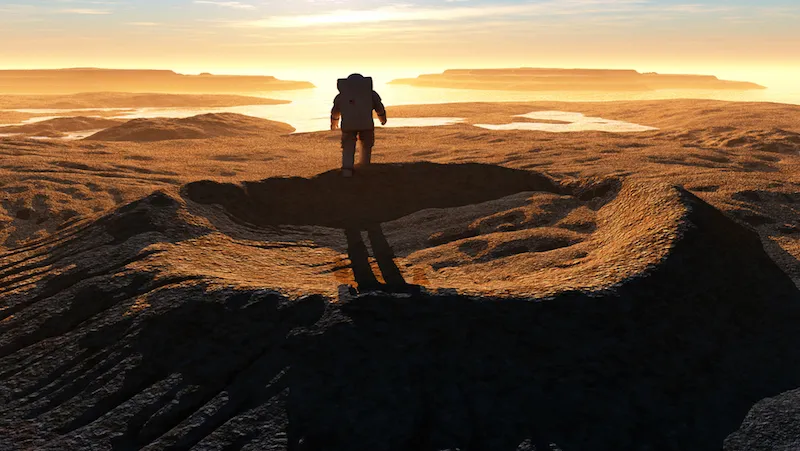
To brave the conditions of microgravity, thin air and harsh ionizing radiation for any length of time, humans may need to borrow genes from some of the hardiest organisms on the planet, Lisa Nip, a doctoral candidate at the MIT Media Lab in Cambridge, Massachusetts, said in a recent TED Talk.
Using the tools of synthetic biology, scientists could genetically engineer humans, and the plants and bacteria they bring with them, to create Earth-like conditions on another planet — known as terraforming, Nip said. This would be much more efficient than other proposed terraforming methods, such as hauling all of the tools to create a hermetically sealed environment, she added. [7 Most Mars-Like Places on Earth]
Human limitations
Humans are the ultimate homebodies. Having evolved for hundreds of thousands of years on our verdant, oxygen-rich, temperate planet, humans are uniquely well adapted to Earth's gentle conditions.
But space explorers will face much harsher conditions. In outer space, microgravity can weaken bones and damage the heart, and ionizing radiation can wreck DNA, she said.
Even on Mars — by far the most "hospitable" of the seven other planets in our solar system — the average temperature is about minus 85 degrees Fahrenheit (minus 65 degrees Celsius), yearly rainfall is zero, the miniscule atmosphere offers no shield against solar radiation and the soil is similar to the volcanic ash in Hawaii, Nip said.
"If we were to dump any of us on Mars right this minute — even given ample food, air and water and a suit — we are likely to experience very unpleasant health problems from the ionizing radiation," she said.
Get the world’s most fascinating discoveries delivered straight to your inbox.
Superspeed evolution
Instead of hiding humans behind a wall of lead or a suit of armor that weighs as much as the body itself, people should take a page from extremophile bacteria already living on Earth, she said. For instance, the world's toughest bacterium, Deinococcus radiodurans, can withstand 100 times the ionizing radiation that would kill a human, with no apparent adverse effects. Scientists already understand some of the pathways that give D. radioduransits incredibly hardy nature, so harnessing just a handful of these could help humans become more resilient in the harsh environments lurking in the cosmos, Nip said.
But synthetic biology also could be used to alter the creatures and flora that humans bring along for space colonization. For instance, growing food on Mars with traditional crops means "engineering endless acres of land on an entirely new planet and releasing trillions of gallons of atmospheric gases, and then enclosing it all in a glass dome," Nip said.
Instead, plants could be engineered to be both more drought-resistant more cold-resistant. For instance, genes for antifreeze found in fish could be transplanted into these crops to allow them to resist the endless winter on the Red Planet, Nip said.
Of course, genetic engineering has its risks and ethical challenges. And humans, and all other organisms for that matter, already have a time-tested way to adjust to their environment: evolution that proceeds via natural selection. But typically, that requires many small changes adding up over a relatively long period of time, in many, many organisms.
"Evolution requires two things that we may not always have or be able to afford: They are death and time," Nip said. "In our species' struggle to find our place in the universe, we may not have the time necessary for the natural evolution of extra functions on new planets."
Instead, humans may need to engage in targeted evolution at hyperspeed to survive the vagaries of the cosmos, she said.
Follow Tia Ghose on Twitterand Google+. Follow Live Science @livescience, Facebook & Google+. Original article on Live Science.

Tia is the editor-in-chief (premium) and was formerly managing editor and senior writer for Live Science. Her work has appeared in Scientific American, Wired.com, Science News and other outlets. She holds a master's degree in bioengineering from the University of Washington, a graduate certificate in science writing from UC Santa Cruz and a bachelor's degree in mechanical engineering from the University of Texas at Austin. Tia was part of a team at the Milwaukee Journal Sentinel that published the Empty Cradles series on preterm births, which won multiple awards, including the 2012 Casey Medal for Meritorious Journalism.