Live Science Plus


Zombie Cyborg Wood May Lead to Better Night-Vision Cameras

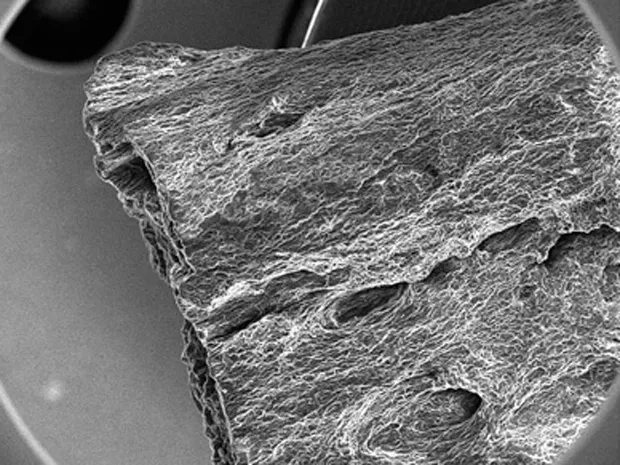
A new so-called cyberwood that continues to work even after its living components die could lead to technological advances in thermal night-vision cameras and temperature sensors.
This "zombie" cyborg wood is a hybrid material made of tobacco laced with teensy carbon tubes, and the whole contraption can act like a heat detector even after the plant cells have perished.
Currently, electronic thermometers and thermal night-vision cameras sense heat by using materials whose electrical conductivity changes as the temperature changes. The best heat-detecting materials available now change their electrical conductivity just by a few percent per degree temperature change.

In contrast, the new cyberwood that the scientists created is hundreds of times more responsive to changes in temperature than the best man-made materials currently used in heat detectors. Samples of cyberwood were sensitive enough to detect people from only their body heat from a distance of up to 31.5 inches (80 centimeters) away. [Biomimicry: 7 Clever Technologies Inspired by Nature]
Making cyberwood
Prior research had revealed that living plants are exceptionally sensitive to changes in temperature. Their sensitivity is based on the behavior of chemicals within the cell walls of the plants. However, this sensitivity fades after the cells die.
To create a material with the potential to be as temperature-sensitive as plants, scientists watered tobacco cells with a solution loaded with carbon nanotubes, hollow pipes just nanometers (billionths of a meter) in diameter. Although carbon nanotubes are only about the width of a strand of DNA, they are about 100 times stronger than steel and only one-sixth as heavy. Moreover, their conductive properties for both electricity and heat rival those of the best metal conductors.
Get the world’s most fascinating discoveries delivered straight to your inbox.
The carbon nanotubes formed a complex network among the plant cells and partially infiltrated the plant cell walls. The resulting cyberwood has a microscopic structure that resembles that of natural wood, and mechanical properties similar to those of balsam fir, a kind of pine tree, the researchers said in the new study.
"We are not trying to engineer plants with nanotechnology — we let plant cells do the nanoengineering," said study co-author Chiara Daraio, a materials scientist at the Swiss Federal Institute of Technology in Zurich. "Instead of trying to mimic properties found in biological systems, we allow biological systems to fabricate new materials for us, with properties not achievable before in man-made materials."
The carbon nanotubes served as permanent electrically conductive pathways that substituted for water after the cyberwood dehydrated, stabilizing its unique properties even after the plant cells died.
"It is possible to immortalize, in composite materials that combine biological and synthetic elements, properties that are common only in living plants," Daraio told Live Science. [Incredible Tech: How to Engineer Life in the Lab]
The cyberwood proved exceptionally sensitive to temperature, with its electrical conductivity changing by about 1,730 percent per 1.8 degree change in Fahrenheit (1 degree change in Celsius) at about room temperature. This temperature sensitivity worked best at temperatures below the boiling point of water, 212 degrees F (100 degrees C), after which the cyberwood's structure began to unravel.
"The cyberwood response to temperature changes was so extreme, we initially could not believe the data," Daraio said.
Future cyberwood devices
The carbon nanotubes in the cyberwood remain highly electrically conductive. This suggests that materials like cyberwood — a specimen of what the researchers call "plant nanobionics" — could be connected to electronic circuits for use in devices, the researchers said.
"The creation of nanobionic materials, derived by combining living cells with synthetic nanostructures, is an emerging area of research, which offers numerous opportunities to create materials with properties so far only found in biological materials," Daraio said.
The scientists also found that humidity influenced cyberwood's electrical response to changes in temperature. This suggests that a material like cyberwood could be used as a temperature sensor as long as the humidity is kept constant, and as a humidity sensor as long as the temperature is kept constant.
Cyberwood itself may not be the material that ultimately ends up in future devices. Instead, by using cyberwood to understand why plants are so temperature-sensitive, scientists "now hope to be able to extract from plants the relevant molecules to create new materials using a scalable and economically viable synthesis process," Daraio said.
"For example, we envision creating materials with similarly extreme temperature sensitivity, which could also be flexible, transparent and even biocompatible," Daraio added. "These new materials could then be used to create affordable thermal cameras for night vision, or in new temperature sensors for biomedical applications or as sensors embedded in consumer products."
Daraio and her colleagues Raffaele Di Giacomo of the Swiss Federal Institute of Technology and Bruno Maresca of the University of Salerno in Italy detailed their findings online March 30 the journal Proceedings of the National Academy of Sciences.
Follow Live Science @livescience, Facebook & Google+. Original article on Live Science.