













World Cup Soccer Ball Is Nice and Stable, Study Finds

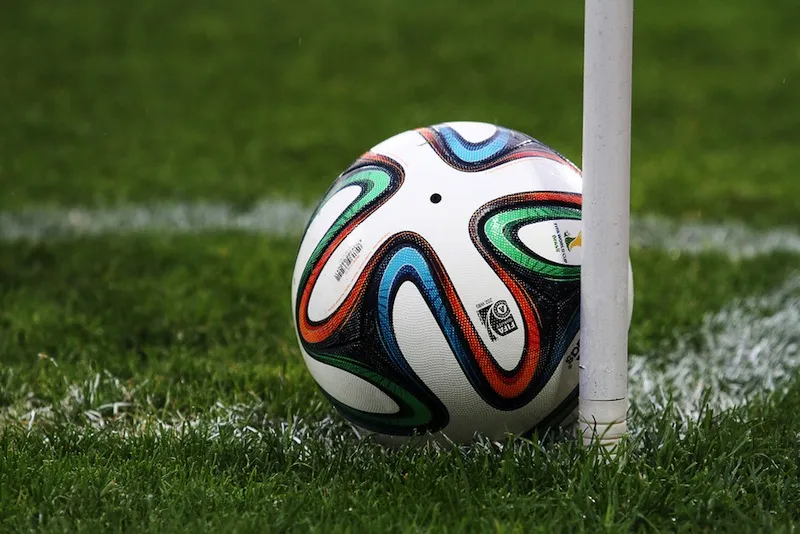
Players in the 2014 FIFA World Cup may find their kicks sending the ball flying true, according to new research on the physics of the official World Cup soccer ball.
Conventional soccer balls are made of 32 pentagonal and hexagonal panels, but the 2014 World Cup ball is a model called the Brazuca, made by Adidas. The Brazuca has only six panels, a design that gives it superior stability to other balls on the market, according to the new study published today (May 29) in the journal Scientific Reports.
Traditional soccer balls, with their honeycomb-like stitching, are iconic. Nevertheless, manufacturers have been playing with the 32-panel design in recent years. The Adidas Teamgeist II, for example, has 14 panels and was used in the 2008 Euro Cup. The Jabulani has only eight panels and was widely criticized in the 2010 World Cup by players, who said that its flight path was unpredictable. [Twisted Physics: 7 Mind-Blowing Findings]
Testing the design
This year, fans are chattering about the Brazuca, which is designed with stability in mind. But research on the physics of soccer balls has failed to connect the dots between tests in wind tunnels and actual flight trajectories, sports science researchers Sungchan Hong and Takeshi Asai of the University ot Tsukuba in Japan wrote in Scientific Reports.
Hong and Asai used wind-tunnel tests and a ball-kicking robot to analyze the physics of five different types of soccer balls, connecting the raw numbers of drag and lift to real-life performance. They analyzed the Brazuca, the Teamgeist II, the Jabulani and a conventional 32-panel ball. They also analyzed the 32-panel Adidas Cafusa ball, which is used in many professional matches and has a slightly different arrangement of panels than a traditional 32-panel ball.
The wind tunnel tests found varying levels of drag, or air resistance, as well as different levels of lift, the force that holds the ball aloft. With those differences in mind, the researchers tested each ball with a robot programmed to kick in exactly the same way every time. The kickbot would send the ball flying toward a net 82 feet (25 meters) away, and the researchers would measure the consistency of the spot where the ball hit. [Video: Watch the Kick Robot in Action]
Get the world’s most fascinating discoveries delivered straight to your inbox.
Flying true
The researchers found that the Brazuca ball was the most consistent flier of the bunch, followed by the conventional 32-panel ball. Confirming the suspicions of prior World Cup players, the Jabulani was the most unstable ball tested. The Cafusa and Teamgeist II were also variable, the researchers reported.
The tests revealed that the Cafusa tends to wobble horizontally in flight, while the Jabulani wobbles vertically. The researchers were also able to link measurements in the wind tunnel to performance when kicked. [Peering Inside the World Cup's Brazuca Ball (Op-Ed )]
The researchers suggest the findings could help in the design of new soccer balls, as well as inform coaches about how to teach their players to shoot. Nevertheless, they wrote, questions remain: Materials, surface roughness, symmetry and the glue holding the ball together all affect the flight path, too.
Follow Stephanie Pappas on Twitter and Google+. Follow us @livescience, Facebook & Google+. Original article on Live Science.

Stephanie Pappas is a contributing writer for Live Science, covering topics ranging from geoscience to archaeology to the human brain and behavior. She was previously a senior writer for Live Science but is now a freelancer based in Denver, Colorado, and regularly contributes to Scientific American and The Monitor, the monthly magazine of the American Psychological Association. Stephanie received a bachelor's degree in psychology from the University of South Carolina and a graduate certificate in science communication from the University of California, Santa Cruz.