It's quick and easy to access Live Science Plus, simply enter your email below. We'll send you a confirmation and sign you up for our daily newsletter, keeping you up to date with the latest science news.
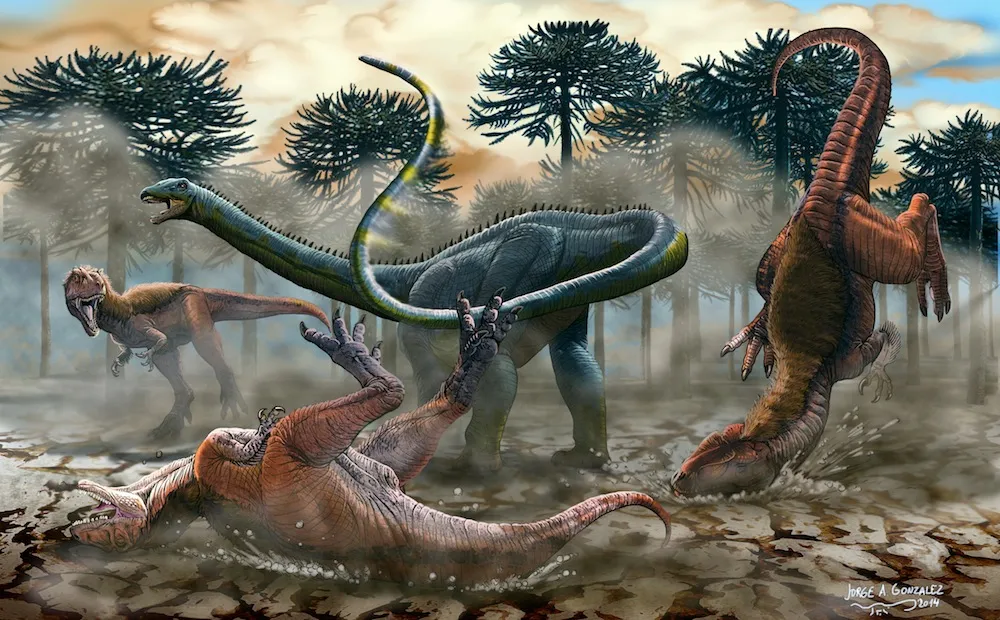
A long-neck relative of Apatosaurus and Diplodocus has been discovered in South America, becoming the first of its kind ever found on that continent.
Discovered in rock from the Early Cretaceous Period about 140 million years ago, the new dinosaur lived later than its relatives found in Africa, Europe and North America, which hail from the Jurassic, the period before the Cretaceous. At about 30 feet (9 meters) long, the new long-neck is also a relative pipsqueak. Other dinosaurs in this group — the diplodocids — are more than 66 feet (20 m) long, said study researcher Pablo Gallina, a paleontologist at the Universidad Maimonides in Buenos Aires.
The fossil site in Patagonia where the new dinosaur was discovered.
(Image credit: Pablo A. Gallina)
Gallina and his collagues excavated the fossil during three trips to Patagonia in 2010, 2012 and 2013. The fossil site is in Argentina's Neuque´n province, where the landscape is dry and scrubby, with reddish dirt hills. In the Early Cretaceous, the environment would have been semi-arid, bordering a large desert on the supercontinent of Gondwana, Gallina said.
The skeleton is fragmentary, but the researchers were able to use the shape of the animal's vertebrae to determine that it was a new species. They dubbed the dinosaur Leinkupal laticauda. In the language of the native Mapuche people of Patagonia, "lein" means "vanishing," and "kupal" means "family." The researchers chose this name because previously discovered diplodocid relatives come from the Jurassic, meaning L. laticauda may have been among the last of its line.
The second part of the dinosaur's name has meaning, as well. "Lati" comes from the Latin for "wide," and "cauda" from the Latin for "tail." The vertebrae suggest that L. laticauda had a very broad, muscular tail, which may have allowed it "remarkable control and fortitude," Gallina said.
Sign up for the Live Science daily newsletter now
Get the world’s most fascinating discoveries delivered straight to your inbox.
Unique discovery
Diplodocids are famed for their long necks and long tails; the earliest discovered specimens came from the rich Jurassic fossil beds in Colorado. They had also been discovered in Africa, which led paleontologists to suspect they lived in South America as well. At the time this group of dinosaurs lived, the two continents were combined into one, called Gondwana.
Previous Patagonian fossil finds came from the upper, or Late Cretaceous, about 100 million to 66 million years ago. L. laticauda is the first dinosaur ever found in the region from the Early Cretaceous, Gallina said.
When the bones were first discovered in 2010, they looked unpromising and damaged by erosion. But the paleontologists could find no other bones to excavate, so they began the process of digging out the skeletal fragments. It wasn't until the bones were out of the ground that the researchers began to realize they had something unique on their hands, Gallina said.
The researchers report their findings today (May 14) in the open-access journal PLOS ONE.
Stephanie Pappas is a contributing writer for Live Science, covering topics ranging from geoscience to archaeology to the human brain and behavior. She was previously a senior writer for Live Science but is now a freelancer based in Denver, Colorado, and regularly contributes to Scientific American and The Monitor, the monthly magazine of the American Psychological Association. Stephanie received a bachelor's degree in psychology from the University of South Carolina and a graduate certificate in science communication from the University of California, Santa Cruz.