New transparent armor to protect U.S. troops on the battlefield could be inspired by the structure of seashells, researchers say.
Scientists would love to develop tough, hard, lightweight materials for applications such as body armor. Increasingly, researchers seek to create materials that mimic structures found in nature, a strategy known as biomimetics.
"We have long studied natural exoskeletons as inspiration for the development of advanced engineered protective systems," said study author Christine Ortiz, a materials scientist at the Massachusetts Institute of Technology.
Latest Videos From
To develop the novel armor, Ortiz and her colleague Ling Li investigated the windowpane oyster, Placuna placenta. They were especially interested in this mollusk, because it has a shell that permits 80 percent of visible light to shine through it. The shell sometimes finds use in windowpanes in place of glass in the Philippines, India and other Asian countries. [7 Cool Animal-Inspired Technologies]
"About five years ago we started searching for natural armor systems, which were also optically clear," Ortiz said. Transparent armor could serve in "soldier eye or face protection, windows and windshields, blast shields and combat vehicles," she said.
This seashell is made nearly entirely of calcite, the main component of relatively fragile rocks such as limestone and chalk. However, the scientists discovered this seashell could dissipate energy from penetrations about 10 times better than ordinary calcite.
Scientists have examined mollusk and other shells for tips on how to create armor, but "this is the first thorough study of a natural armor that resists mechanical penetration but is also optically clear," Ortiz told Live Science. "We wanted to find out how the material resists penetration but also preserves this unique optical property."
To find out how this seashell could do so much better than regular calcite, the researchers examined its structure on the scale of nanometers, or billionths of a meter. The seashell is made of layers of long diamond-shaped crystals of calcite joined together by organic material.
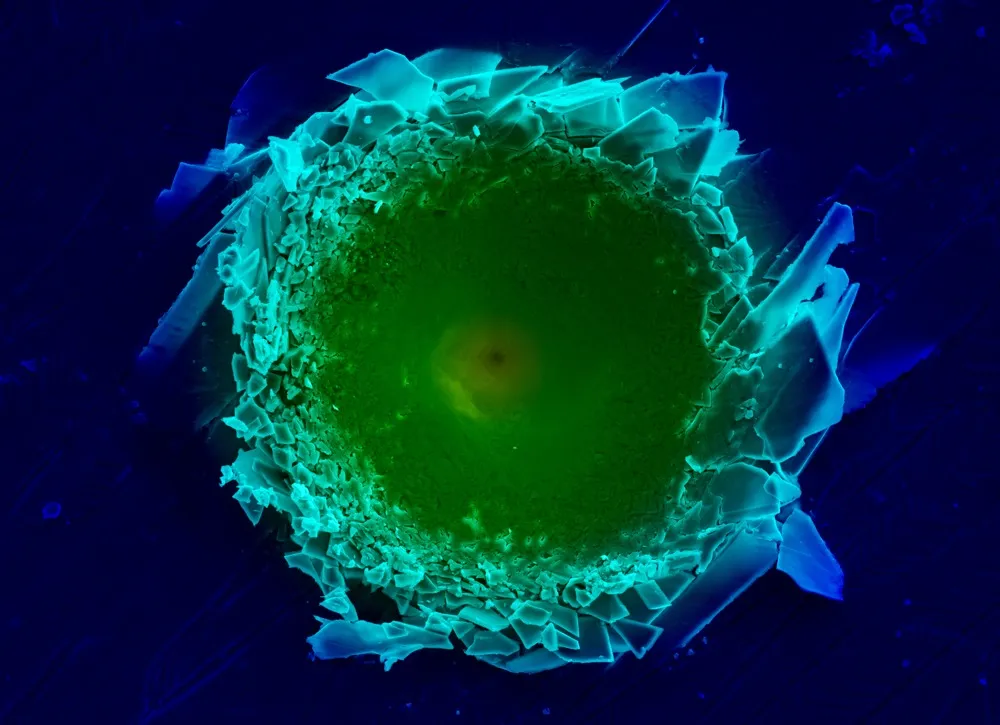
When the seashell was subjected to microscopic denting from a diamond-tipped probe, the scientists found the shell deformed via "twinning" — crystals of calcite that were mirror images of each other formed around the penetration zone. Such twinning helped dissipate energy and localize damage, by deflecting cracks from spreading farther, for instance.
Ultimately, twinning, along with the shell's nano-level structure, confined damage to a small volume and preserved the mechanical integrity of the rest of the structure. Armors based on this strategy of twinning and of nano-level structure could survive multiple hits, researchers said.
"The findings in this work may provide design principles for synthetic engineering of lightweight structural materials with efficient energy dissipation," Ortiz said. "We are continuing to study other armored species that exhibit semitransparent properties and intend to create a library of biological design principles."
Li and Ortiz detailed their findings online yesterday (March 30) in the journal Nature Materials.
Follow us @livescience, Facebook & Google+. Original article on Live Science.