Young Earth’s molten lava ocean was layered like a pudding cake, according to a study published today (Nov. 6) in the journal Nature.
Researchers think the Earth's first millennia were spent covered in magma, following a giant impact that formed the moon. Now, thanks to an experiment that brought basalt rock to the highest pressures ever tested, scientists think this lava sea was stratified, separated into lighter and denser layers.
The tests were designed to mimic the conditions inside the deepest part of Earth's mantle, the thick zone between the planet's iron core and its cold, wrinkly crust. Today, the mantle is mostly solid rock, but soon after Earth formed, the mantle was mostly liquid, scientists think. But a lively debate exists regarding the size of the magma ocean and how long it took the magma ocean to cool. Little evidence remains from this ferocious period of Earth's history, so scientists rely on experiments and computer modeling to recreate the past.
Latest Videos From
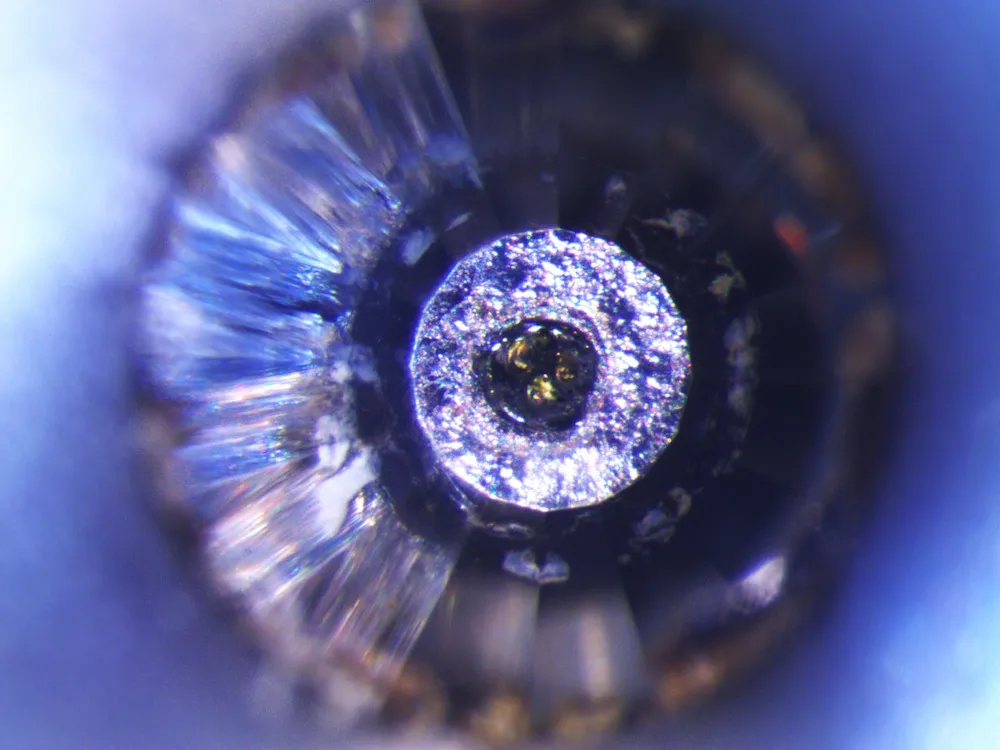
To melt rock at the same conditions as deep inside the mantle, a team led by geophysicist Chrystèle Sanloup of the University Pierre et Marie Curie in Paris beamed powerful X-rays at a tiny sliver of basalt as it was squeezed between a diamond-tipped anvil.
"Silicate liquids like basaltic magma play a key role at all stages of deep Earth evolution, ranging from core and crust formation billions of years ago to volcanic activity today," Sanloup said. While no one know the exact composition of the ancient magma oceans, basaltic lava erupts from volcanoes that tap the mantle, such as Hawaii, and from oceanic spreading ridges. And seismic waves passing through Earth's mantle suggest pockets of superdense liquid magma hide out in the deepest mantle, near the core. "The ultra-low velocity zones are 10 percent denser than the surrounding, fully-crystalline mantle," Sanloup told LiveScience.
During the experiment, at pressures above 35 gigapascals (GPa), one of the most common ingredients in basalt became denser, the researchers found. (A gigapascal is a unit of pressure. A pressure of 35 gigapascals corresponds to a depth of about 560 miles, or 900 kilometers, in the Earth.)
As pressures increased, the oxygen atoms surrounding silicon rearranged themselves, packing six atoms around silicon instead of four, the tests revealed. Like tourists crowding into New York City's Times Square on New Year's Eve, this atomic close packing makes the liquid basalt more dense. The basalt density increased from about 2.7 grams per cubic centimeter at low pressure to almost 5 g/cm3 at 60 GPa (about 930 miles, or 1,500 km depth). The mantle is 1,800 miles (2,900 km) thick. [Infographic: Tallest Mountain to Deepest Ocean Trench]
Based on the experimental results, the team thinks a similarly dense magma could have oozed over the early Earth in the deep mantle. Because it was so dense, as the liquid lava oceans cooled, crystallized rock would have floated on the surface, unable to drop into the denser magma. Above this cap of crystallized rock, which could have been up to 185 miles (300 km) thick, sat another layer of less dense magma, Sanloup said.
The cooled rock would have acted like a blanket, trapping heat inside the lower mantle. "This crystalline layer would slow down the cooling, acting as an insulator for the deeper magma ocean. Hence it would take much longer for the whole mantle to crystallize, as opposed to a single magma ocean," Sanloup said.
Email Becky Oskin or follow her @beckyoskin. Follow us @livescience, Facebook & Google+. Original article on LiveScience.

 Live Science Plus