













If you dread going to the dentist, be thankful you didn't live in the Stone Age.
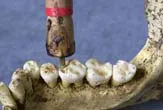
Roughly 8,000 years before Novocaine and some 7,300 years before they could even swig whiskey to dull the pain, prehistoric patients were having holes drilled into their teeth with drill bits carved from stone.
Scientists found 11 teeth from the skeletons of four females, two males and three individuals of unknown gender in an ancient cemetery in Pakistan that show signs of having undergone the painful procedure.
Life after pain
All the teeth had worn a bit after the holes were made, confirming that the drillings were performed while the people were still alive.
It's unlikely the holes were drilled for decorative purposes since all of teeth were first or second permanent molars located deep inside the mouth, said study leader Roberto Macchiarelli from the Universite de Poitiers in France.
The researchers think the dental work may have been done to ease pain, since four of the teeth showed signs of decay and the jaw of at least one individual showed signs of massive infection. One poor soul had three drilled teeth and another had a tooth that had been drilled twice.
Get the world’s most fascinating discoveries delivered straight to your inbox.
The procedure would have caused a lot of pain, too. The holes ranged from about 1 to 3 millimeters in diameter and were about 0.5 to 3.5 millimeters deep.
One minute of torture
The researchers reconstructed a flint-tipped drill and found they could create similar holes in less than a minute.
But even with anesthetic, it would likely have been a very long one minute, Macchiarelli said.
"The extent and depth of the drilling would have produced horrible pain," he told LiveScience. "These people took the capability of facing pain to another level."
At the excavation site, flint drill heads were found alongside beads made of bone, shell, turquoise and other material. The researchers think the early dentists learned their craft from artisans skilled at making beads.
The findings are detailed in the April 6 issue of the journal Nature.