Climate Change Evidence: 'Unprecedented' Warming Is Man-Made (Infographic)

Get the world’s most fascinating discoveries delivered straight to your inbox.
You are now subscribed
Your newsletter sign-up was successful
Want to add more newsletters?
Delivered Daily
Daily Newsletter
Sign up for the latest discoveries, groundbreaking research and fascinating breakthroughs that impact you and the wider world direct to your inbox.
Once a week
Life's Little Mysteries
Feed your curiosity with an exclusive mystery every week, solved with science and delivered direct to your inbox before it's seen anywhere else.
Once a week
How It Works
Sign up to our free science & technology newsletter for your weekly fix of fascinating articles, quick quizzes, amazing images, and more
Delivered daily
Space.com Newsletter
Breaking space news, the latest updates on rocket launches, skywatching events and more!
Once a month
Watch This Space
Sign up to our monthly entertainment newsletter to keep up with all our coverage of the latest sci-fi and space movies, tv shows, games and books.
Once a week
Night Sky This Week
Discover this week's must-see night sky events, moon phases, and stunning astrophotos. Sign up for our skywatching newsletter and explore the universe with us!
Join the club
Get full access to premium articles, exclusive features and a growing list of member rewards.
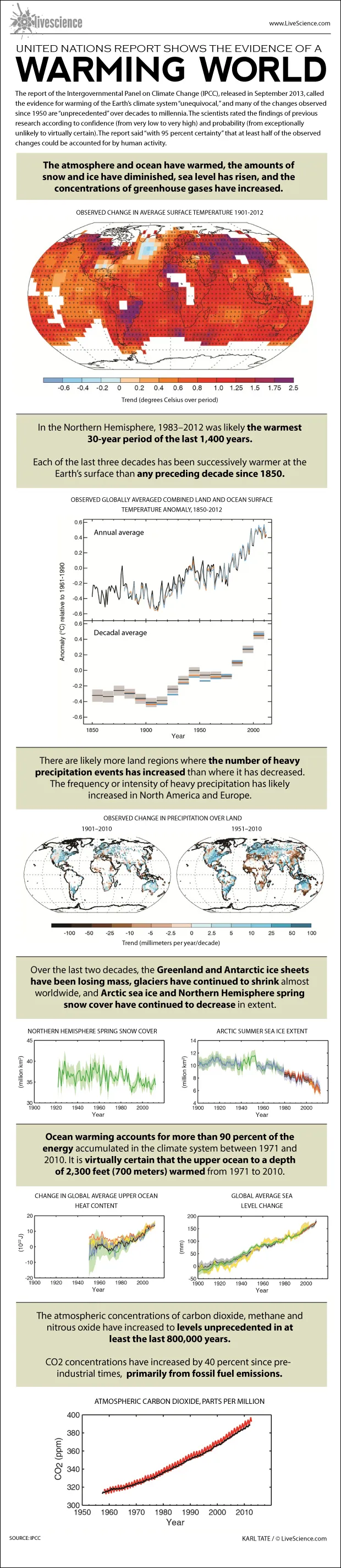
The report of the Intergovernmental Panel on Climate Change (IPCC), released in September 2013, called the evidence for warming of the Earth’s climate system “unequivocal,” and many of the changes observed since 1950 are “unprecedented” over decades to millennia. The scientists rated the findings of previous research according to confidence (from very low to very high) and probability (from exceptionally unlikely to virtually certain). The report said “with 95 percent certainty” that at least half of the observed changes could be accounted for by human activity.
The atmosphere and ocean have warmed, the amounts of snow and ice have diminished, sea level has risen, and the concentrations of greenhouse gases have increased.

In the Northern Hemisphere, 1983–2012 was likely the warmest 30-year period of the last 1,400 years. Each of the last three decades has been successively warmer at the Earth’s surface than any preceding decade since 1850.
There are likely more land regions where the number of heavy precipitation events has increased than where it has decreased.
The frequency or intensity of heavy precipitation has likely increased in North America and Europe.
Get the world’s most fascinating discoveries delivered straight to your inbox.
Over the last two decades, the Greenland and Antarctic ice sheets have been losing mass, glaciers have continued to shrink almost worldwide, and Arctic sea ice and Northern Hemisphere spring snow cover have continued to decrease in extent.
Ocean warming accounts for more than 90 percent of the energy accumulated in the climate system between 1971 and 2010. It is virtually certain that the upper ocean to a depth of 2,300 feet (700 meters) warmed from 1971 to 2010.
The atmospheric concentrations of carbon dioxide, methane and nitrous oxide have increased to levels unprecedented in at least the last 800,000 years.
CO2 concentrations have increased by 40 percent since pre-industrial times, primarily from fossil fuel emissions..