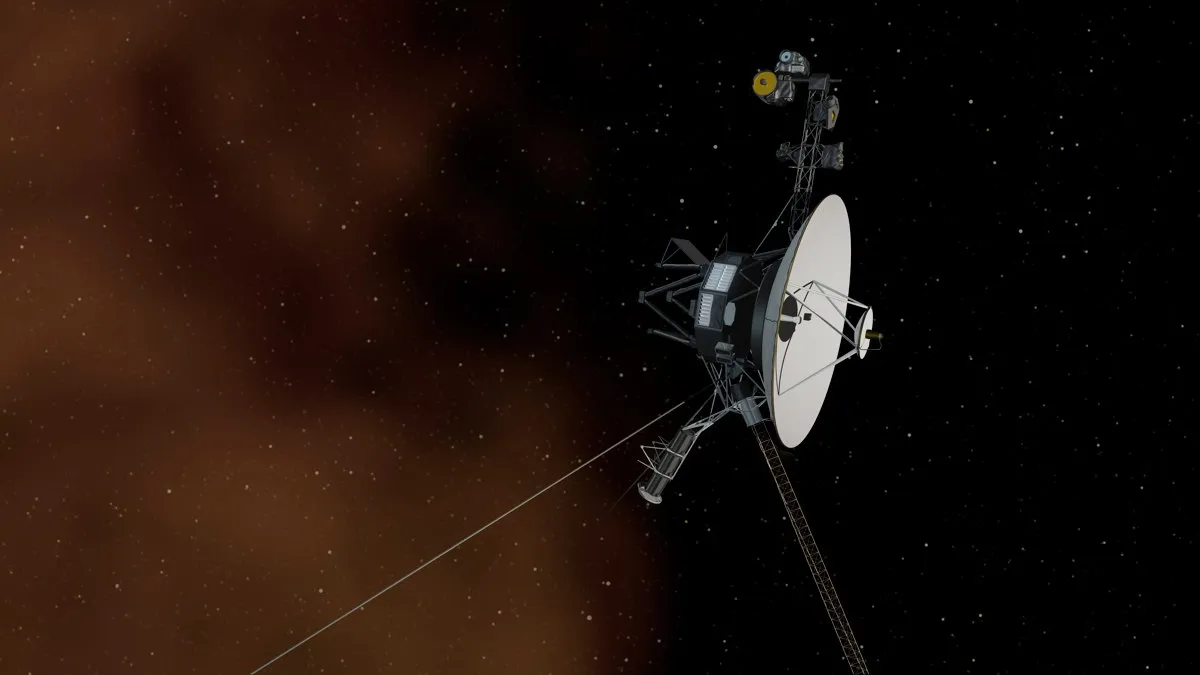
Voyager 1 has left the solar system. The big news that the spacecraft reached interstellar space on Aug. 25, 2012, after its decades-long sojourn begs the question: Just how far did it have to travel to knock on cold, dark space's door?
In other words, just how big is the solar system that earthlings call home?
That's a question whose answer is steeped in hot gas traveling faster than the speed of sound.
Latest Videos From
"There's a gas flowing outward from the sun called the solar wind, at about a million miles an hour, it's supersonic," said study researcher and Voyager 1 team member Donald Gurnett, of the University of Iowa, who is principal investigator of the plasma wave instrument. [How the Voyager Space Probes Work (Infographic)]
As the charged gas zips away from the sun, it expands and spreads out; at the same time, its density decreases.
"Fifty years ago or thereabouts, it was recognized or postulated that the solar wind has to be stopped by the interstellar gas pressure, the gas between the stars," Gurnett told LiveScience in an interview.
Scientists knew this cold, dark space between stars existed, calling the boundary between it and the bubble of hot, charged particles surrounding our solar system the heliopause. Even so, they didn't know how dense this boundary might be.
The boundary would mark the end of the solar system and the beginning of interstellar space, hence revealing the size of the solar system.
"There's been a great quest for a long time to figure out where this boundary was," Gurnett said. "It was once thought — at least two scientific papers 30 or so years ago claimed it was just beyond Jupiter."
Now that Voyager 1, which launched in 1977, has penetrated the heliopause and entered the stars' chilly quarters, Gurnett and his colleagues can say the boundary is much farther out than Jupiter's orbit.
The end of the solar system is about 122 astronomical units (AU) away from the sun, where one AU is 93 million miles (150 million kilometers). That's about three times as far out as Pluto, which is about 40 AU from the sun, or about six times farther away from Earth than Neptune's orbit.
That means Voyager 1 is about 1 light-day away from planet Earth. For comparison, the nearest star Alpha Centauri lies 4.3 light-years away. A radio signal, which travels at the speed of light (186,000 miles a second, or nearly 300,000 km/s), takes 17 hours to travel from Voyager 1 to Earth.
"Voyager is the highest-speed object ever produced by a human," Gurnett said.
The scientists involved in the mission knew the spacecraft had pushed through the heliopause on April 9, 2013, when they saw a Voyager 1 recording of a sudden spike in oscillations of plasma (hot, ionized gas) at a certain frequency. "When we saw that, it took us 10 seconds to say we had gone through the helio-pause," Gurnett said in a statement. The frequency suggested a plasma density that was 80 times higher than anything seen inside the heliosphere's outer edge.
In fact, the density was close to what astronomers would expect in interstellar space. They then back-calculated when Voyager 1 would have passed the heliopause.
Voyager 1 is beyond the solar bubble but has yet to reach the Oort Cloud, a repository of comets a light-year or so away from which many of the icy bodies travel to the inner solar system. The Oort Cloud forms a sort of icy shell around the solar system.
Follow Jeanna Bryner on Twitter and Google+. Follow us @livescience, Facebook & Google+. Original article on LiveScience.