
 Live Science Plus


North Pole 'Lake' Vanishes

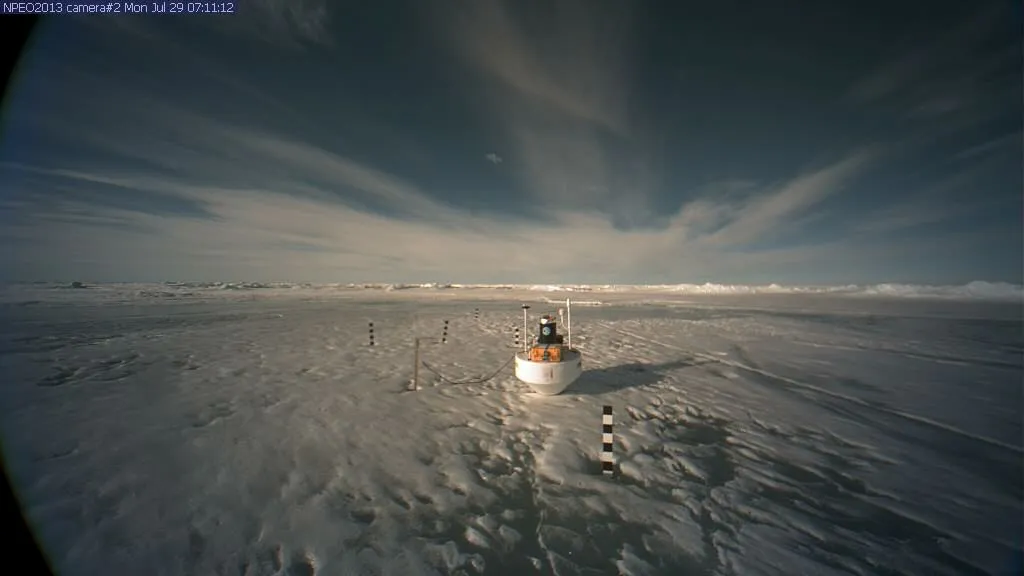
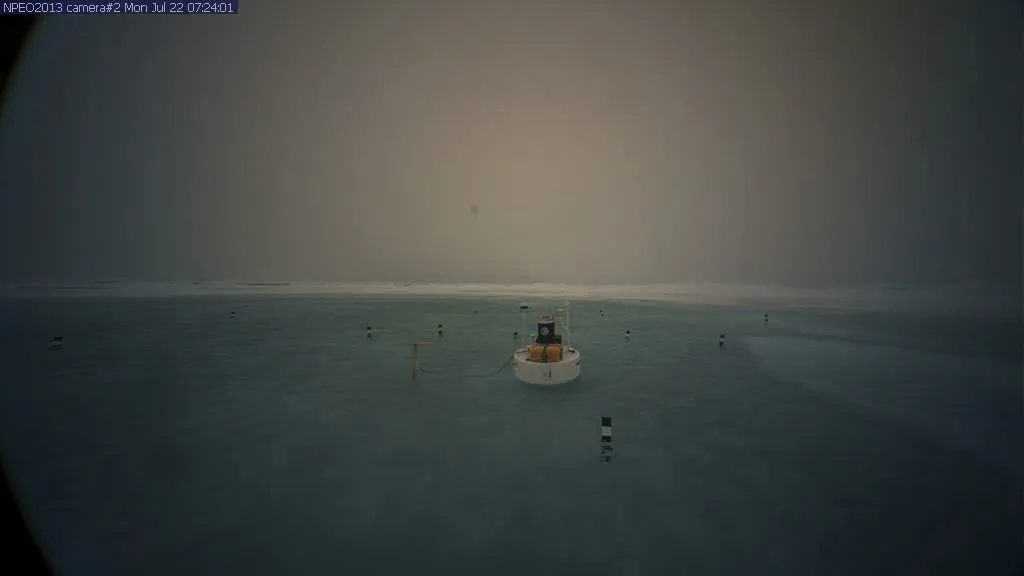
Like a politician whose peccadillos lead to "family time," the North Pole lake has had its fill of Internet notoriety. The stunning blue meltwater lake that formed on the Arctic ice disappeared on Monday (July 29), draining through a crack in the underlying ice floe.
Now, instead of 2 feet (0.6 meters) of freshwater slopping against a bright-yellow buoy, a remote webcam shows only ice and clouds.
Though the North Pole lake's 15 minutes of fame focused worldwide attention on global warming's effects on Arctic sea ice, the melting is actually part of an annual summer thaw, according to researchers who run the North Pole Environmental Observatory. "The formation of these ponds and their disappearance is part of a natural cycle," said Axel Schweiger, head of the Applied Physics Laboratory's Polar Science Center at the University of Washington, which helps run the observatory.

The lake, about the size of an Olympic swimming pool, started forming in mid-July, LiveScience first reported on July 23. The size and timing of the lake are typical for this time of year and location, the researchers said.
However, scientists at the observatory and elsewhere are studying the Arctic's meltwater ponds to understand how global warming is changing their total extent.
"It's important to recognize that these ponds may be linked to global warming, but the questions are more: How many and how deep they are, and when they appear and when they drain," Schweiger told LiveScience.

For instance, warmer temperatures in the Arctic already cause surface melting to start earlier on the ice, so the ponds are forming sooner than they used to, Schweiger said. But other factors play a role, such as snow cover and ice thickness. "It's a very open research question," he said.
The observatory has tracked yearly ice changes in the Arctic since 2000. Every spring, scientists fly to the North Pole and anchor buoys with remote webcams into ice floes. The buoys then drift with the ice. [Image Gallery: Back-Breaking Science at the Earth’s Poles]
When the meltwater lake appeared in mid-July, the buoys were about 375 miles (600 kilometers) south of the geographic North Pole. Their journey from April to July put the buoys on parallel to the magnetic North Pole, which is currently west of Greenland.
Email Becky Oskin or follow her @beckyoskin. Follow us @livescience, Facebook & Google+. Original article on LiveScience.com.
