















Exactly 150 summers ago, stargazers were admiring a beautiful new comet. Discovered in mid-July 1862 by Americans Lewis Swift and Horace Tuttle, the new object became favorably positioned high in the northern sky through the remainder of the summer.
During that last week of August, the comet was at its best, shining at second magnitude and displaying a long, bright tail. In telescopes, luminous jets of nebulosity blossom outward from a bright, highly condensed nucleus. French astronomer Camille Flammarion ranked comet Swift-Tuttle among the ten "really fine and striking comets" of the 19th century. Others would simply refer to it as "The Great Comet of 1862."
From this bright visitor we learned quite a bit about comets in general and their relationship to meteor showers. Among the interesting points raised by this comet’s mid-19th century appearance was the announcement in 1867 by the Italian astronomer Giovanni Schiaparelli that the orbit of comet Swift-Tuttle appeared to be nearly coincident with the orbit of the source of the Perseid meteor shower.
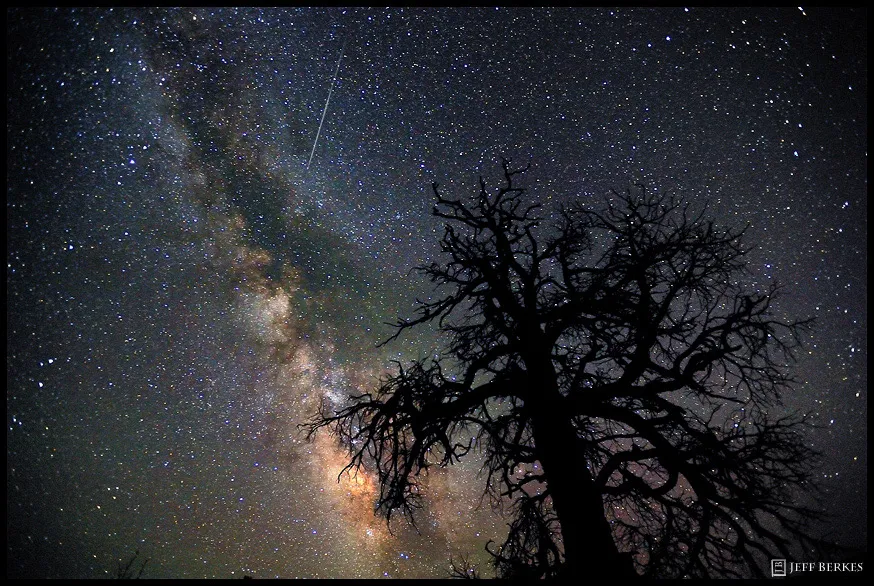
Schiaparelli postulated that the comet had discarded the tiny fragments that produce the Perseids as it swept through the inner solar system. These swift streaks of light appear to dart across our northern skies from their namesake constellation from late July through most of August. [Amazing Perseid Meteor Shower Photos]
Comet Crumbs
These comet fragments — countless bits of metal and stone — are called meteoroids while they exist in and move through space. But a meteor is not a particle of matter itself. It is merely the short-lived streak of light produced by the meteoroid as it is heated to incandescence by its plunge through the Earth’s atmosphere.
The kinetic energy released per gram of the meteoroid’s weight far exceeds the energy efficiency of the most powerful man-made explosives. Thus, an object the size of a pea or pebble can create a very substantial meteor trail.
Get the world’s most fascinating discoveries delivered straight to your inbox.
Ultimately, Schiaparelli was proven correct; comet Swift-Tuttle is indeed the progenitor of the Perseid meteor shower — the first direct correlation to be found between a comet and meteor shower. Soon afterward, Schiaparelli suggested that another annual display, the November Leonids, was caused by Earth’s interception of the debris of the comet Tempel-Tuttle (discovered in December 1865).
Today, while not all meteor showers have been associated with specific comets, astronomers think that all showers probably have a cometary origin. Over 500 cometary meteor swarms that produce (or have produced) meteor showers are currently known.
A meteoroid swarm is sometimes referred to as a "flying gravel bank," though it is not a very compact one. The Perseid meteoroids, for example, are anywhere from 60 to 100 miles (96 to 160 kilometers) apart at the densest part of the swarm. Earth enters the outer fringes of the gravel bank around July 25, but does not leave it behind until we see the last stragglers around August 18. All told, the Perseid stream is immense – perhaps as large as 50 million miles in diameter.
2012: A favorable Perseid year
In 2012, the Earth is expected to encounter the "core" of the Perseid swarm, where meteoroid concentration is densest, on Aug. 12. This is when the Perseids put on their best show as the meteors appear to diverge from a patch of sky near the Double Cluster in Perseus. This is actually an illusion of perspective, since that is the direction toward which the Earth’s orbital motion carries us at this time of the year. [Early Perseid Meteors Light Up Sky (Video)]

At the same time, the meteoroids are traveling on parallel paths nearly perpendicular to the Earth’s orbit. The combined speeds of the Earth and the meteoroids cause the Perseids to rush into our atmosphere at average speeds of 37 miles (60 km) per second.
The moon will be a crescent phase and will rise during the morning hours, and will be little more than a nuisance to prospective meteor watchers. For a single observer with access to a wide-open view of a clear, dark sky, meteors should appear at an average rate of about one every minute or two. Veteran observers, however, say that the Perseids tend to appear in bunches: several over an interval of minute or two followed by a lull of several more minutes before the sky again "bears fruit."
Perseids: Is the best yet to come?
The comet Swift-Tuttle made its most recent appearance nearly twenty years ago, in December 1992. Its orbit is highly elongated orbit and as such it takes roughly 130 years to make one trip around the Sun.
For several years before and after its 1992 return, the Perseids were a far more prolific display, appearing to produce brief bursts of as many as several hundred meteors per hour, many of which were dazzlingly bright and spectacular.
The most likely reason was that the Perseids' parent comet was itself passing through the inner solar system and that the streams of Perseid meteoroids in the comet’s vicinity were larger and more thickly clumped together. Hence the reason for the brighter meteors and much-higher-than-normal meteor rates.
In recent years, with the comet now far back out in space, Perseid activity has apparently returned to normal. However, looking ahead into the future, a few meteor astronomers suggests that the Perseids may yet provide some surprises.
French astronomer, Jérémie Vaubaillon of the The Institut de Mecanique Celeste et de Calcul des Ephemerides (IMCCE) has made plots of Earth’s passage through the Perseid swarm from 1990 to 2100. In the immediate future for the year 2016, Vaubaillon indicates that Earth will pass through a dense clump of dusty material around 0 hours Universal Time on Aug. 12.
Unusually high Perseid activity could persist for roughly half a day, meaning that both Europe and North Americans would get an excellent view. The moon would be a couple of days past first quarter phase but will set after midnight leaving the early morning sky dark for prospective observers.
This forecast is corroborated by Russian meteor expert Mikhail Maslov,who has made his own set of Perseid forecasts covering the years 1901-2100. For 2016, Maslov predicts 160-180 meteors per hour at 23:23 UT on Aug. 11.
2028 Perseid meteor shower
Esko Lyytinen of Finland, has also made calculations concerning extra-dense filaments of dust trailing well behind comet Swift-Tuttle. Lyytinen concludes that the Perseids may put on an even more dramatic Perseid display in 2028 as the Earth passes to within 37,000 miles (59,000 km) from a stream of debris that comet Swift-Tuttle released into space back in the year 1479.
"I expect this to produce a real storm (1,000 meteors per hour or more) over the United States, although it will come under rather unfavorable moonlight conditions (the Moon will be near Last Quarter)," Lyytinen writes.
So, for those of you planning to be around more than a quarter-century from now, mark your calendars accordingly!
Editor's note: If you snap an amazing photo of the 2012 Perseid meteor shower that you'd like to share for a possible story or image gallery, send images and comments (including name and location) to managing editor Tariq Malik at tmalik@space.com.
This story was provided by SPACE.com, a sister site to Live Science. Joe Rao serves as an instructor and guest lecturer at New York's Hayden Planetarium. He writes about astronomy for The New York Times and other publications, and he is also an on-camera meteorologist for News 12 Westchester, New York.
