
Bizarre 'Zombie' Worms Use Acid to Eat Whale Bones

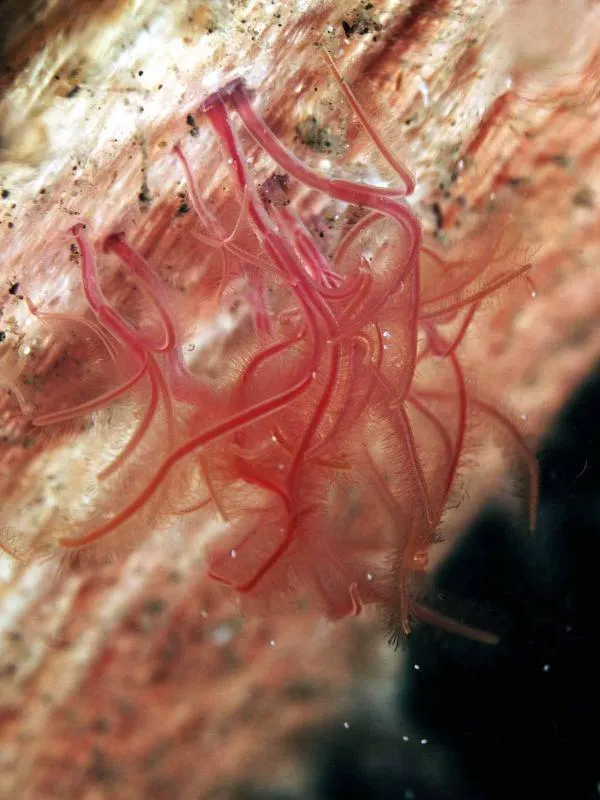
Deep in oceans around the world lurks a type of worm without a mouth, anus or gut that makes its living by eating the bones of whales and other deceased sea creatures. But how does an animal without a mouth penetrate bone? That's just what a group of researchers aimed to find out.
The so-called zombie worms break down bone by excreting acid, according to research just presented at the Society for Experimental Biology's meeting in Salzburg, Austria.
It was previously unclear how the worms did it, since they lack any organs for "drilling," said researcher Sigrid Katz of the Scripps Institution of Oceanography in La Jolla, Calif.
Article continues belowThe researchers found two different types of acid-secreting enzymes in the animal, Katz told OurAmazingPlanet. One of the enzymes, a proton pump, was abundant in the roots, the part of the worm that penetrates the bone.
The animals produce acid using the same basic mechanism as the human cells ? called osteoclasts ? involved in bone resorption, necessary for the continual turnover and reformation of bone.
Symbiotic bacteria allow the worms to digest fats and other materials within bones.
The worm's closest relatives, which also lack guts and mouths, live in deep-sea hydrothermal vents and rely on a different set of bacteria to allow them to survive in these hot and acidic conditions.
Get the world’s most fascinating discoveries delivered straight to your inbox.
The worms, whose official genus name is Osedax, are about 1 inch (3 centimeters) long and were discovered on a whale carcass in 2002. But that's just the females. The males never make it past the larval stage and are about 1/20th of an inch (1 millimeter) long; hundreds of them may live inside a gelatinous tube covering part of the female. The male's sole purpose seems to be fertilizing the female's eggs, Katz said.
Reach Douglas Main at dmain@techmedianetwork.com. Follow him on Twitter @Douglas_Main. Follow OurAmazingPlanet on Twitter @OAPlanet. We're also on Facebook and Google+.
