














Images: Deep-Sea 'Black Smoker' Vents in Action

Hydrothermal vent chimney

This photo-montage shows a deep-sea hydrothermal vent chimney--one of many that were recently discovered by MBARI researchers in the southern Gulf of California. Some of the recently discovered chimneys were over 65 feet (20 meters tall. The "smoke" emanating from this chimney is actually tiny mineral particles that form when the hydrothermal fluids come in contact with near-freezing seawater.
Out of nowhere

This deep-sea hydrothermal vent chimney was one of many recently discovered by MBARI researchers in the southern Gulf of California. Some of the recently discovered chimneys were over 20 meters (65 feet) tall. The "smoke" emanating from this chimney is actually tiny mineral particles that form when the hydrothermal fluids come in contact with near-freezing seawater.
Smoke stack

This deep-sea hydrothermal vent chimney was one of many recently discovered by MBARI researchers in the southern Gulf of California. Some of the recently discovered chimneys were over 20 meters (65 feet) tall. The "smoke" emanating from this chimney is actually tiny mineral particles that form when the hydrothermal fluids come in contact with near-freezing seawater.
Tech Discoveries
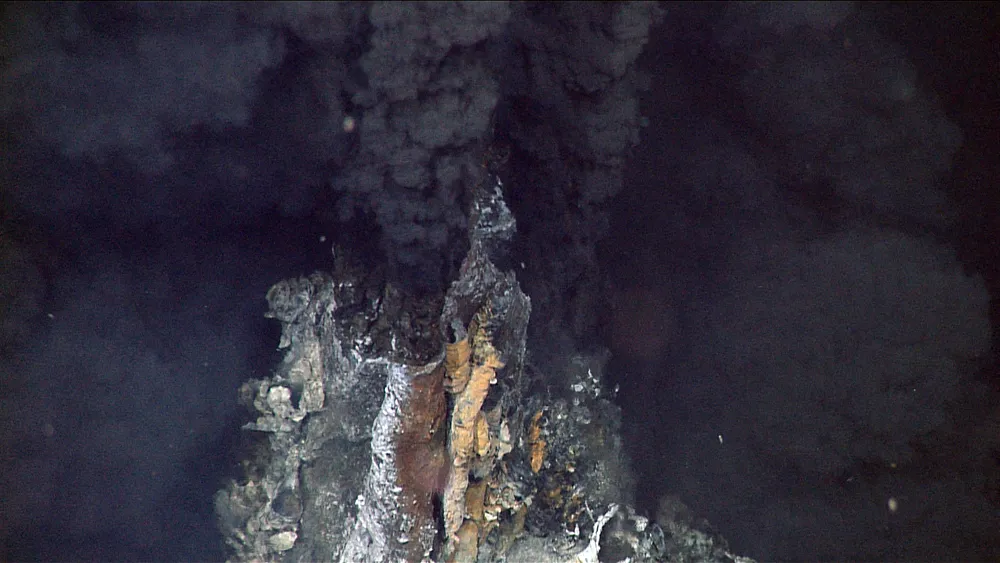
This deep-sea hydrothermal vent was one of many recently discovered by MBARI researchers in the southern Gulf of California using two underwater robots--one (an autonomous underwater vehicle) to map the seafloor and a second (a remotely operated vehicle) to explore the seafloor, take video, and collect samples. The water from some of these vents is at least 300 degrees Celsius (570 degrees Fahrenheit). The "smoke" emanating from this chimney is actually tiny mineral particles that form when the hydrothermal fluids come in contact with near-freezing seawater.
Less than freezing

This deep-sea hydrothermal vent was one of many recently discovered by MBARI researchers in the southern Gulf of California using two underwater robots--one (an autonomous underwater vehicle) to map the seafloor and a second (a remotely operated vehicle) to explore the seafloor, take video, and collect samples. The water from some of these vents is at least 300 degrees Celsius (570 degrees Fahrenheit). The "smoke" emanating from this chimney is actually tiny mineral particles that form when the hydrothermal fluids come in contact with near-freezing seawater.
Doctor in the house

This photo shows the manipulator arm from MBARI's remotely operated vehicle "Doc Ricketts" holding a temperature probe used to measure the temperature of the water from the recently discovered deep-sea hydrothermal vents in the southern Gulf of California. The water from some of these vents is at least 300 degrees Celsius (570 degrees Fahrenheit). The "smoke" emanating from vents is actually tiny mineral particles that form when the hydrothermal fluids come in contact with near-freezing seawater.
Working it

This photo shows the manipulator arm from MBARI's remotely operated vehicle "Doc Ricketts" holding a temperature probe used to measure the temperature of the water from the recently discovered deep-sea hydrothermal vents in the southern Gulf of California. The water from some of these vents is at least 300 degrees Celsius (570 degrees Fahrenheit). The "smoke" emanating from vents is actually tiny mineral particles that form when the hydrothermal fluids come in contact with near-freezing seawater.
Get the world’s most fascinating discoveries delivered straight to your inbox.
Make use of what you have

These large tubeworms were photographed by MBARI researchers at a recently discovered hydrothermal vent field in the southern Gulf of California. These worms grow to over three feet (1 meter) tall, and contain bacteria that help them live off of chemicals flowing out of the hydrothermal vents.
Finding the needle in a haystack

This sonar map allowed researchers to pinpoint the location of the vents, which had remained elusive for nearly a decades.
