
















Male Water Bugs Sprout Hooks and Spikes For Sex Battle

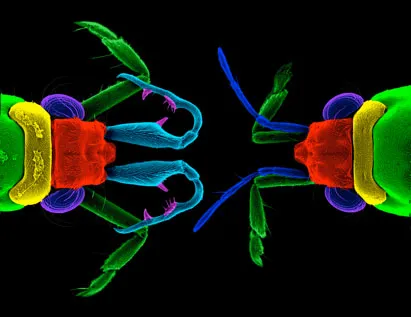
An evolutionary arms race between female and male water bugs leads to strange spikes, hooks and pads on the lad's antennae, a new study finds.
These unusual extras accessories allow the male water striders to grasp resistant females during sex, increasing the likelihood that the males will have offspring. Now, scientists have uncovered the gene responsible for this evolutionary advance, and they've shown that when that gene is quieted, these lanky bugs struggle to mate.
The study essentially turns back the clock on evolution, allowing researchers to see each step in the process of building these antennae.
"If you look at the eye and wonder, 'How did it go from nothing to an eye? It's a highly complex trait. Did it work at every step and just start getting better and better?'" said study researcher Locke Rowe, a professor of ecology and evolutionary biology at the University of Toronto. "Well, you can ask the same thing about these antennae."
Water strider sex
Water striders are the long-limbed pond bugs often seen scooting on the water's surface on their spindly legs. They make good subjects for studying the war between the sexes: Female water striders are able to store up sperm for later fertilization, so it benefits them to only mate once. Males, on the other hand, want to fertilize as many females as possible. So to overcome potential mates' resistance, many male water striders in the genus Rheumatobates have developed specialized appendages to give them an edge in this battle. [Gallery: World's Cutest Bugs]
The subject of the current study, published Thursday (May 3) in the journal Science, was Rheumatobates rileyi. Males of this species hold females during mating with at least four antenna structures: one with a wrenchlike shape formed by the antenna segments; a spike that fits into the groove between the female's head, thorax and eye; a pad that rests under the female's eye; and a hook that can fit either between the head and thorax or between the female's thoracic segments.
Get the world’s most fascinating discoveries delivered straight to your inbox.
Rowe and his colleagues used high-speed video to watch water striders mate to identify these structures. Then they turned to the bug's genome, searching for the genes that might be responsible for building the spikes and hooks.
Genetic advantage
They found their target in a gene called distal-less, already known to play a role in appendage growth in water striders and other insects. By using a technique to "knock out" the gene, the researchers were able to create water striders with varying complexity in their antennae. Some had a mild reduction in spikes, hooks and other appendages, some a moderate reduction and some had no or almost no extra antenna appendages at all.
The bugs with less-pronounced antenna appendages performed consistently worse at mating with females than the normal-type water striders. Each increase in gene activity that led to better-developed antennae structures also led to better mating performance. [See video of the water bugs' battles]
It's worth noting that the ladies are not defenseless in this arms race — in all but 12 percent of occasions, female water striders were able to fight off even normal water striders.
"Even though this male's whole body has been taken over as a grasping device, females are still highly effective at dislodging males," Rowe told LiveScience. That makes the evolutionary selection for good graspers even stronger, he said. If nine out of 10 male water bugs fail to mate, the one that succeeds will be at a huge advantage, and will be more likely to pass on the genes for the specialized antennae that made him successful.
The researchers now plan to delve deeper into the water strider's genome to understand why the distal-less gene affects male, but not female, antennae. They also plan to compare the genetics of different water strider species.
"There's just a remarkable difference in the antennae among species," Rowe said. "We want to understand if this gene is responsible for this diversity."
You can follow LiveScience senior writer Stephanie Pappas on Twitter @sipappas. Follow LiveScience for the latest in science news and discoveries on Twitter @livescience and on Facebook.

Stephanie Pappas is a contributing writer for Live Science, covering topics ranging from geoscience to archaeology to the human brain and behavior. She was previously a senior writer for Live Science but is now a freelancer based in Denver, Colorado, and regularly contributes to Scientific American and The Monitor, the monthly magazine of the American Psychological Association. Stephanie received a bachelor's degree in psychology from the University of South Carolina and a graduate certificate in science communication from the University of California, Santa Cruz.