













Rain Quicker to Arrive and Dry Up During Global Warming

Global warming is revving up the planet's cycle of evaporation and precipitation, making wet places even wetter and dry places dryer, a new study suggests.
A team of researchers found the intensity of the water cycle increased roughly 4 percent over the last half of the 20th century by examining changes in the ocean's salt content.
This means more movement of water between the locations where it's stored, such as the atmosphere, oceans and lakes. Their results indicate that as a result, salty places are becoming saltier due to more evaporation, while fresh places are becoming fresher due to more precipitation.
A warming world
During the study period, from 1950 to 2000, global surface temperatures rose 0.9 degrees F (0.5 degrees Celsius).
"There are all of these independent lines of evidence that climate is actually changing. What this result provides us with is another piece of the puzzle," said study researcher Paul Durack, a postdoctoral researcher at Lawrence Livermore National Laboratory.
Not only was the shift in the water cycle observable — with spatial patterns of evaporation and rainfall intensifying over the world's oceans — but the observations agreed with theoretical expectations for how climate change would affect the water cycle, he said. [The World's Weirdest Weather]
Get the world’s most fascinating discoveries delivered straight to your inbox.
An ocean gauge
When looking at how water cycles through the environment — falling as rain or snow, then evaporating, then eventually cycling back as precipitation — it makes sense to look at the oceans. They occupy 71 percent of the planet's surface, and an even larger share of evaporation and precipitation takes place over them.
"The oceans are where all of the action is happening," Durack said.
The ocean surface's salinity, or salt content, increases with evaporation and decreases when more rain falls into the water, serving as a sort of gauge for large-scale patterns. These changes don't last forever; over long periods, ocean circulation driven by winds and large-scale currents redistributes the salt.
For more than a century, scientists have been recording ocean salinity, which is measured by looking at water's ability to conduct electricity. Since salt is composed of charged atoms, called ions, its presence enhances electrical conductance.
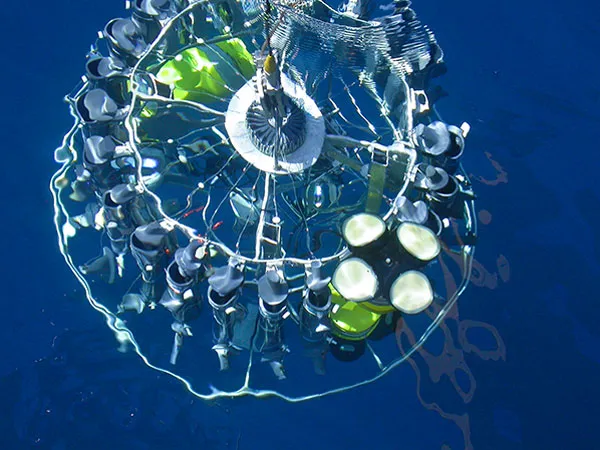
In the last decade, a network of floating sensors, called Argo, that collect data from different depths has greatly increased the information available to scientists. Research ships also continue to contribute measurements, according to Durack.
Computer models that make climate-change projections produce more conservative estimates of shifts in the water cycle than those observed, but the models appear to be correctly capturing the nature of the changes, Durack said.
A question of scale
The team's analysis reveals changes over a large geographic scale over the oceans; they expect to see similar changes over the continents. On a smaller scale, however, these changes are expected to become much more complex.
"What is the more interesting question is how regionally those changes will happen," Durack said. "No one actually experiences global mean rainfall; what we experience is our own regional change in rainfall."
The research conducted by scientists at Australia's Commonwealth Scientific and Industrial Research Organisation and Lawrence Livermore National Laboratory in California appears in the April 27 issue of the journal Science.
You can follow LiveScience senior writer Wynne Parry on Twitter @Wynne_Parry. Follow LiveScience for the latest in science news and discoveries on Twitter @livescience and on Facebook.
