
-
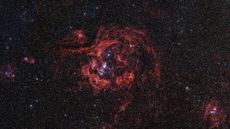 The Andromeda Galaxy glows rosy red in gorgeous new Hubble Telescope image
The Andromeda Galaxy, the Milky Way's closest galactic neighbor, glows brightly in a new Hubble Space Telescope image with swathes of ionized gas that fuel star formation.
astronomy -
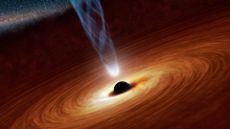 The James Webb telescope found hundreds of 'little red dots' in the ancient universe. We still don't know what they are.
These small galaxies are either crammed with stars or they host gigantic black holes. The data astronomers have collected continues to puzzle them.
astronomy -
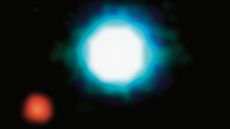 Space photo of the week: The 1st image of an alien planet
The Very Large Telescope in northern Chile imaged a "super-Jupiter" exoplanet called 2M1207b, precisely 20 years ago this week. This was the first direct visual confirmation of a world beyond our solar system.
exoplanets -
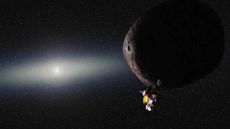 Scientists confirm that most of the universe is 'darkness and nothing more'
Finding the universe's brightness is essential for confirming our theories of what makes up the universe. But to do so, scientists had to send a spacecraft far away from our sun.
space-exploration -
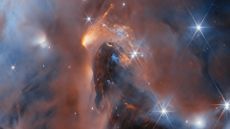 James Webb telescope spots 6 enormous 'rogue planets' tumbling through space without a star
The James Webb Space Telescope has uncovered six "rogue planets" careening through space without a star. The objects are believed to have formed directly from gas collapse, blurring the lines between planets and stars.
astronomy -
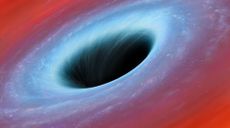 Watch a star get destroyed by a supermassive black hole in the 1st simulation of its kind
Stars that wander too close to supermassive black holes may be violently undone in a process called "spaghettification." New simulations provide the most detailed look ever at the gory interaction.
black-holes -
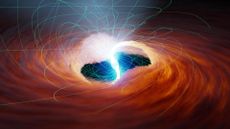 Dead stars sometimes shine again — and gravity itself may be responsible
Do dead stars glow? A strange gravitational phenomenon could be generating enormous amounts of light around neutron stars, new research suggests.
cosmology -
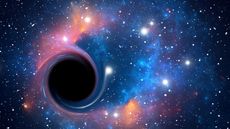 Milky Way's rarest black hole may lurk behind 7 stars that 'shouldn't be there'
Seven strangely-behaving stars in the Milky Way's Omega Centauri cluster may be under the influence of an extremely rare type of black hole, new research suggests.
black-holes -
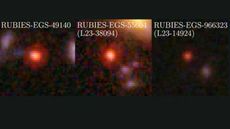 Forbidden black holes and ancient stars hide in these 'tiny red dots'
The James Webb Space Telescope found "tiny red dots" in the early universe representing overgrown supermassive black holes and stars that are impossibly old for the infant cosmos.
black-holes


