














The unexpected behavior of pulsing stars could help us measure the universe
New research offers the most precise measurements yet of pulsating Cepheid stars, which could reveal new clues about the immense size and scale of our universe.
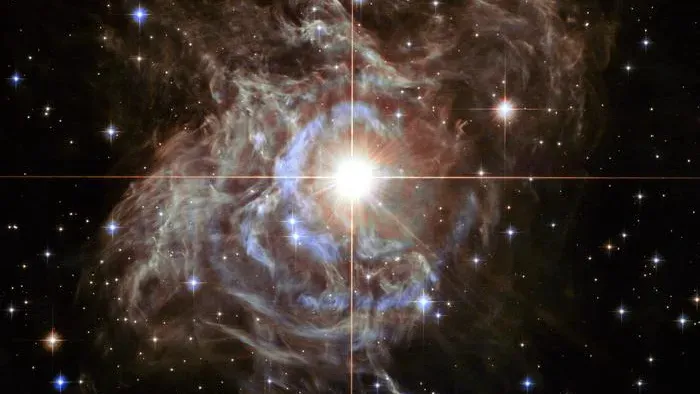
New research offers the most precise measurements yet of pulsating Cepheid stars, which may hold clues about the immense size and scale of our universe.
Cepheids are a type of variable star that brighten and dim within a short period of time, exhibiting specific luminosity patterns. However, while this rhythmic behavior allows astronomers to calculate distances across space based on changes, or pulses, in the stars' brightnesses, it can also make the stars challenging to observe in general.
Using advanced spectrography observations collected between 2010 and 2022 from the Swiss Euler telescope in Chile and the Flemish Mercator telescope on La Palma in Spain, researchers with the Velocities of Cepheids (VELOCE) project studied hundreds of Cepheids with great precision and consistency.
"Understanding the nature and physics of Cepheids is important because they tell us about how stars evolve in general, and because we rely on them for determining distances and the expansion rate of the Universe," Richard I. Anderson, an astrophysicist and lead author of the study from the Swiss Federal Institute of Technology Lausanne (EPFL), said in a statement announcing the new study.
The high-resolution spectrographs on both telescopes allowed astronomers to separate and measure wavelengths of starlight and capture shifts in brightness. Then, referring to the Doppler effect, the team measured the speed at which the stars expand and contract along the telescopes' line of sight, known as radial velocity.
The pulsations lead to changes in the line-of-sight velocity of up to 70 kilometers per second, or about 250,000 kilometers per hour (43 miles per second, or 155,344 miles per hour), Giordano Viviani, a Ph.D. student at the EPFL and co-author of the study explained in the statement. "We have measured these variations with a typical precision of 130 km/h (37 m/s), and in some cases as good as 7 km/h (2 m/s), which is roughly the speed of a fast walking human," Viviani said.
Get the world’s most fascinating discoveries delivered straight to your inbox.
The VELOCE team collected more than 18,000 high-precision radial velocity measurements of 258 Cepheids, revealing additional, unexpected variations in the stars' pulsations, as well as a number of Cepheid stars belonging to a binary system in which two stars orbit each other.
"This suggests that there are more intricate processes occurring within these stars, such as interactions between different layers of the star, or additional (non-radial) pulsation signals that may present an opportunity to determine the structure of Cepheid stars by asteroseismology," Henryka Netzel, a postdoctoral researcher at the EPFL and coauthor of the study, said in the statement.
RELATED STORIES
Thus, this new data will help astronomers untangle the complexities of observing pulsating Cepheids and understand whether the changes observed in the stars' brightness are a result of their individual structure or caused by potential interactions with companion stars, who occasionally eclipse the light of their stellar partners.
"This dataset will serve as an anchor to link Cepheid observations from different telescopes across time and hopefully inspire further study by the community," Anderson said in the statement.
Their findings were published in this year's June issue of the journal Astronomy & Astrophysics.
Originally posted on Space.com.