
-
 A 'new star' has exploded into the night sky — and you can see it from North America
The never-before-seen "nova," dubbed V462 Lupi, recently appeared in the constellation Lupus, after suddenly becoming 4 million times brighter. The shining explosion is visible to the naked eye and can be seen from parts of North America.
3 Commentsastronomy -
 'Strange' star pulses detected in search for extraterrestrial intelligence
A retired researcher has detected an unusual pulse in the light of nearby stars while looking for signs of extraterrestrial intelligence. Aliens are one possible explanation for the strange signal, but as with every other unexplained space phenomenon, it's probably not aliens.
extraterrestrial-life -
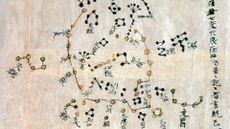 World's oldest star chart may be 2,300 years old and from China — but not everyone agrees
Is the Star Manual of Master Shi the oldest known astronomical catalog? Experts are divided.
archaeology -
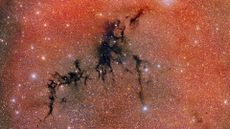 Scientists spot 'dark nebula' being torn apart by rowdy infant stars
The National Science Foundation's Dark Energy Camera reveals a stunning glimpse into the 'dark nebula' known as the Circinus West molecular cloud, a region of space that's so dense with gas that light can't escape it.
2 Commentsastronomy -
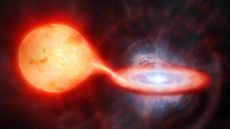 Weird repeating nova explosion is one of the hottest blasts ever seen
Researchers conducted the first-ever near-infrared analysis of an extragalactic recurrent nova and found it is one of the hottest nova explosions ever discovered.
5 Commentsastronomy -
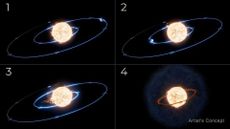 The James Webb telescope reveals the truth about a planet that crashed into its own star
Scientists thought they saw a distant star swallow a planet for the first time ever. But new observations from the James Webb Space Telescope suggest something very different, but equally rare, may have happened instead.
astronomy -
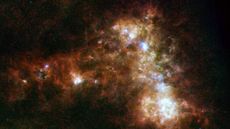 Astronomers are shocked to find our galaxy's nearest neighbor is being torn to shreds
An analysis of star movements from the Gaia spacecraft reveals that the Small Magellanic Cloud — a satellite galaxy bound to the Milky Way — is being torn apart by its larger neighbor.
astronomy -
 Gaia telescope retires: Scientists bid farewell to 'the discovery machine of the decade' that mapped 2 billion Milky Way stars
After 11 years mapping the Milky Way, the European Space Agency's Gaia space telescope has retired. Scientists hailed it as "the discovery machine of the decade."
astronomy -
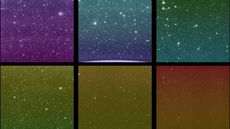 NASA's SPHEREx telescope 'opens its eyes on the universe', taking stunning debut image of 100,000 galaxies and stars
SPHEREx's first images — containing roughly 100,000 points of light stars, galaxies and nebulae — have confirmed that the telescope is working according to its design.
space-exploration


