
-
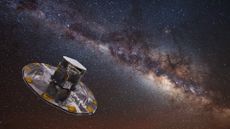 Gaia telescope retires: Scientists bid farewell to 'the discovery machine of the decade' that mapped 2 billion Milky Way stars
After 11 years mapping the Milky Way, the European Space Agency's Gaia space telescope has retired. Scientists hailed it as "the discovery machine of the decade."
astronomy -
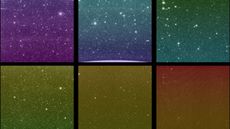 NASA's SPHEREx telescope 'opens its eyes on the universe', taking stunning debut image of 100,000 galaxies and stars
SPHEREx's first images — containing roughly 100,000 points of light stars, galaxies and nebulae — have confirmed that the telescope is working according to its design.
space-exploration -
 Space photo of the week: Hubble zooms in on the glittering galaxy next door
The Small Magellanic Cloud, a dwarf galaxy about 200,000 light-years from the solar system, can be seen with the naked eye from the Southern Hemisphere.
astronomy -
 Vernal equinox: How to see spring begin, just by looking at the stars
You can tell spring has officially begun in the Northern Hemisphere just by looking at the stars. Here's how to easily spot the Spring Triangle without a telescope.
space -
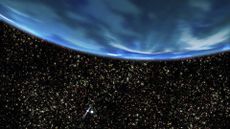 The universe's water is billions of years older than scientists thought — and may be nearly as old as the Big Bang itself
A new study suggests that water first appeared in the universe just a couple hundred million years after the Big Bang — meaning life could have evolved billions of years earlier than previously thought.
12 Commentscosmology -
 Space photo of the week: Hubble hunts a stellar 'imposter' hiding in the Great Bear
The legendary Hubble Space Telescope has turned its gaze to the Ursa Major-adjacent galaxy UGC 5460, revealing spiral arms, star clusters and a possible supernova "imposter".
astronomy -
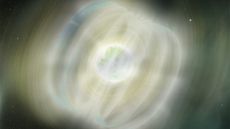 Fast radio burst traced to the outskirts of an ancient 'graveyard' galaxy — and the cause remains a mystery
Scientists have traced a repeating fast radio burst (FRB) to the edge of an ancient galaxy where star formation has drastically dropped. Researchers are struggling to explain what caused it.
astronomy -
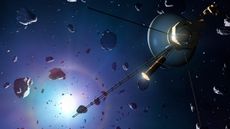 NASA supercomputer reveals strange spiral structure at the edge of our solar system
The mysterious Oort cloud is the source of many of our solar system's comets, but astronomers still have no idea what it looks like. Now, new simulations may have given them a first glimpse.
29 Commentsspace -
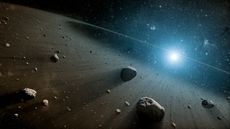 1 million 'interstellar objects' — each larger than the Statue of Liberty — may lurk in the outer solar system
New simulations reveal that around 1 million "macroscopic" objects from our closest stellar neighbors, the Alpha Centauri system, may already reside in the Oort Cloud, far from sight.
7 Commentsastronomy


