
-
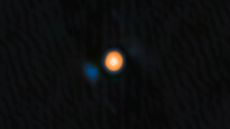 Scientists find best evidence that Betelgeuse has a secret companion star
Astronomers have used a novel technique to find evidence of a secret "buddy" star orbiting Betelgeuse, one of the brightest objects in the night sky — but this sun-size companion may not survive for long.
astronomy -
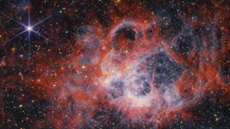 James Webb telescope reveals 'Sleeping Beauty' galaxies in the early universe — snoozing where they weren't supposed to exist
Using data from the James Webb Space Telescope, astronomers have discovered dormant galaxies with a wide range of masses in the first billion years after the Big Bang, moving one step closer to understanding how early galaxies grow.
astronomy -
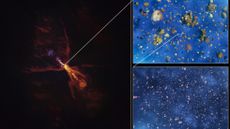 Astronomers spot alien planet system being born before their eyes
Astronomers spotted a baby star displaying the very first signs of planet formation in the zone surrounding it, similar to how our own solar system was born.
astronomy -
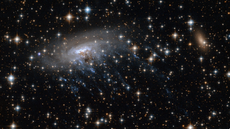 James Webb telescope discovers tentacled 'jellyfish' galaxy swimming through deep space
A possible new "jellyfish" galaxy discovered by the James Webb Space Telescope could deepen our understanding of galaxy evolution and star formation.
2 Commentsastronomy -
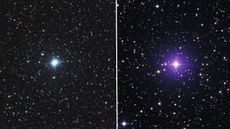 2 'new stars' have exploded into the night sky at once — potentially for the first time in history
Astronomers have spotted another never-before-seen "nova" blaze to life in the night sky. This may be the first time that simultaneous stellar explosions have been visible to the naked eye in recorded history.
2 Commentsastronomy -
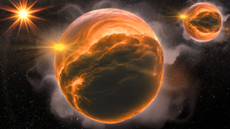 Astronomers discover origins of mysterious double hot Jupiter exoplanets: 'It is a dance of sorts'
Astronomers have discovered the strange dance that leads to the creation of rare "double hot Jupiters" in binary star systems that are "just right."
-
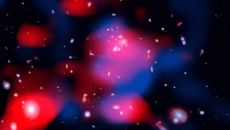 Farthest 'mini-halo' ever detected could improve our understanding of the early universe
Scientists have discovered the farthest-ever 'mini-halo,' a sea of charged particles around a distant galaxy cluster that could reveal unexpected insights about the ancient universe.
astronomy -
 Where do atoms come from? A physicist explains.
Almost everything on Earth is made up of atoms, but where do these fundamental building blocks come from?
4 Commentsphysics-mathematics -
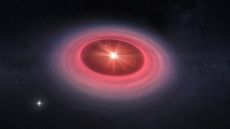 Alcohol-soaked star system could help explain 'why life, including us, was able to form'
The Atacama Large Millimeter/submillimeter Array has detected methanol isotopes around a nearby star, which could help explain why the ingredients for life are present on Earth.
6 Commentsexoplanets


