Get the world’s most fascinating discoveries delivered straight to your inbox.
You are now subscribed
Your newsletter sign-up was successful
Want to add more newsletters?
Join the club
Get full access to premium articles, exclusive features and a growing list of member rewards.
An account already exists for this email address, please log in.
Accidental discovery of 1st-ever 'black hole triple' system challenges what we know about how singularities form
Researchers spotted a second distant star orbiting a well-known black hole and its stellar companion in a never-before-seen gravitational triad. The system's unique configuration suggests that the black hole was not created as scientists initially expected.
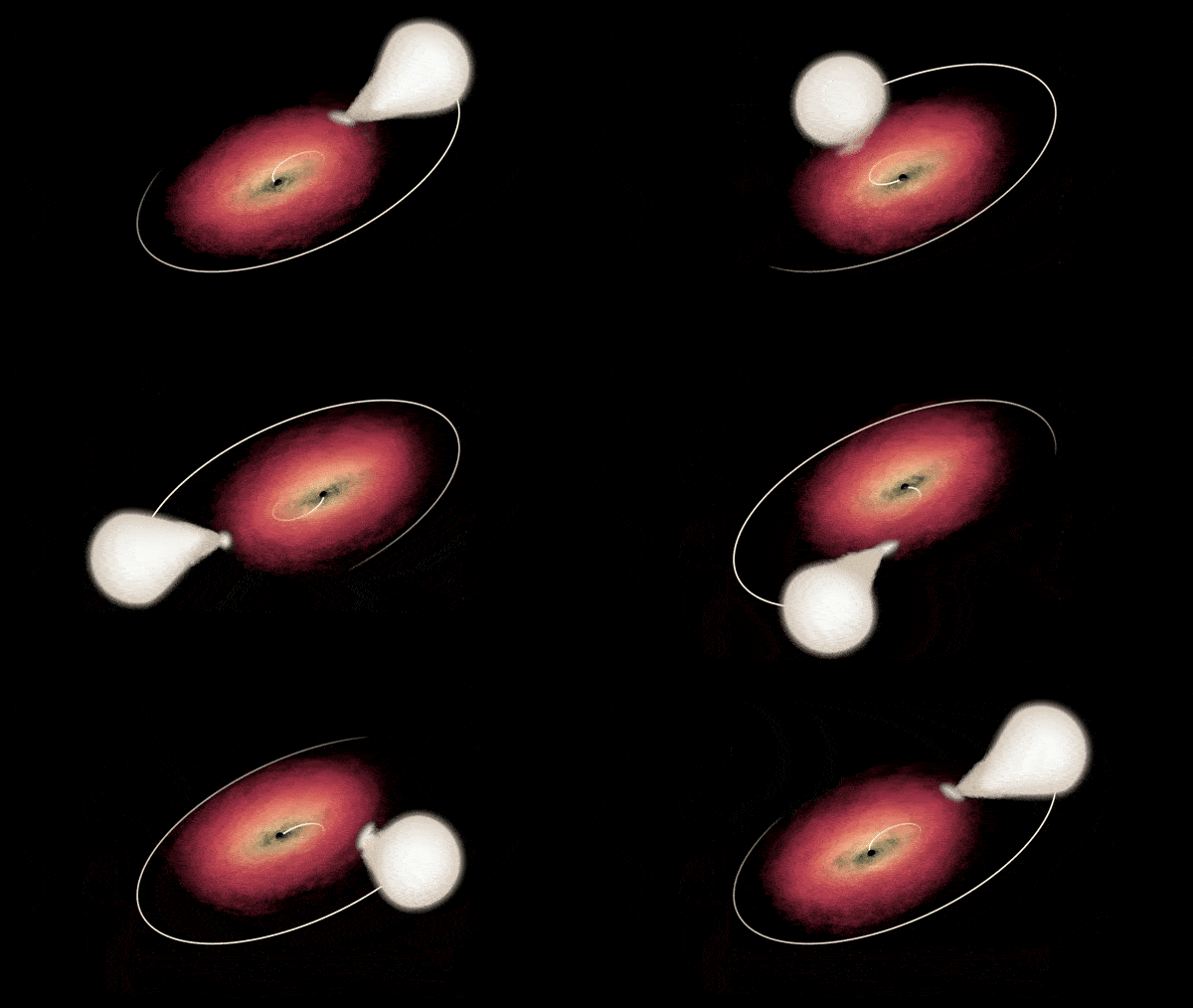
Researchers spotted a new star orbiting far around the black hole V404 Cygni and its nearby stellar companion. This configuration suggests the black hole was not birthed by a supernova.
Astronomers have accidentally discovered the first-known "black hole triple" system, containing a dark void orbited by two stars. The unique configuration of this triad hints that the black hole was not born via a supernova, which blows away what we thought we knew about how these cosmic entities form.
Until now, most discovered black holes — excluding the supermassive variety at the center of most galaxies — exist in binary systems, in which they are orbited by another large object, such as a star, neutron star or a smaller black hole. This is because the invisible space-time voids are easier to spot when they are gravitationally tugging on other objects.
But in a new study, published Wednesday (Oct. 23) in the journal Nature, researchers discovered that one of these known binary systems, which contains the black hole V404 Cygni feasting on a nearby star, actually has a second star circling the pair at a much greater distance.
Gravitational calculations show that the newfound star could not have remained in this delicate system if the black hole was birthed by an exploding star, or supernova, as most other black holes are believed to form. If it had, the distant star would have been blown out of the system by the resulting shockwave. Instead, the team suggests that the black hole formed via the gradual collapse of a massive third star that was once orbited by the other two stars.
This possibility is "super exciting for black hole evolution," study lead author Kevin Burdge, an astrophysicist at MIT, said in a statement. "We think most black holes form from violent explosions of stars, but this discovery helps call that into question," Burdge added.
The black hole in the newly realized triad, V404 Cygni, is about nine times more massive than the sun and located in the Milky Way around 8,000 light-years from Earth. It was one of the first black holes ever discovered when it was spotted in 1992 and has been studied extensively since. Scientists have also long known about its nearby star, which circles the black hole every 6.5 days and is slowly being devoured by its massive partner.
Sign up for the Live Science daily newsletter now
Get the world’s most fascinating discoveries delivered straight to your inbox.
As a result, the study authors were shocked when they reexamined images of V404 Cygni, as part of a wider survey of the Milky Way's black holes, and spotted the second star circling the black hole at a distance of around 3,500 astronomical units — or around 90 times farther away than Pluto orbits the sun. At this distance, it likely takes the newfound star more than 70,000 years to orbit V404 Cygni.
The team then compared the movements of the two stars over the last decade and found that they "moved exactly in tandem," proving that they were gravitationally bound to one another as well as to V404 Cygni. Researchers say the odds that the stars moved in this way without being linked are around 1 in 10 million.
"It's almost certainly not a coincidence or accident," Burdge said. "We're seeing two stars that are following each other because they're attached by this weak string of gravity. So this has to be a triple system."
Scientists have known about V404 Cygni for more than three decades. This 2015 X-ray image shows echoes of light coming off the cosmic entity after a recent outburst.
(Image credit: Andrew Beardmore/University of Leicester/NASA/Swift)
This is not the first time that researchers thought they had found a black hole triple. In 2020, researchers spotted what they believed to be a black hole being orbited by two stars around 1,000 light-years from Earth, which would have made it the closest black hole to us. However, subsequent observations revealed that this system was actually a binary system containing a "vampire star" instead — that is, a star that slowly steals gas from a smaller partner star.
If V404 Cygni formed through gradual collapse, as the researchers suspect, then the team believes the peculiar black hole was birthed at some point in the last 4 billion years, after the two stars were born.
Over the last few years, researchers have begun to suspect that gradual collapse could be a more common origin for black holes than previously realized. And in March, researchers proposed this mechanism could be behind the disappearance of "vanishing stars" that astronomers have recently lost track of. The new findings suggest that this could be the case.
Harry is a U.K.-based senior staff writer at Live Science. He studied marine biology at the University of Exeter before training to become a journalist. He covers a wide range of topics including space exploration, planetary science, space weather, climate change, animal behavior and paleontology. His recent work on the solar maximum won "best space submission" at the 2024 Aerospace Media Awards and was shortlisted in the "top scoop" category at the NCTJ Awards for Excellence in 2023. He also writes Live Science's weekly Earth from space series.