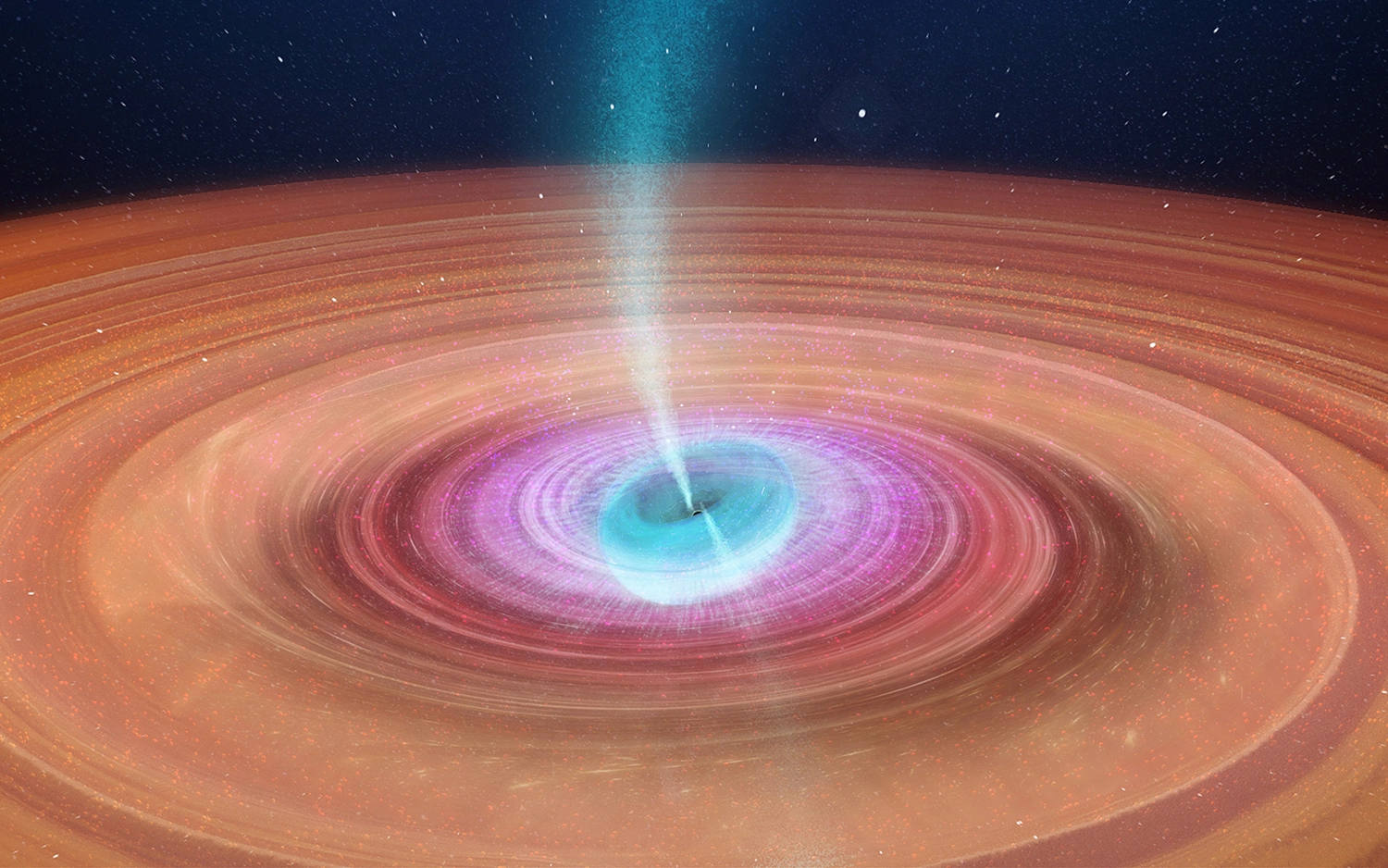
Artist's impression of the accretion disk around the black hole. During a powerful outburst in 2015, intense radiation caused the inner few thousand kilometers of the accretion disk to "puff up" into a doughnut-shaped structure.
A black hole nearly 8,000 light-years from Earth and nine times the mass of our sun was recently caught in the act of slurping up a neighboring star. During this stellar feast, the object showed astronomers something that had never been seen before in black holes.
While siphoning gas from the star into an orbiting cloud called an accretion disk, the black hole spat high-speed jets of plasma in all directions; however, feeding black holes typically expel orderly plasma jets in just one direction, scientists reported in a new study.
What's more, the jets were changing direction rapidly, "on a time scale of minutes to hours," the scientists wrote in their study, published online today (April 29) in the journal Nature. They found that the center of the black hole's accretion disk had inflated like a doughnut and was tilted on its side, spinning off-kilter. And as it rotated, the disk dragged the jets around with it, according to the study. [Stephen Hawking's Most Far-Out Ideas About Black Holes]
"This is one of the most extraordinary black hole systems I've ever come across," lead study author James Miller-Jones, an associate professor at Curtin University in Australia, said in a statement. The study was conducted at Australia's International Centre for Radio Astronomy Research (ICRAR).
Scientists discovered this black hole and its companion star after an explosive release of radiation in 1989, Miller-Jones and his colleagues said. Located in the Cygnus constellation about 7,800 light-years from Earth, the cosmic pair was dubbed V404 Cygni.
Then, in 2015, V404 Cygni began spewing radiation in a massive outburst that lasted two weeks. This offered astronomers around the world the opportunity to capture "amazing observational coverage," Miller-Jones said in the statement.
Artist's impression of V404 Cygni seen close up. The binary star system consists of a normal star in orbit with a black hole. Material from the star falls toward the black hole and spirals inward in an accretion disk, with powerful jets launched from the inner regions close to the black hole.
(Image credit: ICRAR)
For the new study, the researchers examined data gathered by the Very Long Baseline Array, a network of 10 radio telescope dishes extending thousands of miles from Hawaii to the U.S. Virgin Islands. Radio telescopes typically generate one image from several hours of observations, but the jets expelled from V404 were changing so quickly that a 4-hour exposure showed only a blur, said study co-author Alex Tetarenko, an astrophysics postdoctoral fellow at the East Asian Observatory in Hilo, Hawai.
Sign up for the Live Science daily newsletter now
Get the world’s most fascinating discoveries delivered straight to your inbox.
To correct that blur, astronomers captured 103 images that were each exposed for around 70 seconds. This revealed that the innermost portion of the accretion disk, which measures over 6 million miles (10 million kilometers) across, was puffed up by intense radiation that had been generated by the black hole's rapid feeding.
As for what tipped that puffy region over at an angle, the researchers think the black hole may have received a "kick" from its companion star's supernova explosion. When the doughnut spun, its orientation changed, and the black hole's powerful gravity yanked the jets along for the ride, sending them flying outward in all directions.
This discovery provides new insights into accretion disks and the associated plasma jets produced when black holes devour stars, study co-author Gemma Anderson, a research fellow at Curtin University's ICRAR group, said in the statement. Other types of extreme cosmic episodes could also upset the balance of an accretion disk's spin; those could include "supermassive black holes feeding very quickly or tidal disruption events, when a black hole shreds a star," Anderson said.
Mindy Weisberger is a science journalist and author of "Rise of the Zombie Bugs: The Surprising Science of Parasitic Mind-Control" (Hopkins Press). She formerly edited for Scholastic and was a channel editor and senior writer for Live Science. She has reported on general science, covering climate change, paleontology, biology and space. Mindy studied film at Columbia University; prior to LS, she produced, wrote and directed media for the American Museum of Natural History in NYC. Her videos about dinosaurs, astrophysics, biodiversity and evolution appear in museums and science centers worldwide, earning awards such as the CINE Golden Eagle and the Communicator Award of Excellence. Her writing has also appeared in Scientific American, The Washington Post, How It Works Magazine and CNN.