














Giant black hole inside a tiny satellite galaxy defies explanation
"There is no explanation for this kind of black hole in dwarf spheroidal galaxies."

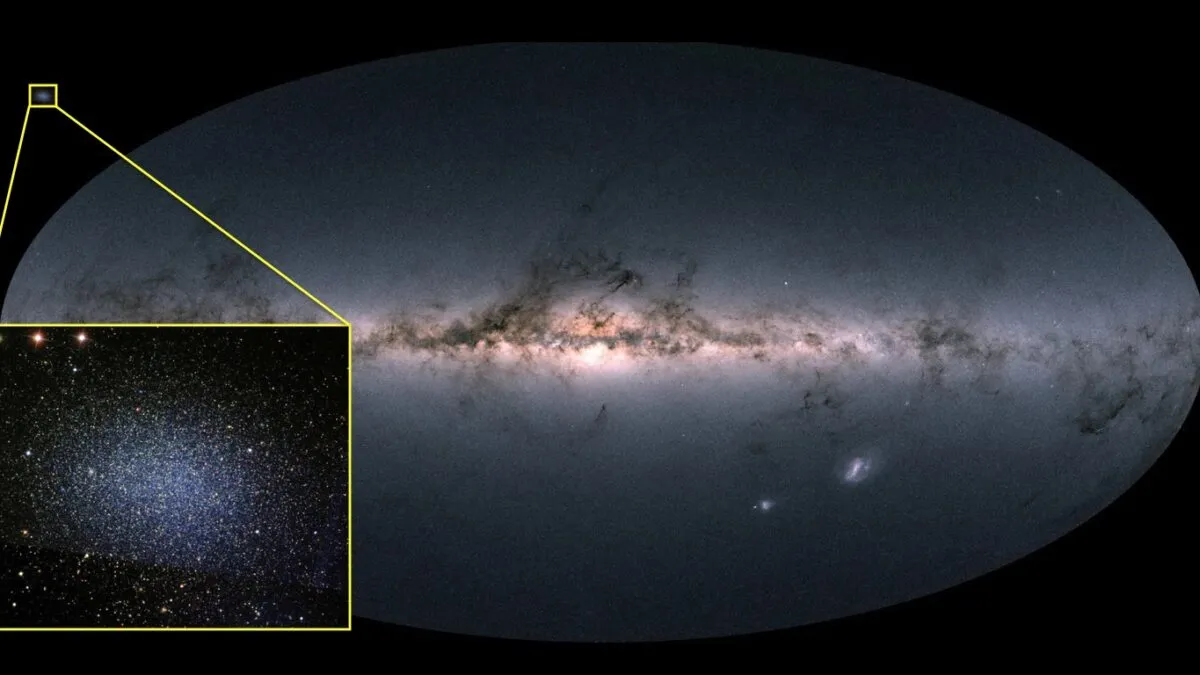
A tiny galaxy orbiting at the outskirts of the Milky Way appears to have a giant black hole at its center, comparable to that of the much larger Milky Way itself, and scientists don't know why.
The Leo I dwarf galaxy, some 820,000 light-years from Earth, is only about 2,000 light-years across. Until now, astronomers thought the galaxy's mass was about 15 to 30 million times the mass of our sun. That's tiny compared to the Milky Way, which is estimated to weigh as much as 1.5 trillion suns and whose disk is over 100,000 light-years wide.
Unexpectedly, at the heart of the little Leo I sits a black hole that is nearly as large as the one at the heart of the entire Milky Way, a new study found. The discovery defies expectations as astronomers believed giant black holes grow from collisions between galaxies and should correspond with the galaxy's size.
Related: 8 ways we know that black holes really do exist
"There is no explanation for this kind of black hole in dwarf spheroidal galaxies," María José Bustamante, an astronomy doctoral graduate at the University of Texas, Austin and lead author of the new paper, said in a statement.
The discovery came rather by chance. The scientists originally set out to measure the amount of dark matter in Leo I using the Virus-W instrument on the University of Texas' McDonald Observatory's 2.7-meter Harlan Telescope. Virus-W measures the motion of stars in small galaxies around the Milky Way and infers the amount of dark matter in those galaxies from those motion. Dark matter is the mysterious invisible stuff that counteracts the force of gravity. Scientists can measure its concentrations in the universe based on its effects on orbits and velocities of nearby stars. The more dark matter in the star's orbit, the faster it travels.
When the team ran data gathered in the observations through their computer models, they found that Leo I appears to have basically no dark matter but a black hole at its center as heavy as 3 million suns. (The Sagittarius A* black hole at the center of the Milky Way is only 25% larger.)
Get the world’s most fascinating discoveries delivered straight to your inbox.
"You have a very small galaxy that is falling into the Milky Way, and its black hole is about as massive as the Milky Way's," Karl Gebhardt, an astrophysicist at the University of Texas, Austin, and a co-author of the new study, said in the statement. "The mass ratio is absolutely huge."
The results differ from previous calculations of dark matter in the Leo I galaxy, the astronomers admitted in the statement. The previous studies, they said, were based on less precise data and didn't have access to such powerful supercomputers as the Austin team.
Related content:
In previous studies, scientists didn't see the denser inner regions of the galaxy and mostly focused on accessible information about a few individual stars. These data sets, however, seemed to contain a disproportionate number of slow stars. Calculations based on these biased dataset then failed to reveal the dark matter in the inner regions. In the case of Leo I, the amount of dark matter in the previously unseen central regions appears much higher than that at the fringes.
The study was published on Dec. 1 in The Astrophysical Journal.
Follow Tereza Pultarova on Twitter @TerezaPultarova. Follow us on Twitter @Spacedotcom and on Facebook.
