
















'Vanishing' stars may be turning into black holes without going supernova, new study hints
Stars that vanish from the sky may be collapsing directly into black holes without going supernova first, a new study of a bizarre binary star system suggests.
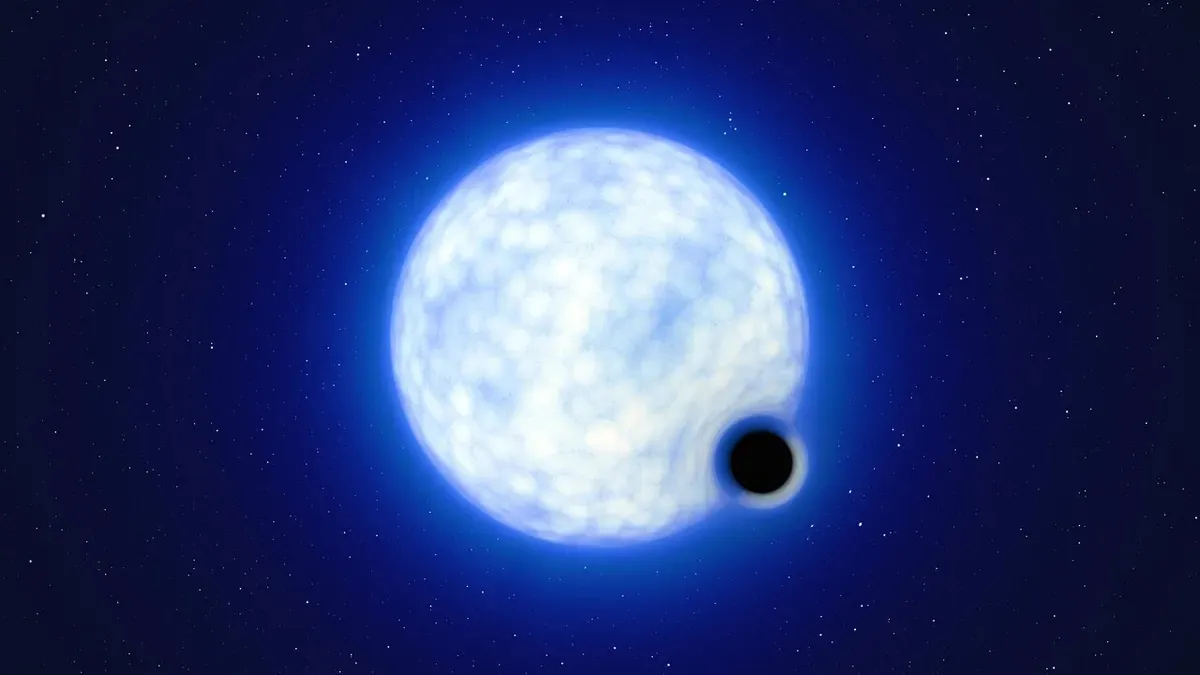
Scientists have discovered strong evidence that some massive stars end their existence with a whimper, not a bang, and sink into a black hole of their own making without the light and fury of a supernova.
To understand why this is important, we must begin with a crash course on stellar evolution. Stars generate energy through nuclear fusion processes in their cores by which they turn hydrogen into helium. When stars with at least eight times the mass of our sun run out of that hydrogen supply, they start fusion reactions involving other elements instead — helium, carbon, oxygen, and so on, until they end up with an inert core of iron that requires more energy be put into the fusion reaction than what it can produce. At this stage, the fusion reactions cease, and the production of energy that holds the star up evaporates. Suddenly, gravity has free reign and causes the core to collapse, while the outer layers of the star rebound off the contracting core and explode outwards — sparking a supernova that, for a few weeks, can sometimes shine brighter than an entire galaxy.
Meanwhile, the collapsing core forms a compact object. This object is often a spinning neutron star called a pulsar — but, under certain conditions, it could be a stellar-mass black hole. This is the standard story of stellar timelines. However, astronomers are now beginning to come around to the idea that some stars that produce black holes may do so without a supernova explosion.
Related: James Webb telescope sees 'birth' of 3 of the universe's earliest galaxies in world-1st observations
Researchers have occasionally noticed occurrences of failed supernovas — stars that begin to brighten as though they are about to explode, but which then falter and die away. Elsewhere, studies of old photographic plates as part of the Vanishing And Appearing Objects During a Century of Observations (VASCO) project, led by Beatriz Villarroel, have found dozens of stars on those old plates that simply aren't seen anymore; it's like they have vanished without a trace.
Could these failed supernovas and vanishing stars be evidence for stars being almost entirely pulled into the black hole they form before they get a chance to explode? Well, maybe, some scientists believe.
"Were one to stand gazing up at a visible star going through a total collapse, it might, just at the right time, be like watching a star suddenly extinguish and disappear from the heavens," said Alejandro Vigna-Gómez of the Max Planck Institute for Astrophysics in Germany in a statement. "Astronomers have actually observed the sudden disappearance of brightly shining stars in recent times."
Get the world’s most fascinating discoveries delivered straight to your inbox.
Though the idea is still just a theory, it now has strong supporting evidence in the form of a strange binary system studied by Vigna-Gómez and his team. Designated VFTS 243, the system was discovered in 2022 and resides in the Tarantula Nebula, which is located in the Large Magellanic Cloud; it contains a 25-solar-mass star and a 10-solar-mass black hole that must have been produced by a massive star that reached the end of its life relatively recently, in cosmic terms.
"VFTS 243 is an extraordinary system," said Vigna-Gómez. "Despite the fact that VFTS 243 contains a star that has collapsed into a black hole, the traces of an explosion are nowhere to be found."
For example, the orbits of the star and the black hole in VFTS 243, around their common center of mass, are still nearly circular. However, supernova explosions are asymmetric, with a little more energy produced in one direction than in the other, which should give the compact object that forms a "natal kick." Such a kick would accelerate the compact object, causing its orbit to widen and become more elongated. Typically, this kick is between 30 and 100 kilometers (19 and 62 miles) per second, yet the black hole in VFTS 243 has, at the most, been kicked by just four kilometers (2.5 miles) per second.
The consequences of natal kicks have been observed before in pulsars, but never before in stellar-mass black holes. It is very possible that this is telling us something about how stellar-mass black holes are formed, and VFTS 243 is the clearest look yet at the results of this process.
Natal kicks are the product of three things: the ejection of debris from the exploding star, a burst of neutrinos from the star's collapsing core, and gravitational waves. However, if there was no supernova, there would be no debris, leaving only the neutrinos and the gravitational waves to provide a much smaller kick — which is exactly what we see in VFTS 243.
If this is correct, then it means that many of the most massive stars in the universe, which shine so very brightly, end their lives in silent darkness as they are pulled into the oblivion of a black hole. This could also be the ultimate fate of the surviving star in VFTS 243 when it reaches the end of its life.
RELATED STORIES
There are also wider repercussions. A supernova explosion is an element factory. Not only are elements such as oxygen, carbon and nitrogen in a dying star's outer layers blasted into space where they can be recycled into the next generation of stars and planets, the intense heat and energy of the supernova shockwave can result in the formation of even heavier elements in supernova debris. For instance, one of the reasons supernovas shine so bright for so long is that the radioactive decay of nickel isotopes produced in the explosion lead to the formation of cobalt and iron.
However, if some massive stars are collapsing completely into black holes without supernova explosions, then they cannot contribute to the creation and recycling of elements. Cosmo-chemists will thus need to factor this concept, if it is indeed true, into their models of how elements are formed and spread across space. Only then can they begin to fully understand the chemical evolution of galaxies, including our own, and how quickly the necessary elements to form planets like Earth, maybe even with life of their own made from elements produced by exploding stars, can accumulate.
The findings from VFTS 243 were published on May 9 in the journal Physical Review Letters.
Originally posted on Space.com.