
-
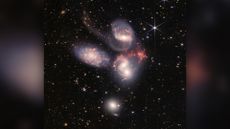 James Webb telescope discovers 'exceptionally rare' 5-galaxy crash in the early universe
Near-infrared images from the James Webb Space Telescope revealed five early universe galaxies merging within a large halo.
4 Commentsastronomy -
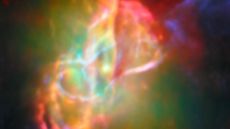 'Butterfly Nebula' spreads its wings in dazzling new James Webb telescope image
In a dazzling new photo, the James Webb Space Telescope zooms in on the Butterfly Nebula — the dying gasps of one of the hottest stars in the sky, which could hold clues to Earth's origins.
astronomy -
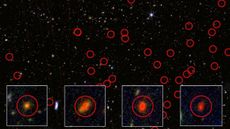 James Webb Space Telescope uncovers 300 mysteriously luminous objects. Are they galaxies or something else?
Deep-field images from NASA's James Webb Space Telescope revealed 300 unusually energetic early galaxy candidates, offering new insights into how the universe formed and evolved over 13 billion years ago.
-
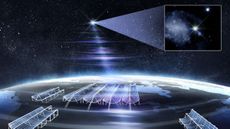 James Webb telescope pinpoints brightest FRB ever detected
Astronomers using the James Webb telescope alongside Canada's CHIME telescope have pinpointed the origin of one of the brightest blasts of radio energy ever detected in Earth's skies.
astronomy -
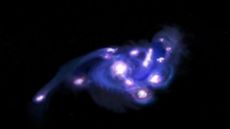 Astronomers find bizarre 'Cosmic Grapes' galaxy in the early universe. Here's why that's a big deal (photo)
A distant galaxy nicknamed "Cosmic Grapes" is bursting with massive star-forming clumps — far more than expected — offering fresh clues about how galaxies grew in the early universe.
-
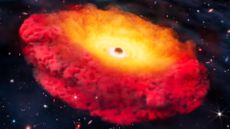 James Webb telescope spots earliest black hole in the known universe, looking 'as far back as you can practically go'
Astronomers using the James Webb telescope have zoomed in on a 'Little Red Dot' that existed just 500 million years after the Big Bang, and found that it may contain the earliest known black hole in the universe.
black-holes -
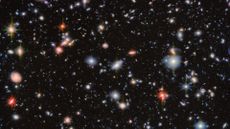 James Webb telescope captures one of the deepest-ever views of the universe — Space photo of the week
The James Webb telescope's 100-hour reexamination of one of Hubble's most iconic extragalactic images reveals extraordinary new details.
3 Commentsastronomy -
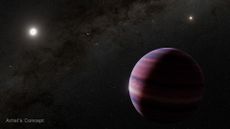 'The most significant JWST finding to date': James Webb spots — then loses — a giant planet orbiting in the habitable zone of our closest sun-like star
Alpha Centauri may have a "disappearing planet', new James Webb Space Telescope observations hint. If confirmed, it could be the closest alien planet to Earth that orbits in its star's habitable zone.
astronomy -
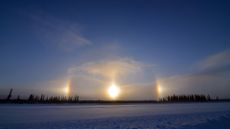 Stunning 'sun dogs' could sparkle in alien skies, James Webb Space Telescope suggests
High-speed winds on exoplanet WASP-17b may align quartz crystals in its atmosphere and create dazzling light effects like "sun dogs."


