














How Pluto captured its largest moon Charon with a 10-hour icy 'kiss'
Pluto may have got romantic to capture its largest moon, colliding and engaging in a passionate but icy 10 hour kiss with Charon billions of years ago.

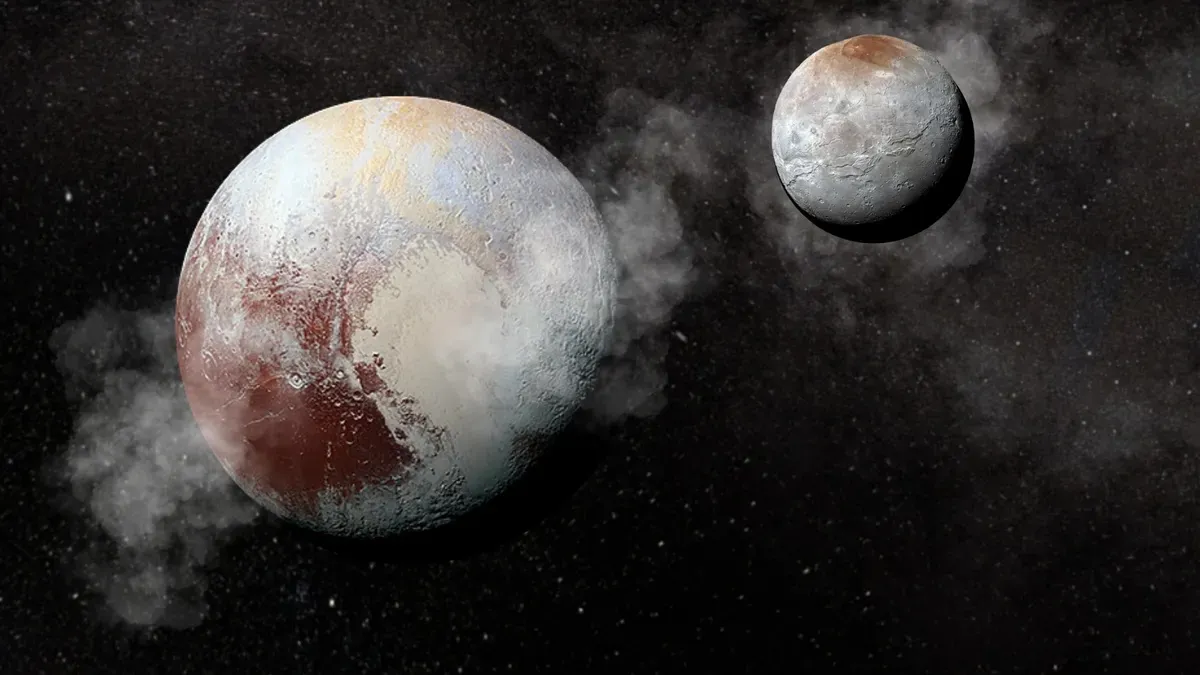
New research suggests that billions of years ago, Pluto may have captured its largest moon, Charon, with a very brief icy "kiss." The theory could explain how the dwarf planet (yeah, we wish Pluto was still a planet, too) could snare a moon that is around half its size.
The team behind this research thinks that two frigid worlds located in the Kuiper Belt, a ring of icy bodies located far from the sun at the edge of the solar system, collided together billions of years ago. Rather than mutually obliterating each other, the two bodies were united as a spinning "cosmic snowman." These bodies separated relatively quickly but remained orbitally linked to create the Pluto/Charon system we see today.
This "kiss and capture" process represents a new theory of moon capture and cosmic collision. It could also help scientists better investigate the structural strength of frigid, icy worlds in the Kuiper Belt.
"We've found that if we assume that Pluto and Charon are bodies with material strength, Pluto can indeed capture Charon from a giant impact," team leader and University of Arizona lunar and planetary researcher Adeene Denton told Space.com. "The process of this collisional capture is called 'kiss-and-capture' because Pluto and Charon briefly merge, the 'kiss' element, before separating to form two independent bodies."
Most planetary collision scenarios are classified as "hit and run" or "graze and merge," meaning this "kiss and capture" scenario is something entirely new.
"We were definitely surprised by the 'kiss' part of kiss-and-capture," Denton continued. "There hasn't really been a kind of impact before where the two bodies only temporarily merge before re-separating!"
The team's research was published Jan. 6 in the journal Nature Geoscience.
Get the world’s most fascinating discoveries delivered straight to your inbox.
Pluto won Charon over with a 10 hour kiss
The reason Pluto's relationship with Charon has been challenging to scientists is because of the relatively small difference in size and mass between the two icy bodies.
"Charon is HUGE relative to Pluto, to the point where they are actually a binary," Denton explained. "It's half Pluto's size and 12% of its mass, which makes it much more similar to the Earth's moon than any other moon in the solar system."
For comparison, our moon is just a quarter of the size of Earth, while the largest moon in the solar system, Ganymede, is around 1/28 the size of its parent planet, Jupiter.
The University of Arizona researcher, who is also a NASA postdoctoral fellow, added that it's hard to get such a relatively big moon in a "normal" way. ("Normal" being the gravitational capture of moons like Mars' moons Phobos and Deimos and the moons of the giant planets Jupiter and Saturn.)
That means that the prevailing theory of the formation of the Pluto and Charon system is based on the collisional capture idea, similar to how a massive body is believed to have slammed into Earth to launch out material that our planet captured to birth our moon.
"Something big hits Pluto, and you get Charon, but like with the Earth-moon system, we don't fully know how that works and the conditions under which that occurs," Denton said. "It's a pretty big question since a bunch of other large Kuiper Belt Objects also have large moons, so it seems like this is something that happens in the Kuiper Belt with some frequency, but we don't know how or why."

A screenshot shows the Pluto/ Charon system during its linked "snowman" phase.
During a standard "collision capture," a massive collision occurs, and the two bodies stretch and deform in a fluid-like way. This process explains the creation of the Earth/moon system well because the intense heat generated in the clash and the greater mass of the bodies involved causes them to act in a fluid way.
When considering Pluto and Charon in a collision capture process, there is an extra factor to consider: the structural strength of the colder icy and rocky bodies. This is something that has been neglected in the past when researchers considered the collisional creation of Charon.
To factor this into simulations, the team turned to the University of Arizona's high-performance computing cluster. When Denton and colleagues accounted for the strength of these materials in their simulation, something completely unexpected emerged.
"Because both bodies have material strength, Charon did not penetrate deep enough into Pluto to merge with it; this isn't true when the bodies are fluids," Denton explained. "For the same impact conditions, if we assume Pluto and Charon to be strengthless, they do merge into one large body, and Charon is absorbed. With strength, however, Pluto and Charon remain structurally intact during their brief merger."

Pluto's moon Charon as seen by the New Horizon's telescope
Because Charon couldn't sink into Pluto in this scenario, it remained beyond the so-called "co-rotation radius" of both bodies. As a result, it could not rotate as fast as Pluto, which meant the two bodies could not stay merged. As they separated and this icy kiss ended, the team thinks that Pluto would have torqued Charon into a close, higher circular orbit from which the moon would have migrated outward.
"The 'kiss' in this kiss-and-capture, the merger is very brief, geologically speaking, lasting for 10 to 15 hours before both bodies separate again," Denton said. "Charon then begins its slow outward migration towards its current position."
The team thinks the initial collision happened very early in solar system history, probably tens of millions of years after the solar system formed, which would be billions of years ago.
"Typical large collisions are straightforward mergers, where the bodies combine, or both bodies remain independent," Denton said. "So this was very new to us. It also raised a lot of interesting geological questions that we'd like to test, because whether kiss-and-capture works depends on the thermal state of Pluto, which we can then tie to Pluto's contemporary geology to test.
"I'd really like to determine how the initial Pluto-Charon impact can influence whether and how Pluto and Charon develop oceans."
Related Stories:
Denton explained that there are two avenues the team can follow to build upon this development.
"The first is looking at how this applies to the other large Kuiper Belt Objects with large moons, like Eris and Dysnomia, Orcus and Vanth, and the others," Denton explained. "Our initial analysis suggests that kiss-and-capture can also be the source of these other systems, but since they're all different in their compositions and mass, it's critical to learn how kiss-and-capture may have operated across the Kuiper Belt."
The second avenue the team intends to follow involves looking at the long-term tidal evolution of Charon to confirm their formation theory.
"To really be sure that this is the process that formed Pluto and Charon, we need to make sure that Charon migrates to its current location at around 8 times the width of Pluto away," Denton said. "However, that's a process that occurs over much longer timescales than the initial collision, so our models aren't well-suited to track it.
"We're planning to have a much closer look at this in the future to determine which conditions not only reproduce Pluto and Charon as bodies but also put Charon in the right spot, where it is today."
Originally posted on Space.com.

Robert Lea is a science journalist in the U.K. who specializes in science, space, physics, astronomy, astrophysics, cosmology, quantum mechanics and technology. Rob's articles have been published in Physics World, New Scientist, Astronomy Magazine, All About Space and ZME Science. He also writes about science communication for Elsevier and the European Journal of Physics. Rob holds a bachelor of science degree in physics and astronomy from the U.K.’s Open University