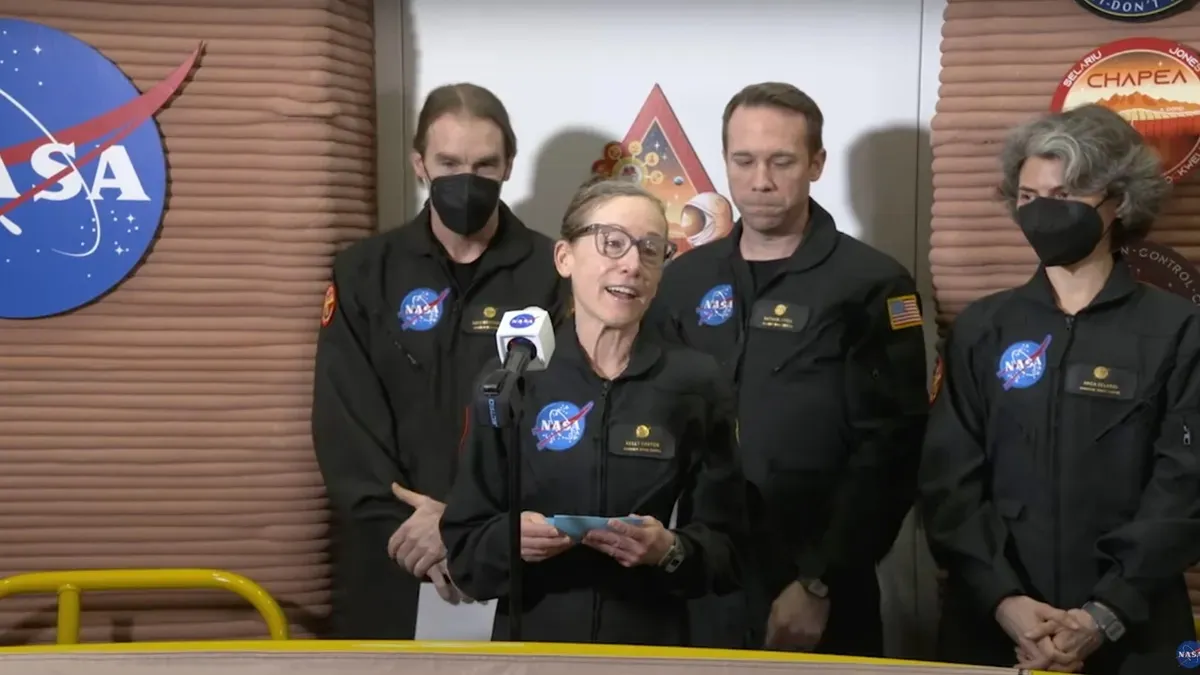
NASA's first year-long mock Mars mission has come to an end.
That mission, the first in the CHAPEA ("Crew Health and Performance Exploration Analog") series, began on June 25, 2023, when four volunteers were sealed inside a simulated Mars habitat at NASA's Johnson Space Center (JSC) in Houston.
The quartet exited the habitat on Saturday (July 6), returning to regular Earth life after a staggering 378 days.
The four volunteers for the CHAPEA-1 mission were Kelly Haston, Anca Selariu, Ross Brockwell and Nathan Jones. Their home for the past year-plus was Mars Dune Alpha, a 1,700-square-foot (158 square meters) 3D-printed habitat designed to feel like an isolated Red Planet outpost.
The quartet's experiences in Mars Dune Alpha will inform NASA's planning for real-life crewed missions to the Red Planet, which the agency aims to start launching in the late 2030s or early 2040s.
"For more than a year, the crew simulated Mars mission operations, including 'Marswalks,' grew and harvested several vegetables to supplement their shelf-stable food, maintained their equipment and habitat and operated under additional stressors a Mars crew will experience, including communication delays with Earth, resource limitations and isolation," NASA officials wrote in a CHAPEA-1 mission description.
Related: Grand Canyon-size 'scar' on Mars revealed like never before in striking new satellite photos
NASA celebrated the quartet's exit with a "welcome home" ceremony at JSC on July 6.
"CHAPEA-1 has been a unique experience, with great challenges, joys and sorrows and a lot of hard work, with a fair bit of fun thrown in as well," Haston, who commanded the mission, said during the livestreamed event.
"I am humbled that being away on a one-year Mars analog brought me closer to those I was with and those I left back at home," she added.
Originally posted on Space.com.