














SETI searches for alien life in over 1,000 galaxies using unexplored radio frequencies
Although no aliens were found, the results have helped constrain expectations of possible alien transmitter power.
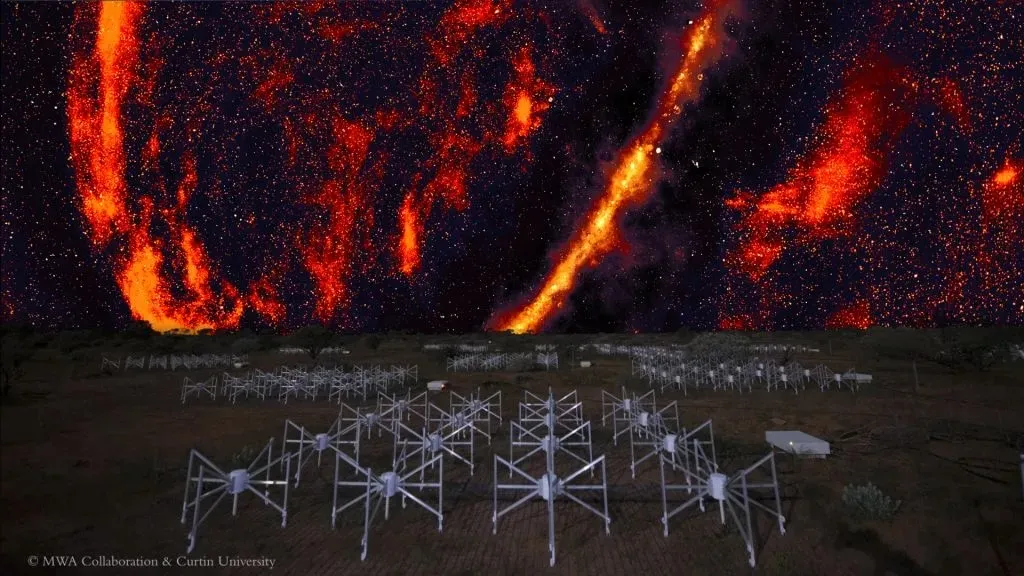
A search of more than 1,300 galaxies for extraterrestrial signals has helped to constrain expectations as to how many communicating, technological civilizations may exist beyond Earth.
Conducted with the Murchison Widefield Array (MWA) in Australia, the search concerned itself with low radio frequencies in the 80–300 MHz range. For comparison, SETI (which stands for Search for Extraterrestrial Intelligence) typically looks for alien signals in the 1,420 MHz hydrogen emission frequency. In fact, low frequencies are relatively unexplored real estate for SETI.
The search was conducted by Chenoa Tremblay of the SETI Institute in California and Steven Tingay, the director of the MWA from Australia's Curtin University. The team focused on a 30-degree field of view in the constellation of Vela, the Sails, encompassing 2,880 galaxies. The redshifts, and hence distances, to 1,317 of these galaxies have previously been measured with high accuracy — so, Tremblay and Tingay targeted these galaxies in particular. By knowing the galaxies' distances, the duo could place constraints on the power of any transmitters in those galaxies.
While their initial search failed to detect an extraterrestrial signal, Tremblay and Tingay concluded in their paper that they would have been capable of detecting one with a transmitter power of 7 x 10^22 watts at a frequency of 100MHz.
"This work represents a significant step forward in our efforts to detect signals from advanced extraterrestrial civilizations," said Tremblay in a statement. "The large field of view and low-frequency range of the MWA makes it an ideal tool for this kind of research, and the limits we set will guide future studies."
Related: Scientists are searching for alien signals at frequencies never studied before
For much of its 64-year history, SETI has focused on stars in our own Milky Way galaxy — in recent years, however, the net has begun to widen.
Get the world’s most fascinating discoveries delivered straight to your inbox.
In 2015, for instance, the Glimpsing Heat from Alien Technologies (G-HAT) project surveyed 100,000 galaxies with NASA's Wide-field Infrared Survey Telescope (WISE) in search of civilizations that may have built "Dyson swarms" around all the stars in their respective galaxies. None were found. In 2023, a team led by Yuri Uno of the National Chung Hsing University in Taiwan suggested that there could be no more than one civilization within three billion light-years of us that's pointing a radio transmitter with a power above 7.7 x 10^26 watts at the Milky Way.
The same year, Michael Garrett of the Jodrell Bank Center for Astrophysics and Breakthrough Listen's Andrew Siemion conducted a search of background galaxies to constrain the maximum detectable power, arriving at a range of about 10^23 watts to 10^26 watts. (The exact maximum power for a potential signal would depend on the distance to the galaxy in which it originates.) Finally, the SETI Institute's Carmen Choza led a team that recently conducted a targeted search of 97 galaxies with the Green Bank Telescope — but detected nothing.
Where would so much power come from?
To achieve these transmitter powers, technological aliens would have to harness the power of a star, or perhaps even several stars.
In 1964, the Soviet astronomer Nikolai Kardashev developed a classification scale for extraterrestrial civilizations based on how much energy they have at their disposal. A type 1 civilization would harness all the energy available on one planet, generalized as 10^16 watts or greater. A type 2 civilization would be able to harness the power of an entire star, which would be 10^26 watts for a sun-like star. And a type 3 civilization would be able to utilize the entire power output of every star in its galaxy, amounting to about 10^36 watts.
The null detections so far do not necessarily mean that technological, communicative extraterrestrial life does not exist, just that our observations are not comprehensive enough yet to say anything about its existence either way. We simply aren't sure. Estimates suggest there are up to 2 trillion galaxies in the observable universe and we have only searched a small fraction of them, and for only a short period of time.
RELATED STORIES
Running an intergalactic radio beacon would also not be cheap; it's possible any radio beacons were switched off to conserve power when we looked. Or, perhaps they were pointed in the direction of other galaxies. Maybe Kardashev type 2 and 3 civilizations are rare, meaning we wouldn't see transmitters with those powers so, per the constraints, the radio beacons might be out there but operating at a power less than our ability to detect. Furthermore, this new survey operated at low frequencies — but transmitters at higher frequencies cannot be ruled out.
Tremblay and Tingay point out that several powerful radio emitters on Earth, as well as some of our earliest transmissions, are at low frequency — thus justifying the search within this range. Plus, given the relative dearth of SETI searches at these low frequencies, there is always the chance of finding something unexpected. For SETI to succeed, radio searches have to cover a multitude of frequencies to make sure that we don’t miss that elusive signal.
"Continuing to work together to cover the frequency space will be crucial in the future," conclude Tremblay and Tingay in their paper.
The study was published on 26 Aug. in The Astrophysical Journal.
Originally published on Space.com.