Get the world’s most fascinating discoveries delivered straight to your inbox.
You are now subscribed
Your newsletter sign-up was successful
Want to add more newsletters?
Join the club
Get full access to premium articles, exclusive features and a growing list of member rewards.
An account already exists for this email address, please log in.
James Webb Space Telescope discovers one of the earliest 'truly gargantuan' supernovas ever seen
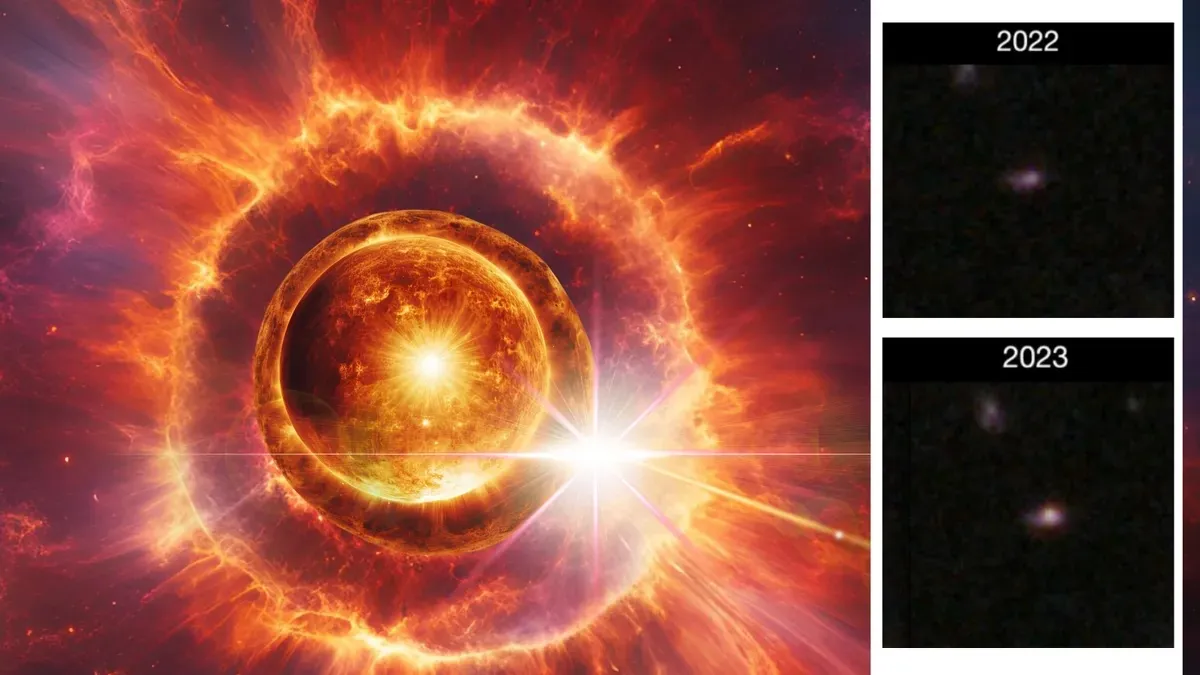
The James Webb Space Telescope has spotted one of the earliest and most distant supernovas, marking the death of a stellar monster 20 times the mass of the sun.
Supernovas in the early universe just hit different. Especially when the stars that exploded was a stellar monster 20 times the mass of the sun.
Using the James Webb Space Telescope (JWST), astronomers have discovered one of the most distant and, thus, earliest star-killing supernovas ever seen. This blast, which rocked the cosmos around 2 billion years after the Big Bang, marked the death of just such a monster star.
This supernova, detected as part of the JWST Advanced Deep Extragalactic Survey (JADES) program, could help scientists add more detail to the cosmic picture of stellar life and death they are currently building.
The supernova, designated AT 2023adsv, erupted around 11.4 billion years ago in a massive early galaxy. Excitingly, this stellar explosion may be somewhat different from the supernovas that have occurred more recently in the local universe. In particular, the high-energy blast seems to have been excessively violent.
"The first stars were considerably different than the stars today. They were massive, they were hot, and they had truly gargantuan explosions," JADES team member and Space Telescope Science Institute (STScI) researcher David Coulter said at the 245th meeting of the American Astronomical Society (AAS) in National Harbor, Maryland, on Monday (Jan. 13). "We don't know how many [supernovas] the JWST will find but we can start to push to the beginning of these first stars and hope to see their explosions."
A story of stellar life, death, and rebirth
The early universe was relatively boring compared to the modern cosmos, especially when considering its chemical contents. That's because it was largely hydrogen, the lightest and simplest element, with some helium, the second lightest element. There existed in the infant universe just a smattering of heavier elements, which astronomers somewhat confusingly refer to as "metals."
The first generation of stars, known as Population III stars (not Population I stars as you'd expect, maybe), was born from overdense patches in this ingredient-light cosmic soup. These stars began to fuse hydrogen and helium into heavier elements.
When the most massive stars (with masses in excess of 8 times that of the sun) reached the end of their supplies of fuel for nuclear fusion, their cores collapsed, creating black holes or neutron stars, while their metal-rich outer layers were blasted away in supernova explosions.
This process seeded clouds of hydrogen and helium in the first galaxies with heavy elements. This meant that when overdense patches in these enriched clouds collapsed to create new stars, this second generation of stars (Population II) was more metal-rich than the first.
Get the world’s most fascinating discoveries delivered straight to your inbox.
JADES Deep Field uses observations taken by NASA’s James Webb Space Telescope (JWST) showing the location of newly discovered supernova explosions
(Image credit: NASA, ESA, CSA, STScI, JADES Collaboration)
This repeated to birth a third generation of even more metal-abundant stars. This is the third generation of stellar bodies, Population I stars (again, not Pop III stars as you'd expect ), to which our star, the sun, belongs.
However, while this may seem like a case of cosmic history repeating, there was something different about the first round of supernovas.
Scientists think that the metal-poor nature of these stars would have caused them to live shorter lives. It would have also made the supernova explosions that mark the end of these lives more violent than the deaths of later descendant stars.
These early supernovas should be incredibly bright and thus visible to the JWST. Indeed, the JADES collaboration, which studies the birth and evolution of the earliest galaxies, has thus far spotted over 80 ancient supernovas.
"Studying distant supernova explosions is the only way to explore the individual stars that populate these early galaxies," team member and University of Arizona in Tucson researcher Christa DeCoursey said in a statement. "The sheer number of detections plus the great distances to these supernovas are the two most exciting outcomes from our survey."
An early supernova with a twist
The chemical composition of AT 2023adsv means it stands out as one of the earliest of these supernovas.
"This supernova is so far away and therefore so far back in time that when the light was first coming to us the universe was less than 2 billion years old," Coulter continued. "That means that this light had been traveling 6 billion years before the sun ever formed.
"So this Supernova also happened in an environment that seems considerably different than the environment that our home star lives in today."
AT 2023adsv, a supernova discovered in a galaxy at a redshift of 3.6. Its progenitor starexploded when the universe was only 2 billion years old.
(Image credit: NASA, ESA, CSA, STScI, JADES Collaboration)
While AT 2023adsv does resemble the metal-poor environment of the early universe in which the star that exploded to launch it was born, there is a twist or two.
"It appears to be a close cousin to local supernovas observed in similarly pristine environments," Coulter said in the statement. "However, the resemblance stops there — 2023adsv appears to have been once a particularly massive star, perhaps up to 20 times the mass of our sun."
Stars of such monstrous sizes are scarce in the local and contemporary universe. 2023adsv also exploded with around twice the energy of the average supernova triggered by nearby massive stars.
"The high explosion energy of 2023adsv could indicate that the properties of supernova explosions might have been different in the early universe, but we need more observations to confirm this idea," team member and National Astronomical Observatory of Japan theorist Takashi Moriya said.
The JWST will get a hand in hunting for the earliest and most distant cosmic explosion in 2026 when NASA is set to launch its next major space telescope, the Nancy Grace Roman Space Telescope.
Current estimates suggest Roman's wide field of view will locate thousands of early supernovas for the sensitive infrared eye of the JWST to hone in on and investigate.
The team's research was presented at the 245th meeting of the AAS on Monday, and a preprint paper is available on the repository site arXiv.
Robert Lea is a science journalist in the U.K. who specializes in science, space, physics, astronomy, astrophysics, cosmology, quantum mechanics and technology. Rob's articles have been published in Physics World, New Scientist, Astronomy Magazine, All About Space and ZME Science. He also writes about science communication for Elsevier and the European Journal of Physics. Rob holds a bachelor of science degree in physics and astronomy from the U.K.’s Open University