














A nearby supernova nearly blew our solar system to bits 4 billion years ago, new research suggests
A supernova that erupted when a massive star died could have destroyed our infant solar system — if it weren't protected by a cocoon of molecular gas.

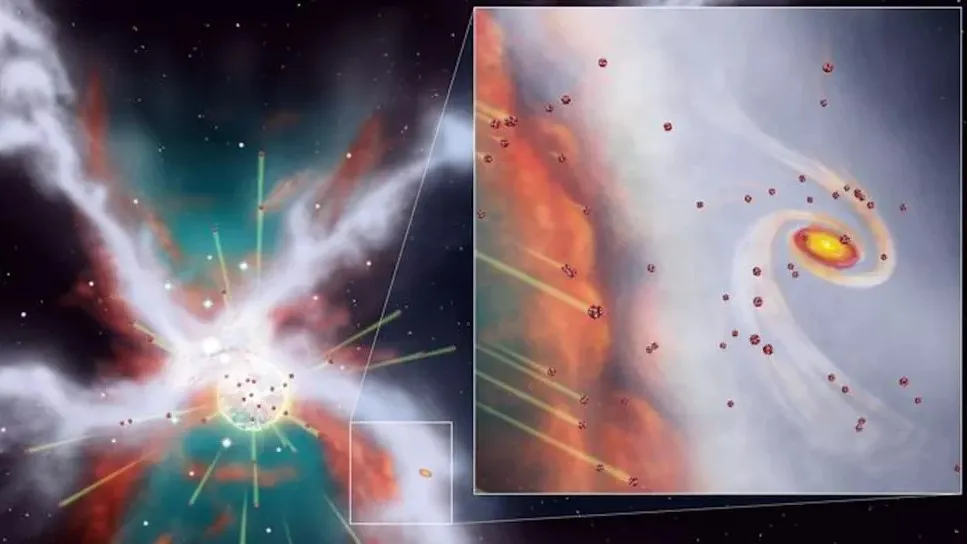
A supernova that exploded close to our newly forming sun could have destroyed what became our solar system — if it weren't for a shield of molecular gas.
Scientists reached this conclusion by studying isotopes of elements discovered in meteorites. These space rocks are pieces of asteroids, which formed from material that was around when the sun and then the planets of the solar system formed. As such, meteorites are fossils of a sort, allowing scientists to reconstruct the evolution of the solar system.
The research team found varying concentrations of a radioactive isotope of aluminum in meteorite samples. This information revealed that, around 4.6 billion years ago, an additional amount of the radioactive aluminum entered our planetary backyard. The best explanation for such an injection of radioactive material is a nearby supernova blast, study team members said.
Related: 25 gorgeous nebula photos that capture the beauty of the universe
Our infant solar system therefore probably survived a supernova blastwave, according to the researchers, led by National Astronomical Observatory of Japan astrophysicist Doris Arzoumanian. The birth cocoon of the solar system likely acted as a buffer to this shockwave, they added.
Supernova explosions occur when dying massive stars run out of the fuel for nuclear fusion, and their cores can no longer support themselves against gravitational collapse. As the core collapses, a supernova is triggered that spreads the heavy elements the star has forged throughout its life into space.
This material becomes the building blocks of the next generation of stars — but the blast wave that carries it outward can be strong enough to rip apart any newborn planetary systems that happen to be nearby.
Get the world’s most fascinating discoveries delivered straight to your inbox.
Stars are born in giant clouds of molecular gas that are composed of dense tendrils or filaments. Smaller stellar bodies, like the sun, form along these filaments, while larger stars, like the one that would have exploded in this supernova, tend to form at points where these filaments cross each other.
Considering this, Arzoumanian and the team estimated that it would take around 300,000 years for the supernova shockwave to break up the dense filament shielding the infant solar system.
Meteorites that are rich in radioactive isotopes broke apart from larger bodies like asteroids that were born in the first 100,000 of the solar system, while it was still in this dense filament. The cocoon would have acted to protect the forming solar system from harsh radiation emitted from hot and massive stars called OB stars, something that could have negatively impacted the formation of planets like Earth.
The new results suggest that, as well as acting like a shield, the filament could have caught and channeled radioactive isotopes, bringing them into the region around the infant sun.
RELATED STORIES
The researchers believe that their findings could be crucial in understanding the formation and evolution of stars and their planetary systems.
"This scenario may have multiple important implications in our understanding of the formation, evolution and properties of stellar systems," the team wrote in the study which was published in April in the Astrophysical Journal Letters.
"For example, the host filament may play an important role in shielding the young solar system from the far-ultraviolet radiation from OB stars that would photo-evaporate the protostellar disk affecting its final size, which would have a direct impact on planet formation within the disk," they added.
Originally posted on Space.com.

Robert Lea is a science journalist in the U.K. who specializes in science, space, physics, astronomy, astrophysics, cosmology, quantum mechanics and technology. Rob's articles have been published in Physics World, New Scientist, Astronomy Magazine, All About Space and ZME Science. He also writes about science communication for Elsevier and the European Journal of Physics. Rob holds a bachelor of science degree in physics and astronomy from the U.K.’s Open University