













World's early mega-settlements mysteriously collapsed — this might be why
Whether intentional or not, the way mega-settlements in southeastern Europe from 6,000 years ago were laid out would have cut down on the spread of disease.


In my research focused on early farmers of Europe, I have often wondered about a curious pattern through time: Farmers lived in large dense villages, then dispersed for centuries, then later formed cities again, only to abandon those as well. Why?
Archaeologists often explain what we call urban collapse in terms of climate change, overpopulation, social pressures or some combination of these. Each likely has been true at different points in time.
But scientists have added a new hypothesis to the mix: disease. Living closely with animals led to zoonotic diseases that came to also infect humans. Outbreaks could have led dense settlements to be abandoned, at least until later generations found a way to organize their settlement layout to be more resilient to disease. In a new study, my colleagues and I analyzed the intriguing layouts of later settlements to see how they might have interacted with disease transmission.
Earliest cities: Dense with people and animals
Çatalhöyük, in present-day Turkey, is the world's oldest farming village, from over 9,000 years ago. Many thousands of people lived in mud-brick houses jammed so tightly together that residents entered via a ladder through a trapdoor on the roof. They even buried selected ancestors underneath the house floor. Despite plenty of space out there on the Anatolian Plateau, people packed in closely.

Modern excavations at what was once Çatalhöyük, where inhabitants lived in mud-brick houses that weren't separated by paths or streets.
For centuries, people at Çatalhöyük herded sheep and cattle, cultivated barley and made cheese. Evocative paintings of bulls, dancing figures and a volcanic eruption suggest their folk traditions. They kept their well-organized houses tidy, sweeping floors and maintaining storage bins near the kitchen, located under the trapdoor to allow oven smoke to escape. Keeping clean meant they even replastered their interior house walls several times a year.
These rich traditions ended by 6000 BCE, when Çatalhöyük was mysteriously abandoned. The population dispersed into smaller settlements out in the surrounding flood plain and beyond. Other large farming populations of the region had also dispersed, and nomadic livestock herding became more widespread. For those populations that persisted, the mud-brick houses were now separate, in contrast with the agglomerated houses of Çatalhöyük.
Was disease a factor in the abandonment of dense settlements by 6000 BCE?
Get the world’s most fascinating discoveries delivered straight to your inbox.

Homes at Çatalhöyük were so tightly packed that people entered through the roof and even buried some ancestors beneath the floor.
At Çatalhöyük, archaeologists have found human bones intermingled with cattle bones in burials and refuse heaps. Crowding of people and animals likely bred zoonotic diseases at Çatalhöyük. Ancient DNA identifies tuberculosis (TB) from cattle in the region as far back as 8500 BCE and TB in human infant bones not long after. DNA in ancient human remains dates salmonella to as early as 4500 BCE. Assuming the contagiousness and virulence of Neolithic diseases increased through time, dense settlements such as Çatalhöyük may have reached a tipping point where the effects of disease outweighed the benefits of living closely together.
Related: Skeletons of Incan kids buried 500 years ago found marred with smallpox
A new layout 2,000 years later
By about 4000 BCE, large urban populations had reappeared, at the mega-settlements of the ancient Trypillia culture, west of the Black Sea. Thousands of people lived at Trypillia mega-settlements such as Nebelivka and Maidanetske in what's now Ukraine.
If disease was a factor in dispersal millennia before, how were these mega-settlements possible?

Geophysical plot of Nebelivka settlement shows its circular layout, divided into neighborhoods.
This time, the layout was different than at jam-packed Çatalhöyük: The hundreds of wooden, two-story houses were regularly spaced in concentric ovals. They were also clustered in pie-shaped neighborhoods, each with its own large assembly house. The pottery excavated in the neighborhood assembly houses has many different compositions, suggesting these pots were brought there by different families coming together to share food.
This layout suggests a theory. Whether the people of Nebelivka knew it or not, this lower-density, clustered layout could have helped prevent any disease outbreaks from consuming the entire settlement.
Archaeologist Simon Carrignon and I set out to test this possibility by adapting computer models from a previous epidemiology project that modeled how social-distancing behaviors affect the spread of pandemics. To study how a Trypillian settlement layout would disrupt disease spread, we teamed up with cultural evolution scholar Mike O'Brien and with the archaeologists of Nebelivka: John Chapman, Bisserka Gaydarska and Brian Buchanan.
Simulating socially distanced neighborhoods
To simulate disease spread at Nebelivka, we had to make a few assumptions. First, we assumed that early diseases were spread through foods, such as milk or meat. Second, we assumed people visited other houses within their neighborhood more often than those outside of it.
Would this neighborhood clustering be enough to suppress disease outbreaks? To test the effects of different possible rates of interaction, we ran millions of simulations, first on a network to represent clustered neighborhoods. We then ran the simulations again, this time on a virtual layout modeled after actual site plans, where houses in each neighborhood were given a higher chance of making contact with each other.
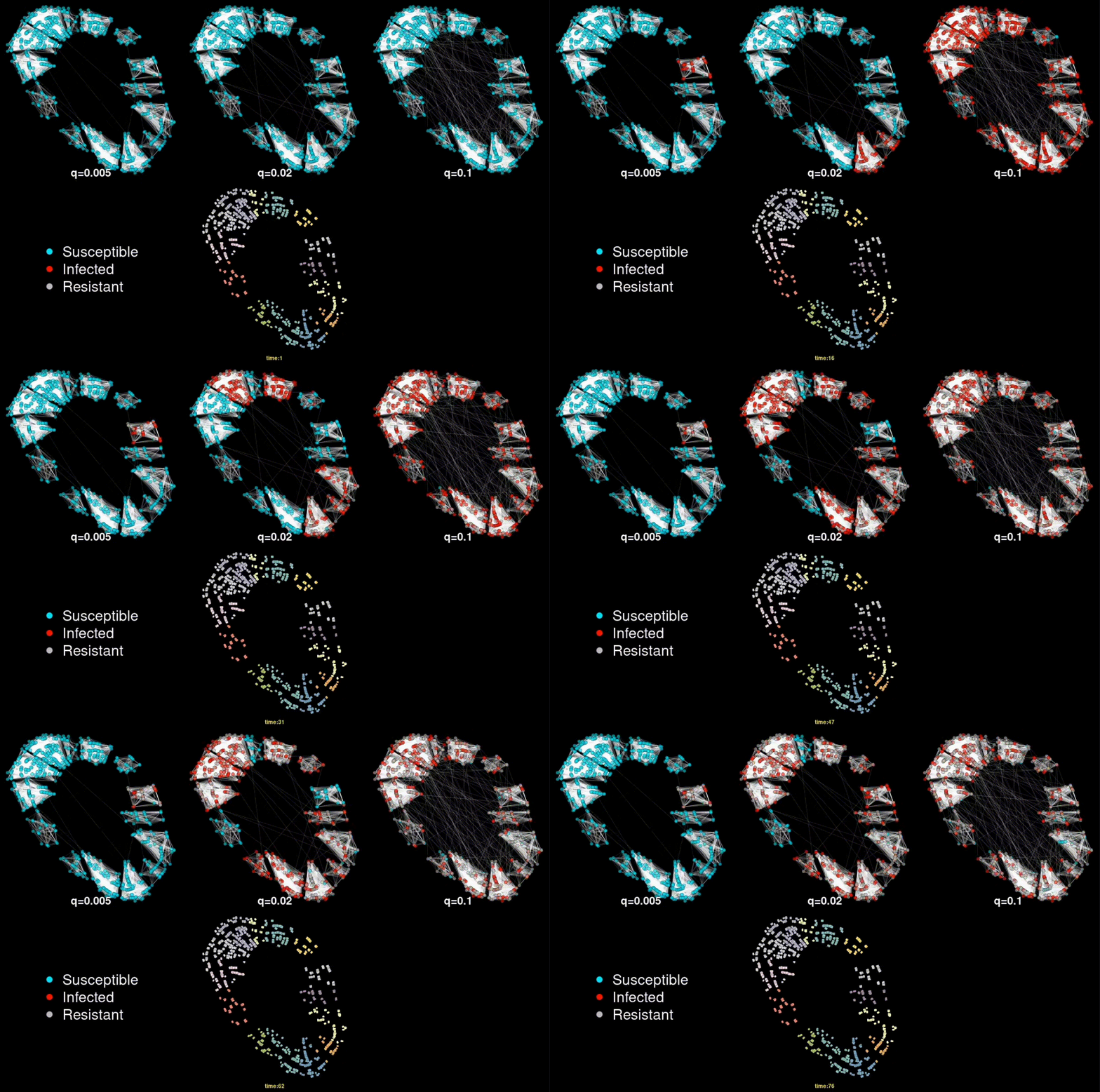
Simulations of disease spread at Nebelivka, for three different levels of cross-neighborhood interaction. On the map at bottom, the houses are colored by neighborhood. The parameter q captures how often household members visit neighborhoods outside their own (from left to right, rarely to frequently). More mixing results in more spread of infection.
Based on our simulations, we found that if people visited other neighborhoods infrequently — like a fifth to a tenth as often as visiting other houses within their own neighborhood — then the clustering layout of houses at Nebelivka would have significantly reduced outbreaks of early foodborne diseases. This is reasonable given that each neighborhood had its own assembly house. Overall, the results show how the Trypillian layout could help early farmers live together in low-density urban populations, at a time when zoonotic diseases were increasing.
The residents of Nebilevka didn't need to have consciously planned for their neighborhood layout to help their population survive. But they may well have, as human instinct is to avoid signs of contagious disease. Like at Çatalhöyük, residents kept their houses clean. And about two-thirds of the houses at Nebelivka were deliberately burned at different times. These intentional periodic burns may have been a pest extermination tactic.

Re-creation of a Trypillian house-burning, with additional straw and wood necessary to burn hot enough to match archaeological evidence.
New cities and innovations
Some of the early diseases eventually evolved to spread by means other than bad foods. Tuberculosis, for instance, became airborne at some point. When the bacterium that causes plague, Yersinia pestis, became adapted to fleas, it could be spread by rats, which would not care about neighborhood boundaries.
Were new disease vectors too much for these ancient cities? The mega-settlements of Trypillia were abandoned by 3000 BCE. As at Çatalhöyük thousands of years before, people dispersed into smaller settlements. Some geneticists speculate that Trypillia settlements were abandoned due to the origins of plague in the region, about 5,000 years ago.
The first cities in Mesopotamia developed around 3500 BCE, with others soon developing in Egypt, the Indus Valley and China. These cities of tens of thousands were filled with specialized craftspeople in distinct neighborhoods.
RELATED STORIES
This time around, people in the city centers weren't living cheek by jowl with cattle or sheep. Cities were the centers of regional trade. Food was imported into the city and stored in large grain silos like the one at the Hittite capital of Hattusa, which could hold enough cereal grain to feed 20,000 people for a year. Sanitation was helped by public water works, such as canals in Uruk or water wells and a large public bath at the Indus city of Mohenjo Daro.
These early cities, along with those in China, Africa and the Americas, were the foundations of civilization. Arguably, their form and function were shaped by millennia of diseases and human responses to them, all the way back to the world's earliest farming villages.
This edited article is republished from The Conversation under a Creative Commons license. Read the original article.

Alex Bentley is Professor of Anthropology at University of Tennessee. Author of over 100 peer-reviewed articles, his research test models of cultural evolution on a range of datasets documenting culture, health, social influence and decision-making, at time scales ranging from decades to days. Bentley spent over a decade of his career at universities in the UK, most recently Bristol University. A recent book is The Acceleration of Cultural Change (M.I.T. Press 2017).