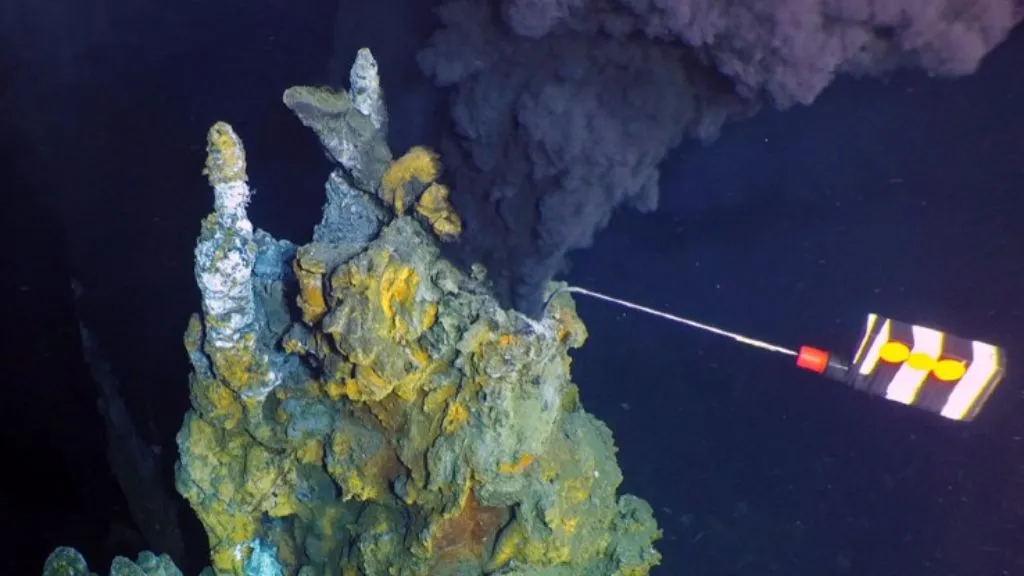
Researchers surveyed hydrothermal vents in the Pacific using temperature loggers manufactured by EP Oceanographic. The loggers collect data every ten minutes, in order to track changes in vent fluid temperature that can be used to infer changes in permeability of the crust beneath the vent.
(Image credit: Woods Hole Oceanographic Institution, National Deep Submergence Facility, remotely operated vehicle Jason team, WHOI-MISO Facility, National Science Foundation)
Scientists sent underwater robots into the depths of the Pacific, about 1.5 miles (2.5 kilometers) beneath the surface, and discovered something unexpected: a football field-size expanse of towering hydrothermal vents that cropped up in an area these underwater chimneys haven't typically been seen.
The vents, shaped like candelabras, stand roughly 35 to 40 feet (10 to 12 meters) tall, or about as tall as three-story buildings, the research team leaders, from Lehigh University, said in a statement. These striking structures gush black, mineral-filled water that reaches temperatures of up to 694 degrees Fahrenheit (368 degrees Celsius), although the water likely starts out at an even higher temperature, closer to 818 F (437 C), the team determined. Such high temperatures hint that a volcanic eruption may occur at the site in the next few years.
The newfound vent field is located about 200 miles (321 km) off the coast of western Mexico, in the East Pacific Rise, a range of underwater volcanoes that extends nearly from the Gulf of California to Antarctica.
"We were astounded that not only was the field very active, but it is larger in area and hotter in origin temperature than any other hydrothermal vent field known along this portion of the East Pacific Rise that has been studied for the past 30 years," Daniel Fornari, a marine geologist at the Woods Hole Oceanographic Institution in Massachusetts and a co-author of the paper, said in the statement.
The remotely operated vehicle (ROV) "Jason" samples 694 F (368 C) black smoker fluids using titanium syringe-style samplers for analysis in the McDermott laboratory at Lehigh University.
(Image credit: Woods Hole Oceanographic Institution, National Deep Submergence Facility, remotely operated vehicle Jason team, National Science Foundation)
As a midocean ridge, the East Pacific Rise marks a region where tectonic plates in Earth's crust are spreading apart and molten rock is rushing in to fill the gap, according to the Monterey Bay Aquarium Research Institute. The magma's movement triggers volcanic eruptions and creates cracks in the crust, allowing water to trickle down into the fractures, get superheated by the hot rock below and then shoot back up through the seafloor, forming hydrothermal vents.
Most hydrothermal vents discovered on the East Pacific Rise have been found along the "axis" of the ridge — the plate boundary where the spreading occurs — where magmatic activity has formed a 54- to 109-yard-wide (50 to 100 meters) trough. By comparison, the newfound vent field was discovered about 820 yards (750 m) east and 4.3 miles (7 km) north of these previously known vents.
Sign up for the Live Science daily newsletter now
Get the world’s most fascinating discoveries delivered straight to your inbox.
"Although 750 m may not seem like a great distance from the axis, known vents are so tightly localized in the [axial summit trough] that this discovery stands out as something very different," William Seyfried, leader of the Aqueous Geochemistry Lab at the University of Minnesota, and Jeffrey Karson, leader of the Oceanic Lithosphere Tectonics Group at Syracuse University, wrote in a commentary about the research.
These so-called off-axis vents likely derive their heat from a different source than the vents found on the axis, said Seyfried and Karson, who were not involved in the new study. The discovery hints that there are more hydrothermal vents in the deep sea than once thought and that these off-axis vents could serve as a "presently underappreciated source of heat and chemicals that might be significant on a global scale," they wrote.
"There is much still left to be discovered about deep-sea vents along the global mid-ocean ridge, both in terms of where they are located as well as their geological, geochemical and biological characteristics," lead author Jill McDermott, chemical oceanographer and faculty member in Lehigh University's Department of Earth and Environmental Sciences, said in the statement. "I hope our study will motivate future research efforts to target mapping off-axis areas along the global mid-ocean ridge crest to better quantify the extent of off-axis versus on-axis hydrothermal venting."
Nicoletta Lanese is the health channel editor at Live Science and was previously a news editor and staff writer at the site. She is a recipient of the 2026 AHCJ International Health Study Fellowship, with a project focused on antibiotic stewardship practices in Japan and the U.S. They hold a graduate certificate in science communication from UC Santa Cruz and degrees in neuroscience and dance from the University of Florida. Beyond Live Science, Lanese's work has appeared in The Scientist, Science News, the Mercury News, Mongabay and Stanford Medicine Magazine, among other outlets. Based in NYC, she also remains involved in dance and performs in local choreographers' work.