
 Live Science Plus


Astronomers spot dark matter creating eerie clones of a distant galaxy
The cosmic triplets were formed by the warping of light around a gigantic, unknown mass.

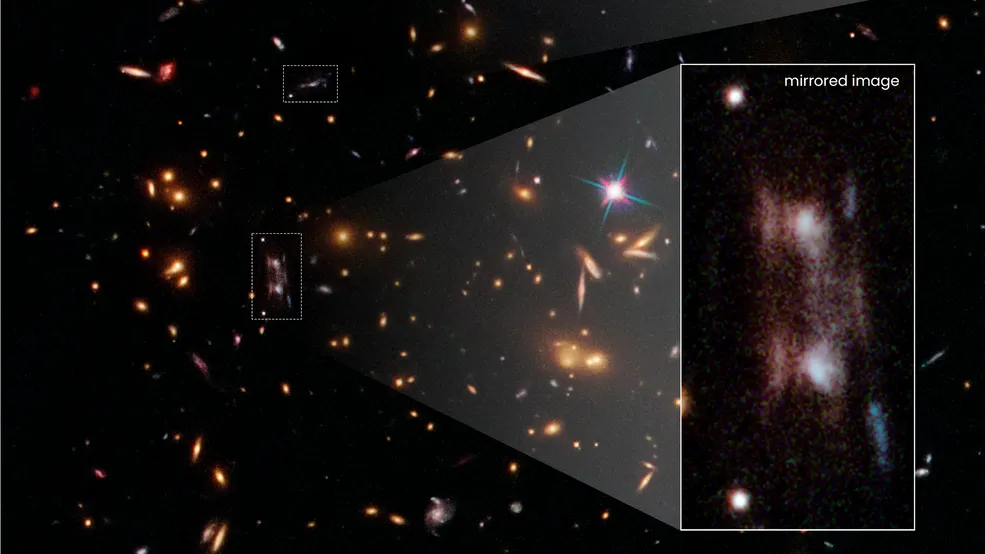
Astronomers have finally explained three perfectly identical galaxies in the deepest recesses of space — the cosmic triplets are actually just one galaxy, but its image has been multiplied by dark matter.
The galactic doppelgangers were discovered by accident in 2013 by the astronomer Timothy Hamilton of Shawnee State University in Portsmouth, Ohio. While analyzing data from the Hubble Space Telescope, Hamilton found two identical galaxies, one the mirror-image of the other, sitting right next to each other in space.
Not only did the two images have the same shape, with both having the same star-flecked galactic centers, but they were also streaked with the same dark, parallel lines. The mystery only deepened when Hamilton spotted a third galaxy — not far above them — that was identical to the other two galaxies.
Related: The 12 strangest objects in the universe
"We were really stumped," Hamilton said in a statement. "My first thought was that maybe they were interacting galaxies with tidally stretched-out arms. It didn't really fit well, but I didn't know what else to think."
Now, after eight years of speculation, Hamilton and his colleagues have finally hit upon a satisfying explanation, published in a study May 17 in the journal Monthly Notices of the Royal Astronomical Society. The eerie cosmic clones are one and the same galaxy, located 11 billion light-years from Earth. But the gravity of a huge concentration of dark matter is bending the light from the distant source into three images.
Dark matter is a mysterious, invisible substance, believed to make up most of the universe's matter, and scientists hypothesize that it's the glue that prevents galaxies from flying apart.
Get the world’s most fascinating discoveries delivered straight to your inbox.
Einstein’s theory of general relativity describes how massive objects warp the fabric of space-time. Einstein explained the idea that gravity isn't produced by an unseen force, but is simply our experience of space-time curving and distorting in the presence of matter and energy.
This curved space, in turn, sets the rules for how energy and matter move. In the case of these galactic triplets, light traveling through an extremely curved region of space-time travels in a curve — warping and twisting through a gigantic funhouse mirror until it emerges at three exit points as three perfect copies.
RELATED CONTENT
"Think of the rippled surface of a swimming pool on a sunny day, showing patterns of bright light on the bottom of the pool," lead author Richard Griffiths, a physics professor at the University of Hawaii, said in the statement. "These bright patterns on the bottom are caused by a similar kind of effect as gravitational lensing. The ripples on the surface act as partial lenses and focus sunlight into bright squiggly patterns on the bottom."
By looking at the region of space close to the images, the researchers were able to identify the culprit behind the unusual lensing effect: a dense blob of dark matter belonging to a cluster of galaxies 7 billion light-years away from Earth, and situated between Earth and the galaxy whose light was being bent.
Using a specially designed computer program, the physicists calculated the distribution of this dark matter by studying how it had stretched the three images of the galaxy. They concluded that for the images to appear as they do now, the dark matter would need to be "smoothly" distributed across the light-bending galactic cluster — a result that not only helps them to explain the images, but also gives them a fresh insight into how dark matter may be dispersed throughout the universe.
"We know it's [dark matter is] some form of matter, but we have no idea what the constituent particle is. So we don't know how it behaves at all. We just know that it has mass and is subject to gravity,” Griffiths said. “The significance of the limits of size on the clumping or smoothness is that it gives us some clues as to what the particle might be. The smaller the dark matter clumps, the more massive the particles must be."
Originally published on Live Science.

Ben Turner is a U.K. based writer and editor at Live Science. He covers physics and astronomy, tech and climate change. He graduated from University College London with a degree in particle physics before training as a journalist. When he's not writing, Ben enjoys reading literature, playing the guitar and embarrassing himself with chess.