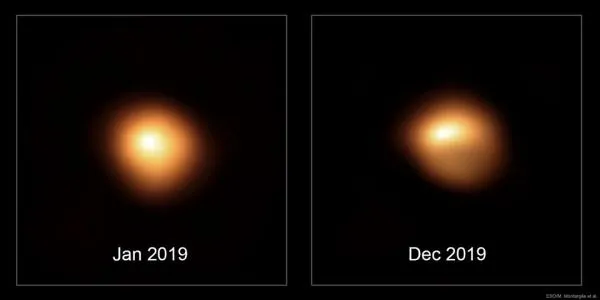
An image captured by the European Southern Observatory's Very Large Telescope in Chile shows Betelgeuse in December 2019, at right, early in what would become the dramatic dimming episode that culminated in February 2020.
A year ago, the bright red star Betelgeuse in the Orion constellation hit the headlines when stargazers noticed a stark fading episode that astronomers couldn't explain. They still can't, although they keep trying.
The suspense is particularly high now, since the star, which typically dims and brightens on a regular schedule, should soon start to fade again, for the first time since last year's strange antics. Scientists hope that this year's observations of Betelgeuse will put last year's episode in context, which could shape astronomers' understanding of stellar activities more generally. One such astronomer shared an update at the 237th meeting of the American Astronomical Society, held virtually in January, in advance of the dimming predicted to occur this April.
"We want to see whether last year was really unique," Andrea Dupree, an astrophysicist at the Harvard-Smithsonian Center for Astrophysics, told Space.com after the conference.
"What if it happens again? Then, I don't know," she said. "I don't know if it's going to be a once-in-a-lifetime [event] or whether it's going to happen again or whether it's now in a new phase and what this means."
What she and her colleagues do know is that scientists have been recording detailed observations of Betelgeuse for 150 years, and nowhere in those records does there appear anything like last year's fading event. Usually, the star dims and brightens over a cycle of about 420 days in a breath-like rhythm, growing and shrinking in size and luminosity alike.
But in December 2019, skywatchers noticed something strange was happening as Betelgeuse began to dim.
Sign up for the Live Science daily newsletter now
Get the world’s most fascinating discoveries delivered straight to your inbox.
"It's never been as faint as it was last February," Dupree said. Even just stargazing, catching sight of Betelgeuse from Honolulu in early January during the 235th American Astronomical Society meeting, the difference was clear, she said. "The constellation just looked weird, absolutely weird. The bright red star in the shoulder of Orion was not there, it was fainter than the others. That's not how it's supposed to be."
Some observers hoped it was a sign that humans were about to get a front seat to Betelgeuse's dramatic demise. As an old, red supergiant, according to NASA, Betelgeuse is doomed to a messy fate: when the star runs out of fuel, it will explode in a brilliant supernova, spewing its innards across the cosmic neighborhood. (In fact, the star may have done so already, and scientists are just waiting to see the aftermath.)
Dupree didn't think that was the most likely scenario for last year's antics. But if scientists do indeed catch Betelgeuse at the perfect time, just before it explodes, the observations would be unprecedented.
"Nobody knows what a star does right before it goes supernova," Dupree said. "People have looked maybe six months before or two years before, but until we have a nightly survey of the whole sky and all the sky, we don't have any information on what happens the night before it blows up."
Even if no supernova materializes soon, more observations of bright Betelgeuse are still helpful, particularly when the star is doing anything unusual. "The sun is really the only star that we can see in detail and see what happens, and Betelgeuse is the next best candidate," Dupree said.
An artist's depiction of one hypothesis to explain Betelgeuse's dramatic dimming: The star shot out matter that eventually traveled far enough from the star to cool into dust, blocking Earth's view of the star.
(Image credit: NASA, ESA, and E. Wheatley (STScI))
In particular, she hopes that Betelgeuse could teach astronomers about stellar outbursts. Using Hubble Space Telescope observations gathered in the fall of 2019, before Betelgeuse began dimming, scientists concluded that the star spit out a huge wad of dense gas, Dupree said. That in and of itself isn't too unusual, although strangely, this outburst came from a different region of the star than scientists have previously observed, Dupree said.
She suspects that as that mass kept moving away from Betelgeuse, it slowly cooled into dust — dust that she believes would have caused the apparent fading that was so striking last year. Other astronomers think that ejection was a coincidence, and that a large cool spot on the star's surface caused the strange fading.
Dupree's hope is that observing Betelgeuse this year could help scientists distinguish between those two scenarios and tackle additional questions like the strange location of the outburst.
"How does the star lose material?" she said. "Does it flow gently? Does it come out in bursts? Does it come from various parts of the star? How does it change as it moves from the surface of the star, which is hot, out into the interstellar medium, which is cold?"
Conveniently, last year's dimming occurred about halfway through a three-year program in which Dupree had already arranged for the Hubble Space Telescope to check in on Betelgeuse four times a year. It's some of those Hubble observations that spotted the mass of material moving out from the star before its dimming began.
Most recently, Hubble checked in on the star in February; the last of the allotted observations will occur in April, Dupree said, although she plans to request additional time with Hubble given the star's recent activity.
But Betelgeuse is a tricky target; from late April to late August, it is too close to the sun in our skies for Hubble and ground-based instruments to see it, Dupree said. That's particularly inconvenient given that the star's usual cycle of about 240 days would put it at its dimmest just as humans can't see it.
In between Hubble observations last summer, Dupree enlisted NASA's sun spacecraft STEREO-A, located about a third of an orbit behind Earth. When the sun blocks Betelgeuse from Earth, the spacecraft has a clear view of the star. The spacecraft will make another four or five such observations this summer, after Hubble's last opportunity to see the star this spring.
For now, the star continues to keep astronomers on their toes.
"Betelgeuse is 'quiet,'" Dupree wrote in an email update on March 1, adding that she's beginning to suspect the star won't make its predicted April fade, according to the schedule it had been following for so many years. "Maybe that outburst in 2019 changed its personality!"
Whether Betelgeuse fades or not, Dupree and her colleagues will be watching, eager to hone in on the star's secrets. "We shall see," she said, "that's what's always fun!"
Email Meghan Bartels at [email protected] or follow her on Twitter @meghanbartels. Follow uson Twitter @Spacedotcom and on Facebook.
Meghan is a senior writer at Space.com and has more than five years' experience as a science journalist based in New York City. She joined Space.com in July 2018, with previous writing published in outlets including Newsweek and Audubon. Meghan earned an MA in science journalism from New York University and a BA in classics from Georgetown University, and in her free time she enjoys reading and visiting museums. Follow her on Twitter at @meghanbartels.